

The best way to clean a carpet at home without a machine is to vacuum slowly, treat stains with a weak dish soap solution, rinse with plain water and blot dry. Use baking soda for odours, an enzymatic cleaner for pet urine, and a bucket-and-brush shampoo for a full deep clean.
Most carpets do not need a machine to look fresh again. They need the right method for the mess, the right mix for the fibre, and careful drying. This guide by Nova Floor shows you how to clean a carpet at home with ten tested methods. You will also find a stain chart, safe homemade recipes and drying advice for humid UAE homes.
Contents
What You Need Before You Start
You probably own most of these items already. Gather them first so a spill never waits while you search for a cloth.
Tools
- A vacuum with a crevice tool and an upholstery tool
- White cotton or microfiber cloths (coloured cloths can transfer dye)
- A soft to medium nylon brush
- Two spray bottles and two buckets
- A spoon and a blunt butter knife
- Old towels, a fan and a few heavy books
Household Ingredients
- Clear liquid dish soap
- White vinegar (5% acetic acid)
- Baking soda and fine table salt
- Club soda
- 3% hydrogen peroxide
- An enzymatic pet stain cleaner
- Ice cubes
Choose clear dish soap over coloured soap. Never use laundry detergent on carpet. Many laundry detergents contain optical brighteners, which act like dyes and can leave bright patches. Dishwasher detergent is also unsafe because it often contains bleaching agents.
Two rules apply to every method below. First, patch test any solution on a hidden spot, such as inside a wardrobe or under a sofa. Apply it, wait ten minutes, then press a white cloth on the spot. If colour transfers, stop. Second, always blot and never rub. Rubbing frays the fiber tips and pushes the stain deeper.
Check Your Carpet Fiber First
Fiber type decides how much water and heat your carpet can take. A method that works on nylon can ruin sisal. Check the label, your invoice, or ask your supplier before you start.
| Fiber | Water Tolerance | Heat Tolerance | Safest Approach |
| Wool | Moderate | Low | Cool water, neutral soap, fast drying, no alkaline cleaners |
| Nylon | High | Good | Suits almost every method in this guide |
| Polyester | High | Moderate | Dish soap works well; vacuum often because it attracts oily soil |
| Polypropylene (olefin) | Very high | Low | Water is fine, but avoid irons and hot water because it melts easily |
| Sisal and jute | Very low | Low | Dry methods and a barely damp cloth only |
Natural plant fibers need the most care. If you own a natural sisal carpet, treat water as the main risk. Even a small wet patch can dry into a brown ring. Fitted wall-to-wall carpets also need low-moisture methods, because you cannot lift them to dry the floor underneath.
Which Carpet Cleaning Method Should You Choose?
Pick the method that matches your problem. This saves time and protects the fiber.
| Method | Best For | Active Time | Drying Time |
| 1. Slow vacuuming | Daily dust, sand, pet hair | 15 to 30 min | None |
| 2. Dish soap solution | Food and general spots | 10 to 20 min | 2 to 4 hours |
| 3. White vinegar rinse | Soap residue, light odours | 10 min | 2 to 4 hours |
| 4. Baking soda | Whole-room odours | 10 min plus waiting | None |
| 5. Baking soda and salt | Dull, lightly soiled areas | 30 to 60 min | 4 to 8 hours |
| 6. Club soda | Fresh liquid spills | 5 min | 1 to 2 hours |
| 7. Hydrogen peroxide | Set-in stains on light carpet | 15 min | 2 to 4 hours |
| 8. Enzymatic cleaner | Pet urine, vomit, blood | 15 min plus dwell | 12 to 24 hours |
| 9. Hand shampoo | Full deep clean | 2 to 4 hours | 8 to 24 hours |
| 10. Iron and paper towel | Wax, oil, grease | 10 to 20 min | None |
10 Best Ways to Clean a Carpet Without a Carpet Cleaner
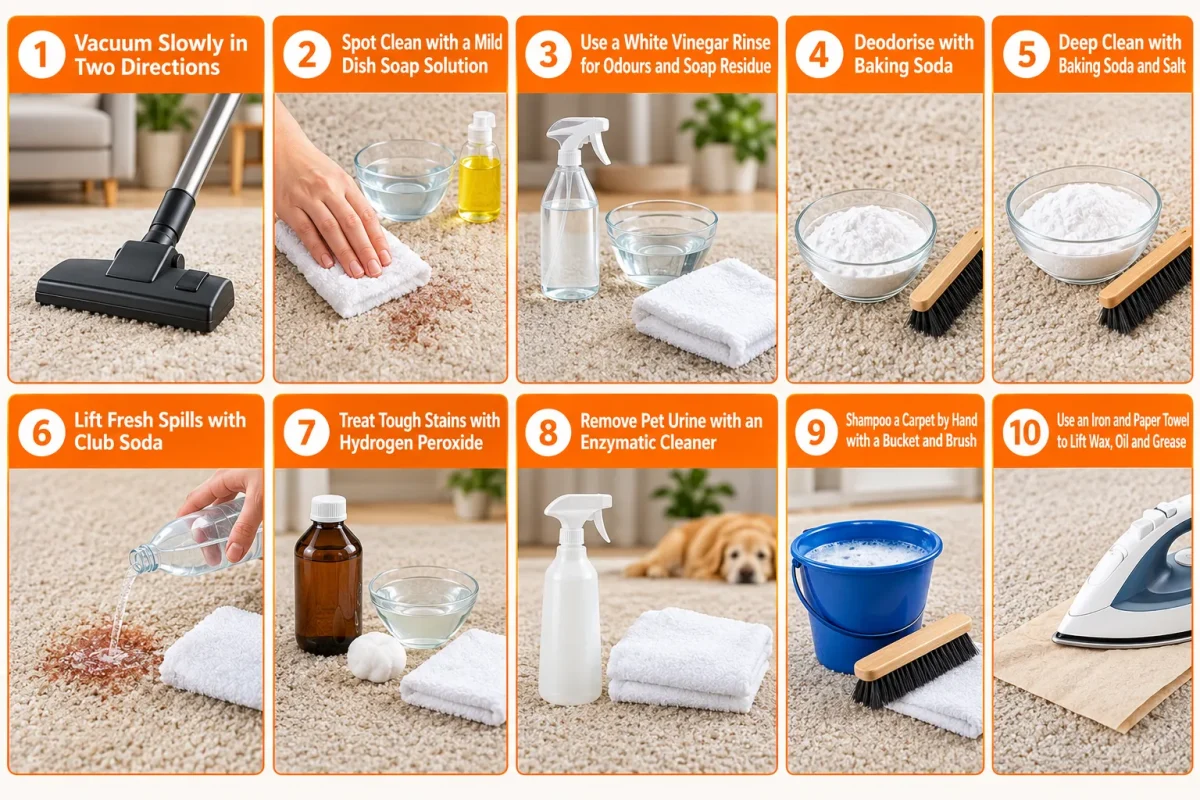
1. Vacuum Slowly in Two Directions
Vacuuming removes the dry soil that causes most carpet wear. Sand and grit act like sandpaper and cut fibers each time someone steps on them. In the UAE, fine desert dust makes this even more important.
- Move chairs and small items off the area.
- Set the vacuum height to match your pile. A head set too high loses suction. A head set too low drags on the carpet.
- Push the vacuum slowly. A slow pass gives the brush time to loosen deep dust.
- Make two or three passes on each area. More passes add very little.
- Go over the room once more at a right angle to your first direction.
- Run the crevice tool along skirting boards, where dust builds up.
- Empty the bag or bin once it reaches half to two-thirds full. A full bag cuts suction.
For area rugs, vacuum from the center towards the fringe, and switch off the beater bar near the edges. Flip the rug every few months and vacuum the back. This removes the grit trapped in the base. On stair carpets, use the upholstery tool on each tread and the crevice tool along the nosing, where grit collects.
2. Spot Clean with a Mild Dish Soap Solution
This is the most useful homemade carpet cleaner you can make. It lifts food, drink and everyday grime from most synthetic and wool carpets.
Recipe: Mix ¼ teaspoon of clear dish soap into 1 cup of lukewarm water.
That amount looks small, and that is the point. Many online recipes call for a full tablespoon. Extra soap stays in the fibers as a sticky film. That film grabs new dirt, so the spot turns grey again within days.
- Scoop up solids with a spoon. Scrape semi-solids gently towards the center.
- Blot the spill with a dry white cloth until no more liquid transfers.
- Dampen a clean cloth with the solution. Avoid pouring it straight onto the carpet.
- Dab the stain from the outer edge towards the center.
- Wait two minutes, then blot with a dry cloth.
- Repeat until the stain stops transferring.
- Rinse by dabbing with a cloth dampened in plain water, then blot dry.
The sticky test: Press your fingertips on the spot once it dries. If it feels tacky or stiff, residue remains. Rinse and blot again.
3. Use a White Vinegar Rinse for Odours and Soap Residue
White vinegar is mildly acidic. It neutralizes alkaline residue left by soaps and many spills. It also cuts light odours and helps fade coffee and tea marks.
Recipe: Mix 1 cup of white vinegar with 2 cups of water in a spray bottle.
- Mist the area lightly. Do not soak it.
- Wait five to ten minutes.
- Blot firmly with a dry white cloth.
- Leave it to air dry. The vinegar smell fades as the carpet dries.
Use vinegar as a separate step, never in the same bowl as baking soda. The two react and cancel each other out. The fizz looks impressive, but it mostly leaves salty water behind. Apply baking soda, vacuum it up, then use vinegar if you still need it.
4. Deodorize with Baking Soda
Baking soda absorbs odours and loosens light surface dirt. It also suits sisal and jute, because it needs no water.
- Make sure the carpet is completely dry. Damp baking soda turns into a paste.
- Sprinkle a thin, even layer, like a light dusting of sugar.
- Work it into the pile with a soft brush.
- Leave it for at least 30 minutes. Leave it overnight for strong odours.
- Vacuum slowly, twice, in two directions.
Fine powder can clog a bagless vacuum filter. Empty the bin and tap out the filter after this method.
5. Deep Clean with Baking Soda and Salt
This low-moisture method gives tired, dull carpet a deeper refresh than baking soda alone. Salt adds gentle scrubbing power and helps lift greasy film.
- Mix equal parts baking soda and fine table salt.
- Divide the room into one-metre squares so you never step on a finished area.
- Sprinkle the mix over one square.
- Mist it with cool water until the surface feels just damp. Stop well before it feels wet.
- Brush in one direction, then at a right angle.
- Wipe the surface with a damp towel to collect the loosened dirt.
- Let the carpet dry fully, then vacuum twice.
Skip this method on sisal, jute and silk. Fine table salt works better than coarse salt, which can scratch delicate fibers.
6. Lift Fresh Spills with Club Soda
Club soda is mostly clean water with light carbonation. Its real benefit is that it dilutes a fresh spill before the colour bonds to the fiber. Do not expect it to fix old stains.
- Blot the spill straight away.
- Pour a small splash of club soda onto the spot.
- Blot hard with a dry cloth.
- Repeat two or three times.
- If a mark remains, follow with Method 2.
Use it within the first few minutes on wine, juice, cola or coffee. If you have no club soda, cold tap water does almost the same job.
7. Treat Tough Stains on Light Carpets with Hydrogen Peroxide
Hydrogen peroxide breaks down colour compounds. It works well on old coffee, tea, wine and dried blood. It can also lighten carpet dye, so use it with care.
Recipe: Mix 2 tablespoons of 3% hydrogen peroxide with a few drops of clear dish soap.
- Patch test first and wait a full hour before you judge the result.
- Dab the mix onto the stain with a cotton ball.
- Wait five to ten minutes.
- Blot, then rinse with a cloth dampened in cold water.
- Repeat once or twice if needed.
Use only 3% strength. Avoid it on wool and on dark or bright carpet. Store it in its original dark bottle, because light weakens it.
8. Remove Pet Urine with an Enzymatic Cleaner
Urine leaves uric acid salts deep in the fibers and underlay. Soap and vinegar can hide the smell for a while. In humid weather, the salts absorb moisture and the odour returns. Enzymatic cleaners digest these compounds instead of masking them.
- Stack paper towels on the wet spot and stand on them. Repeat until they come up almost dry.
- Dab with cool water and blot again.
- Apply the enzymatic cleaner generously. Urine spreads wider below the surface, so cover an area about twice the size of the visible mark.
- Cover the spot with a damp towel to keep it moist for the time on the label.
- Let it air dry completely.
Skip other cleaners before you apply the enzymes, because some can weaken them. Never use heat or steam on urine, since heat sets both the stain and the smell. To find old spots, switch off the lights and scan the carpet with a UV torch. Dried urine glows under UV light. This method also works on vomit and blood.
9. Shampoo a Carpet by Hand with a Bucket and Brush
This method shows you how to clean carpet without a shampooer. It takes effort, but it cleans the full surface, not just spots. Use it on nylon, polyester and polypropylene. Avoid it on sisal and jute.
Wash bucket: 1 teaspoon of clear dish soap in 4 cups of lukewarm water.
Rinse bucket: Plain lukewarm water.
- Vacuum the whole room thoroughly first.
- Start at the wall farthest from the door and work in one-meter squares.
- Dip the brush, then shake off the excess. A wet brush oversoaks the backing.
- Brush along the pile, then across it, with light pressure.
- Lay a dry towel on the square and stand on it to pull out the dirty water.
- Dampen a clean cloth in the rinse bucket and wipe the square.
- Press a fresh dry towel on it again.
- Change the rinse water whenever it turns cloudy.
Plan a full morning for an average room. This method suits thick-pile living room carpets, where soil builds up around sofas and walkways.
10. Use an Iron and Paper Towel to Lift Wax, Oil and Grease
Heat melts wax and loosens grease, and paper soaks it up. This method needs no liquid at all.
- For wax, hold an ice pack on it for ten minutes. Scrape the hardened wax away with a blunt knife.
- Lay a plain white paper towel or brown paper bag over the spot.
- Set the iron to low, with steam switched off.
- Press the iron on the paper for about ten seconds while moving it slowly.
- Lift the paper. If it shows grease or wax, use a fresh piece and repeat.
- Clean any shadow left behind with Method 2.
Do not use this method on polypropylene, olefin or shaggy synthetic piles. Their fibers can melt. Never hold the iron still in one place.
How to Clean a Rug Without a Carpet Cleaner
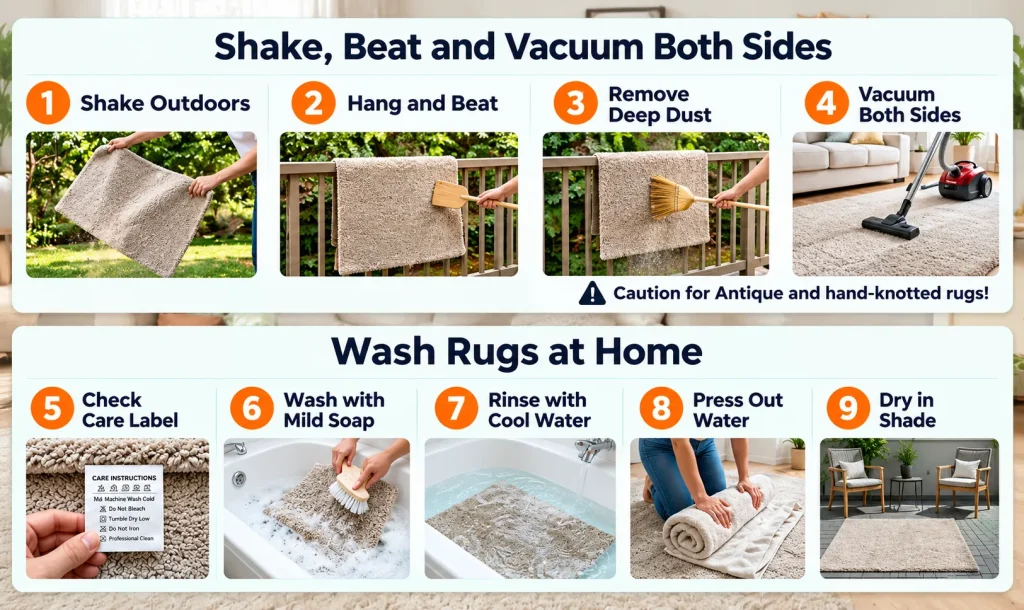
If you want to know how to wash carpets without a carpet cleaner, start with your rugs. You can move them, so washing at home works best on them.
Shake, Beat and Vacuum Both Sides
- Take the rug outside and shake it hard.
- Hang it over a sturdy rail or line.
- Beat the back with a broom handle to knock out deep grit.
- Vacuum both sides once it is back inside.
Skip beating for antique or hand-knotted rugs. Hard blows can break old foundation threads.
How to Wash a Carpet at Home in the Bathtub or Outdoors
Washing suits small synthetic rugs with no latex backing. Soaking can make latex backing crumble.
- Check the care label. If it says machine washable, follow its temperature setting and tumble dry on low heat.
- For hand washing, fill a tub with cool water and a small squeeze of clear dish soap.
- Press the rug under the water and work the suds through with your hands or a soft brush.
- Drain the tub and rinse until the water runs clear.
- Press the water out. Roll the rug in towels and walk on the roll. Never wring it.
- Dry it flat or draped over two chairs in the shade. Flip it halfway through.
Small synthetic round rugs from under coffee tables usually fit in a bathtub. Polypropylene outdoor carpets handle a garden hose and soapy brush on a balcony or patio. Do not wash wool, silk, sisal or jute rugs this way. Hand-knotted Turkish rugs need gentle surface cleaning at home, or a specialist wash.
How to Remove Carpet Stains Naturally
Always start with the gentlest option, then move up only if the stain stays. Two more rules make a big difference.
- Keep dry stains dry. Vacuum coffee grounds, spices and dry soil first. Water can turn them into a permanent stain.
- Use cold water on protein stains. Heat cooks the proteins in blood, milk, egg and vomit, and locks them into the fiber.
| Stain | First Step | Natural Fix | Avoid |
| Coffee or tea | Blot, then dab cold water | Method 2, then Method 3; Method 7 on light carpet | Hot water |
| Red wine | Blot, then club soda | Cover with salt, let it dry, then vacuum and use Method 2 | Rubbing |
| Blood | Dab cold water | Method 2 in cold water; Method 7 for dried blood | Warm water |
| Grease or oil | Cover with baking soda for 15 min | Vacuum, then Method 2 or Method 10 | Adding water first |
| Chewing gum | Freeze with ice for 10 min | Scrape with a blunt knife, then Method 2 | Pulling fibers |
| Candle wax | Freeze and scrape | Method 10 | A hot iron |
| Pet urine | Stand on paper towels | Method 8 | Heat or steam |
| Vomit | Scoop with a spoon | Baking soda, vacuum, then Method 8 | Spreading it |
| Mud | Let it dry fully | Break up, vacuum, then Method 2 | Wiping wet mud |
| Henna | Scrape off dried paste | Method 2 in cool water; Method 7 on light synthetics | Hot water |
| Ballpoint ink | Blot | Dab rubbing alcohol on a cloth, after a patch test | Soaking |
| Nail polish | Blot wet polish | Dab non-acetone remover on a cloth, after a patch test | Acetone on synthetics |
If a stain survives two careful rounds, stop. Repeated treatment damages the fiber faster than the stain does.
Safety Rules for Homemade Carpet Cleaners
- Never mix bleach with vinegar or ammonia. Bleach mixed with vinegar releases chlorine gas. Bleach mixed with ammonia releases toxic chloramine vapors. Keep chlorine bleach away from carpet entirely, because it strips dye permanently.
- Rinse between products. Clear one cleaner out with plain water before you try the next.
- Keep solvents for small spots only. Acetone and paint thinner are flammable. They can dissolve some synthetic fibers and the latex in carpet backing.
- Ventilate the room. Open a window or run a fan while you work.
- Protect children and pets. Keep them off treated areas until they dry. This guide skips borax because it is harmful if swallowed.
How to Dry a Carpet Fast After Cleaning

Damp carpet that stays wet for more than a day or two can grow mould and develop a musty smell. Fast drying matters as much as cleaning.
- Extract first. Lay dry towels on the area, stand on them, and repeat. For stubborn wet patches, stack towels and place heavy books on top for an hour.
- Move the air. Point a fan low across the carpet surface, not down at it.
- Use the air conditioning. AC pulls moisture out of indoor air. On humid days in coastal cities like Dubai and Fujairah, keep windows shut and run the AC instead. Open windows only when the outdoor air feels dry.
- Lift rug edges. Prop a rug corner on a chair so air reaches the floor underneath.
- Protect the carpet from furniture. Put foil or plastic squares under furniture legs if you must return furniture early. Wooden legs can stain damp carpet, and metal legs can leave rust marks.
- Stay off it. Wet fibers flatten easily and pick up dirt from feet.
- Vacuum once dry. A final pass lifts the pile and removes any leftover powder or residue.
How Often Should You Clean Your Carpet?
Your household decides the schedule. Use this table as a starting point.
| Household | Vacuuming | Spot Cleaning | Deep Clean at Home | Professional Clean |
| Adults only, no pets | Weekly | As spills happen | Every 6 months | Every 12 to 18 months |
| Young children | Twice a week | Same day | Every 3 to 4 months | Every 12 months |
| Pets | Two to three times a week | Same day | Every 3 months | Every 6 to 12 months |
| Allergy sufferers | Two to three times a week | Same day | Every 3 months | Every 6 to 12 months |
Hallways and entrances take more grit than any other area. Vacuum hallway runner carpets every other day if your family walks in from the street.
How to Keep Your Carpet Clean Longer
- Stop sand at the door. Place one mat outside and one inside each entrance. Ask everyone to remove their shoes.
- Rotate rugs every three to six months. This spreads wear evenly. It also prevents strong UAE sunlight from fading one side faster.
- Use blinds during peak sun. Direct afternoon sun fades many dyes within a few months.
- Lay a rug pad. A pad stops slipping and reduces friction wear.
- Lift furniture dents with ice. Place an ice cube in the dent, let it melt overnight, then fluff the pile with your fingers.
- Keep a spill kit ready. Store white cloths, a labelled bottle of the Method 2 solution and a box of baking soda in one place.
- Groom your pets. Regular brushing cuts the hair and dander that end up in the pile.
When to Call a Professional or Replace Your Carpet
Home methods handle routine care well. Call a professional cleaner when urine has soaked into the underlay, when water floods the room, or when you own silk, antique or hand-knotted rugs. Some manufacturers also require periodic professional extraction to keep the warranty valid.
Sometimes cleaning cannot fix the problem. Replace the carpet when matting does not recover after cleaning, when wear reaches the backing, or when odours return after a professional clean. Ripples and loose seams are also signs of the end. Most carpets last between 5 and 15 years, depending on fiber and traffic. If you reach that point, Nova Floor offers carpets in Dubai in durable fibers such as nylon and triexta, with free measurement and samples.
Frequently Asked Questions
What is the best way to clean a carpet at home without a machine?
Vacuum slowly in two directions to remove dry soil. Then spot clean stains with ¼ teaspoon of clear dish soap in 1 cup of lukewarm water. Rinse with plain water and blot dry. For a full deep clean, shampoo the carpet by hand with a bucket, a soft brush and towels.
What is the best homemade carpet cleaner?
The safest all-purpose homemade carpet cleaner is ¼ teaspoon of clear dish soap mixed into 1 cup of lukewarm water. Follow it with a rinse of 1 part white vinegar to 2 parts water to remove soap residue. Use more soap than this and the carpet will resoil quickly.
How do you clean carpet without a shampooer?
Mix 1 teaspoon of clear dish soap into 4 cups of lukewarm water. Work in one-metre squares with a soft brush, using light pressure. Stand on dry towels to pull out the dirty water, then wipe with plain water and blot again. Dry the room with fans and air conditioning.
Can you wash a carpet at home?
You can wash small synthetic rugs at home in a bathtub or outdoors, if they have no latex backing. Use cool water and a little clear dish soap, rinse until the water runs clear, and dry the rug flat in the shade. Do not soak wool, silk, sisal, jute or fitted wall-to-wall carpet.
Does vinegar damage carpet?
Diluted white vinegar is safe for most synthetic and wool carpets. Mix 1 cup of vinegar with 2 cups of water and patch test first. Avoid it on sisal, jute and silk, and never mix it with bleach, because the combination releases toxic chlorine gas.
How long does a carpet take to dry after hand washing?
A spot-cleaned area usually dries in two to four hours. A hand-shampooed room can take 8 to 24 hours, depending on pile depth and humidity. Fans, air conditioning and towel extraction speed this up. Keep furniture and foot traffic off the carpet until it feels completely dry.
Conclusion
Clean carpet comes from small habits, not expensive machines. Vacuum slowly, treat spills within minutes, use weak soap solutions and rinse them out completely. Start with the gentlest method in this guide, check your fiber first, and dry every cleaned area fast.