Travertine looks beautiful. It is also one of the easiest floors to ruin with the wrong cleaner.
This guide by Nova Floor shows you exactly what to use, what to avoid, and how to fix stains, soap scum, mould, and dull patches. Everything here works for floors, walls, showers, and outdoor pavers.
Contents
How to Clean Travertine Tiles
To clean travertine tiles, sweep or vacuum the surface, then mop with warm water and a pH-neutral stone cleaner. Rinse with clean water, and dry the tiles with a microfibre cloth. Never use vinegar, lemon juice, bleach, or any acidic cleaner. Acid eats into travertine and leaves permanent dull marks called etching.
That is the short version. The rest of this guide covers deep cleaning, stains, showers, sealing, and the mistakes that cost people their floors.
Why Travertine Needs Special Care
Travertine is a natural stone made mostly of calcium carbonate. It forms in and around hot springs and mineral-rich water. Two things about it change how you clean it.
It is porous. Travertine is full of tiny holes and channels. Liquids soak in fast. A spill that would wipe off a ceramic tile can sink into travertine within minutes and leave a shadow.
It reacts to acid. Calcium carbonate dissolves when it meets acid. Vinegar, lemon juice, tile descalers, and many bathroom sprays all contain acid. The moment they touch bare travertine, they start eating the surface. The damage is instant and permanent.
Travertine is also soft. On the Mohs hardness scale it sits around 3 to 4, which is about as hard as a copper coin. Sand and grit scratch it easily, and steel wool or a green scouring pad will leave visible marks.
Filled vs unfilled travertine
Check which type you have before you start. It changes your approach.
Filled travertine has its natural holes plugged with resin or cement filler. It is smoother and easier to mop. Over the years, some fillers pop out and leave open pits.
Unfilled travertine shows its natural holes. It traps dust and grit, so it needs vacuuming rather than just sweeping. Never flood it with water, because water sits in the holes.
Finish matters too
Polished travertine is glossy and shows etch marks clearly. Honed travertine is matt and hides small marks. Tumbled travertine has soft, worn edges and a rough texture that holds dirt in the surface.
Safe and Unsafe Cleaners for Travertine
Get this right and most travertine problems disappear. Here is the full list.
| Safe to use | Use with care | Never use |
| pH-neutral stone cleaner | A few drops of mild dish soap (rinse well) | Vinegar |
| Warm water | Rubbing alcohol diluted in water | Lemon, lime, or any citrus cleaner |
| Natural stone cleaner labelled for marble or limestone | Hydrogen peroxide on light stone only | Bleach |
| Stone-safe soap scum remover | Oxygen bleach on grout only | Ammonia and glass cleaner |
| Poultice powder made for stone | Acetone on small spots, light stone only | Tile and bathroom descalers |
| Non-acidic rust remover for stone | Grout cleaners containing acid | |
| Microfibre cloths and mops | Baking soda scrubbed dry on the surface | |
| Soft nylon brush | Steel wool, wire brushes, scouring pads | |
| White nylon pad | Steam mops and steam cleaners |
What “pH-neutral” actually means
The pH scale runs from 0 to 14. Below 7 is acid. Above 7 is alkaline. Exactly 7 is neutral.
A pH-neutral cleaner sits at or very close to 7, so it will not react with the stone. If a bottle does not say “pH neutral” or “safe for natural stone,” assume it is not safe.
Why vinegar and lemon juice damage travertine
Vinegar has a pH of about 2.5. Lemon juice is around 2. Both are strong enough to dissolve the calcium carbonate in travertine on contact.
The result is a dull, rough patch with a slightly lighter colour. Cleaning will not fix it. The stone has physically lost material. Only mechanical honing and polishing can restore the surface.
What about baking soda?
Baking soda is alkaline, so it will not etch travertine. The problem is texture. Scrubbing dry baking soda across soft stone works like fine sandpaper and dulls the finish.
Mixed into a wet paste and used as a poultice, it is fine. Used as a scrub, it is not.
What about rubbing alcohol?
Diluted isopropyl alcohol is a popular budget cleaner for stone. It is roughly neutral and will not etch. Mix about 60 ml (¼ cup) of rubbing alcohol into 1 litre of water.
It works well for light wipe-downs on counters and walls. It will not lift built-up grime from a floor, and it does not replace a proper stone cleaner.
Tools You Need
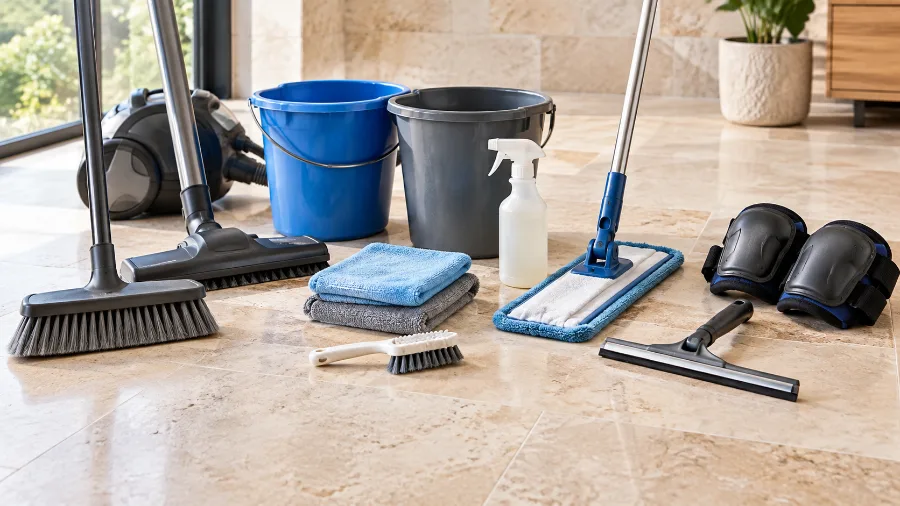
You do not need much. You do need the right things.
- Soft broom, or a vacuum with a soft brush head and no beater bar
- Two buckets
- Microfibre flat mop
- Microfibre cloths for drying
- Soft nylon brush for grout
- pH-neutral stone cleaner
- Spray bottle
- Squeegee for showers
- Knee pads if you are doing a large area
Skip the string mop. It pushes dirty water around and leaves too much moisture on porous stone.
How to Clean Travertine Floors | Step by Step Guide
This is your weekly routine. It takes about 20 minutes for an average room.
Step 1: Remove loose dirt
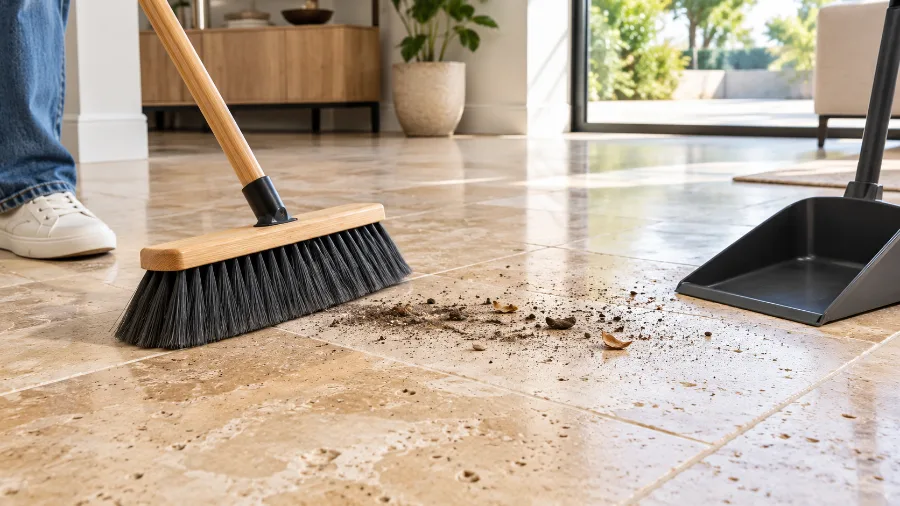
Sweep or vacuum thoroughly. This step matters more than any other. Grit is what scratches travertine, and mopping over grit grinds it into the surface.
For unfilled travertine, vacuum rather than sweep. A broom skims over the holes and leaves dirt sitting in them.
Step 2: Mix your cleaner
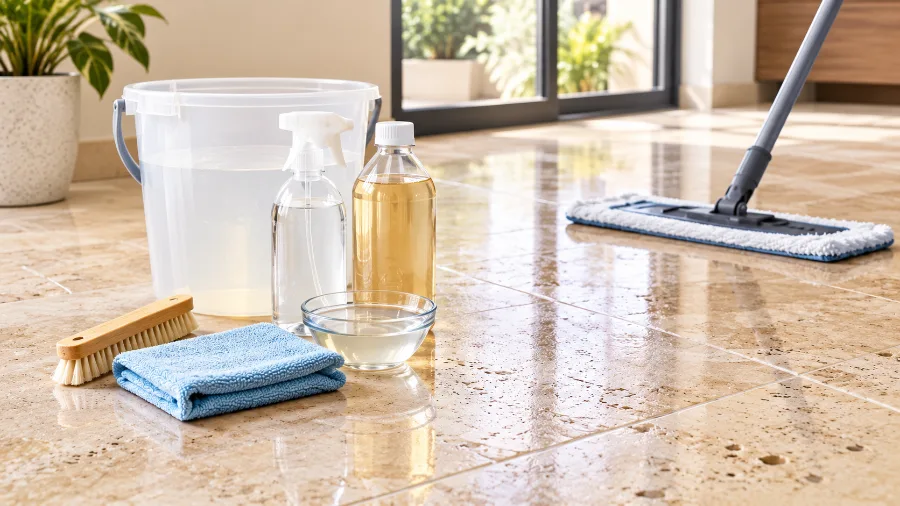
Fill one bucket with warm water and your pH-neutral stone cleaner. Follow the dilution on the bottle. More product does not clean better, and it leaves a film.
Fill the second bucket with plain warm water for rinsing.
Step 3: Mop in sections
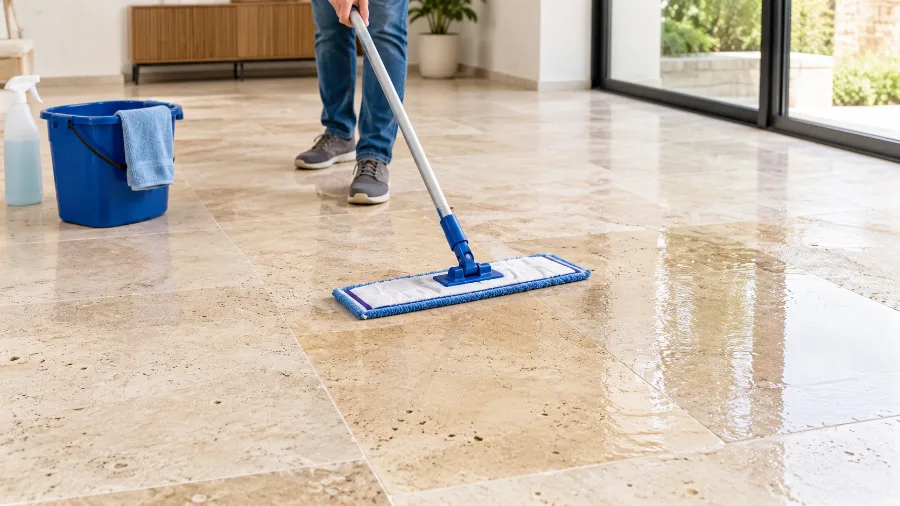
Work in areas of about 2 m × 2 m. Dip the mop, wring it out well, and mop the section.
Keep the mop damp, not wet. Standing water soaks into travertine, dulls the sealer, and can push moisture into the grout.
Step 4: Rinse the mop, not just the floor
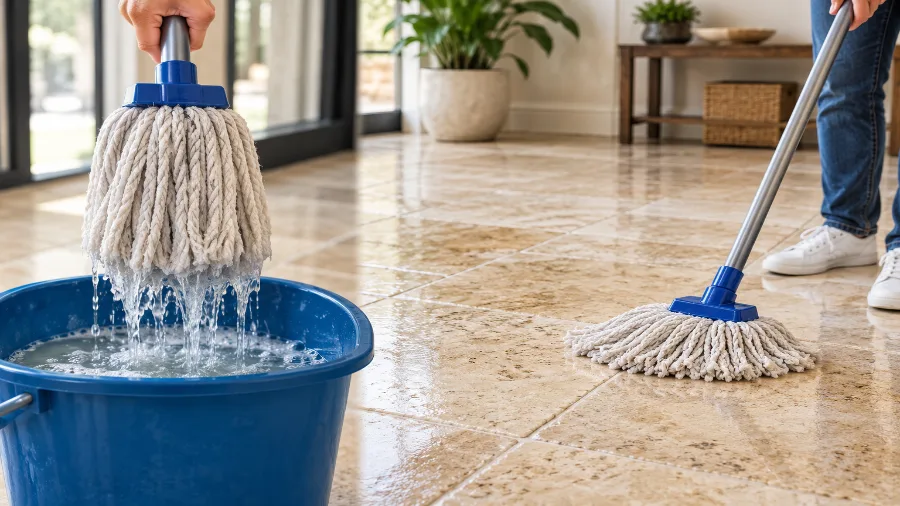
After each section, rinse the mop in the plain water bucket and wring it out. Then go back to the cleaning bucket.
This is the two-bucket method. It stops you from spreading dirty water across the floor, which is the main reason travertine looks hazy after mopping.
Step 5: Rinse the floor
Empty both buckets. Fill one with clean warm water and go over the whole floor again with no cleaner.
Cleaner left behind attracts dirt and builds up into a dull film. Most “my travertine looks cloudy” problems come from skipping this step.
Step 6: Dry it
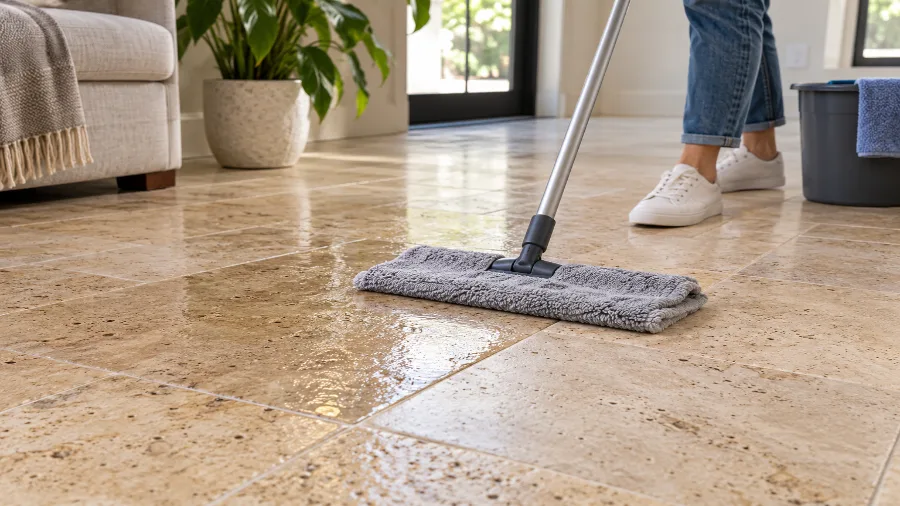
Wipe the floor with a dry microfibre cloth or a dry flat mop. Open a window or run a fan.
Drying prevents water spots, streaks, and mineral marks from hard water. It also stops moisture sitting in the pores, where mould can start.
How to Deep Clean Travertine Tiles
Do this once or twice a year, or whenever the floor looks grey and flat despite regular mopping.
- Vacuum thoroughly, including corners and grout lines.
- Apply an alkaline stone cleaner made for natural stone. These cleaners are stronger than your weekly product but still safe on calcium-based stone. Dilute as directed.
- Let it dwell for 10 to 15 minutes. Dwell time simply means how long the cleaner sits on the surface. This is where the real work happens.
- Do not let it dry. Mist more solution on if the surface starts drying out. Dried cleaner leaves residue that is harder to remove than the original dirt.
- Agitate with a soft nylon brush or a white nylon pad. Work along the grout lines by hand.
- Lift the dirty solution with a wet vacuum, or mop it up with clean water and wring the mop out into a separate bucket.
- Rinse at least twice with clean water. Rinsing is not optional. Leftover alkaline cleaner will keep attracting dirt.
- Dry completely before you reseal.
For very large or badly neglected floors, a slow-speed rotary machine with a soft pad does the job faster. Rent one, or hire a professional.
How to Clean Travertine Grout
Grout is more porous than the stone itself. It takes the worst of the dirt.
Standard cleaning. Spray your pH-neutral cleaner along the grout line. Wait five minutes. Scrub with a soft nylon brush using short strokes. Rinse well.
For stained or discoloured grout. Use an oxygen bleach powder, usually sold as sodium percarbonate, mixed into a paste. Apply it to the grout line only, leave it for 15 minutes, then scrub and rinse thoroughly. Oxygen bleach is far gentler on stone than chlorine bleach.
For grout haze after installation. Use a grout haze remover labelled safe for natural stone. Standard haze removers are acidic and will etch travertine. Remove haze within 3 to 10 days of grouting. After that it hardens and needs mechanical removal.
Two rules for grout:
- Keep the cleaner on the grout, not spread across the tile.
- Never use a stiff wire brush or a rotary grout tool near travertine. It will cut into the stone edges.
Seal your grout separately once it is clean and fully dry. Grout sealer and stone sealer are different products.
How to Clean a Travertine Shower
Showers are the hardest travertine surface to maintain. Heat, constant moisture, and soap all work against the stone. The usual bathroom products are all acidic, so most of the shelf at the supermarket is off-limits.
Removing soap scum from travertine
Soap scum is a waxy film left by soap reacting with minerals in your water. It builds fastest on tumbled and unfilled travertine, where it settles into the texture.
How to remove it:
- Spray the wall with a soap scum remover labelled safe for natural stone. These are alkaline, not acidic.
- Leave it for 5 to 10 minutes. Do not let it dry.
- Scrub gently with a soft nylon brush or a white nylon pad.
- Rinse thoroughly with warm water.
- Dry with a microfibre cloth.
How to stop it coming back: Switch from bar soap to liquid body wash. Bar soap contains talc and fats that create most of the scum. This one change makes a bigger difference than any cleaner.
Removing hard water stains from travertine
Hard water leaves chalky white deposits of calcium and magnesium. This is the trickiest travertine problem, because the normal fix is an acidic limescale remover, and acid destroys travertine.
What to do:
- Use a non-acidic scale remover made specifically for natural stone.
- For light deposits, warm water and a white nylon pad with patient rubbing often works.
- Never reach for CLR, limescale spray, or a descaler. They will etch the stone in seconds.
- If the deposits are old and thick, a stone restoration professional can hone them off. Home methods will not.
Prevention is the real answer. Squeegee the walls after every shower. It takes 20 seconds and removes almost all the water that would otherwise leave deposits. A water softener helps if your area has very hard water.
Removing mould and mildew from travertine
Mould grows in grout lines and in the open pores of unfilled travertine. It shows as black specks or a pink or orange slime. The pink slime is usually bacteria, not mould, and it feeds on soap residue.
How to remove it:
- Mix 3% hydrogen peroxide with water, half and half, in a spray bottle.
- Spray the affected grout and stone.
- Leave for 10 minutes.
- Scrub with a soft brush.
- Rinse well and dry completely.
Hydrogen peroxide is safer on stone than chlorine bleach. Bleach can discolour travertine, break down your sealer, and it rarely kills mould below the surface anyway.
Do not mix hydrogen peroxide with vinegar, and never mix any cleaner with bleach.
Prevention:
- Run an extractor fan during the shower and for 20 minutes after.
- Squeegee the walls and floor.
- Leave the shower door open to let air circulate.
- Reseal shower travertine every year. Showers wear sealer faster than any other surface.
Travertine Stain Removal
Stains and etch marks are different problems. A stain is something absorbed into the stone. An etch mark is damage to the stone itself. Cleaners fix stains. They cannot fix etching.
The first rule is speed. Blot spills immediately with a dry cloth. Blot, do not wipe, because wiping spreads the liquid into more pores.
The poultice method
A poultice is an absorbent paste that pulls a stain back out of the stone. This is the standard method for any stain that has soaked in, and it works on travertine, marble, and limestone.
What you need: a poultice powder made for stone, or plain baking soda, plus the right liquid for the stain type, plastic wrap, and tape.
Steps:
- Clean the area with water and let it dry.
- Mix the powder with the correct liquid until it has the consistency of thick peanut butter.
- Spread it over the stain about 5 mm thick. Extend it 2 to 3 cm beyond the edges of the stain.
- Cover with plastic wrap. Tape down the edges. Poke a few small holes in the top.
- Leave it for 24 to 48 hours.
- Remove the plastic and let the poultice dry fully. The drying is what pulls the stain out, so do not rush it.
- Scrape the dry poultice off with a plastic scraper. Rinse and dry the area.
- Repeat if the stain has faded but not gone. Deep stains often need three or four rounds.
Always test any chemical on a hidden area first, like inside a cupboard or behind a door.
A note on 12% hydrogen peroxide. The 3% peroxide sold in pharmacies is not strong enough for most poultices. The 12% strength used below is sold as a hair developer or a stone-care product. It bleaches skin and hair on contact and can damage eyes. Wear nitrile gloves and eye protection, work in a ventilated room, and keep it off dark or coloured stone.
Stain removal by type
| Stain | What to mix into the poultice | Notes |
| Cooking oil, grease, cosmetics | Baking soda + water | Oil darkens the stone. Blot first, never rub. |
| Red wine, coffee, tea, fruit juice | 12% hydrogen peroxide + a few drops of ammonia | Light-coloured travertine only. Peroxide can bleach darker stone. |
| Ink, marker, dye | Acetone or mineral spirits | Test first. Acetone can lighten some stone. |
| Rust, orange marks | Non-acidic rust remover made for stone | Never use a standard rust remover. Deep rust is often permanent. |
| Pet urine | 12% hydrogen peroxide + a few drops of ammonia | Treat fast, and rinse the area well. |
| Mould, algae, leaves, food | 12% hydrogen peroxide | Organic stains often fade on their own over weeks. |
| Paint | Soak with a stone-safe cleaner and lift gently with a plastic scraper | Never use a chemical paint stripper on stone. |
| Smoke, soot | Poultice powder + water, or a commercial smoke remover | May need repeat rounds. |
A note on pet urine. Fresh urine is mildly acidic and can etch, but it turns alkaline as it breaks down, and the lasting damage is usually a combination of organic staining and salt deposits left as it dries. The poultice removes the stain. Any dull mark left behind is etching and needs polishing.
Etching vs Staining | How to Tell the Difference
This confuses almost everyone, and it decides whether you can fix a mark yourself.
A stain is darker than the stone. Something soaked in. Oil, wine, and rust all leave darker marks. Stains can be pulled out with a poultice.
An etch mark is lighter and duller than the stone. Acid dissolved the surface. It often looks like a water ring or a pale, chalky patch. On polished travertine it kills the shine. On honed travertine it can look slightly rough.
The test. Run your finger over it with your eyes closed. If you feel a change in texture, it is etching. If the surface feels the same and only the colour changed, it is a stain.
Why sealer does not stop etching. A penetrating sealer fills the pores and blocks liquids from soaking in. It does not create a barrier on top of the stone. Acid still reaches the calcium carbonate and still reacts with it. Sealing prevents stains. It does not prevent etching.
How to fix etching. Light etch marks respond to a marble polishing powder rubbed in with a damp cloth. Deep or widespread etching needs professional honing with diamond abrasives. The surface is then refinished to match the rest of the floor.
Cleaning Outdoor Travertine Pavers
Outdoor travertine faces different problems: algae, leaf tannins, pool chemicals, and salt.
Routine cleaning:
- Sweep off leaves and debris.
- Rinse with a garden hose.
- Scrub with a soft-bristle deck brush and a mild stone-safe cleaner.
- Rinse thoroughly.
Algae, moss, and lichen. Use an outdoor stone cleaner made for natural stone. Apply, leave for 15 minutes, agitate, and rinse. Repeat for heavy growth.
Pressure washing. Keep the pressure under 1200 psi, use a wide fan tip, and hold the nozzle at least 30 cm from the surface. High pressure blasts out the soft filler and opens up the pores. When in doubt, scrub instead.
Efflorescence. This is the chalky white powder that appears on new paving. It is mineral salt pushing out from below. Let it dry, brush it off with a stiff broom, then rinse. Do not use acid to remove it. Repeat as needed until it stops, which can take several months.
Pool decks. Rinse chlorine and salt water off regularly. Both leave deposits and dry out the stone. Reseal pool coping every one to two years.
How to Seal Travertine Tiles
Sealing is the single best thing you can do for travertine. A sealed floor gives you time to wipe up a spill before it becomes a stain.
How to check if your travertine needs sealing
Do the water drop test.
- Drop a small puddle of water on the tile.
- Wait 10 minutes.
- Look at it.
If the water beads up and the stone underneath stays the same colour, your sealer is working. If the water soaks in and the stone darkens, it is time to reseal.
Test a few spots. High-traffic areas wear out long before the corners.
Types of sealer
Penetrating or impregnating sealers soak into the stone and block liquids from below the surface. They do not change the look. This is the right choice for most travertine, including floors and showers.
Enhancing sealers are penetrating sealers that also deepen the colour, similar to how the stone looks when wet. Good for outdoor paving and tumbled travertine.
Topical or coating sealers sit on top and create a film. They can look glossy but they scratch, peel, and trap moisture. Avoid them in showers and wet areas.
How to seal travertine
- Clean the surface completely. Sealing over dirt locks the dirt in.
- Let it dry for at least 24 hours. Longer in humid weather.
- Apply the sealer evenly with a lambswool applicator, roller, or sprayer.
- Let it soak in for the time on the label, usually 5 to 15 minutes.
- Wipe off all excess with a clean cloth before it dries. Sealer left on the surface dries into a hazy, patchy film.
- Apply a second coat if the stone is very porous.
- Keep off the floor for the cure time on the label, usually 24 to 72 hours.
How often should you reseal travertine?
| Area | Typical resealing interval |
| Bathroom and shower walls | Every 12 months |
| Kitchen floors and worktops | Every 1 to 2 years |
| Living areas and hallways | Every 2 to 3 years |
| Low-traffic rooms | Every 3 to 5 years |
| Outdoor paving and pool coping | Every 1 to 2 years |
Products vary. Some premium impregnating sealers claim much longer service life. Ignore the marketing and trust the water drop test.
Travertine Maintenance Schedule
| How often | What to do |
| Daily | Wipe spills straight away. Squeegee shower walls after use. |
| Weekly | Sweep or vacuum. Damp mop with pH-neutral cleaner. Rinse and dry. |
| Monthly | Clean grout lines. Check for chipped filler or open holes. |
| Every 6 months | Wash doormats and rugs. Check felt pads under furniture. |
| Yearly | Deep clean. Run the water drop test. Reseal showers. |
| Every 1 to 3 years | Reseal floors based on the water test. |
| Every 5 to 10 years | Consider professional honing or polishing to restore the finish. |
Small habits that save the most work:
- Put doormats at every entrance. Most scratches come from grit walked in on shoes.
- Use felt pads under all furniture legs.
- Use coasters and trivets on travertine worktops.
- Never drag furniture across the floor.
- Keep a microfibre cloth in the bathroom for quick wipe-downs.
10 Common Travertine Cleaning Mistakes
- Using vinegar or lemon juice. The most common and most damaging mistake. Both etch the stone instantly.
- Using generic bathroom or all-purpose sprays. Most contain acid, ammonia, or bleach. Read the label every time.
- Skipping the rinse. Leftover cleaner builds into a dull, sticky film that attracts dirt.
- Using too much cleaner. More product means more residue, not a cleaner floor.
- Mopping with too much water. Standing water soaks in, damages sealer, and feeds mould.
- Mopping before sweeping. You end up grinding grit into a soft surface.
- Using a steam cleaner or steam mop. Heat and pressure force moisture into the stone and break down the sealer.
- Scrubbing with abrasive pads. Steel wool, green scouring pads, and stiff brushes leave permanent scratches.
- Letting spills sit. Travertine absorbs fast. Wine, oil, and coffee become permanent within hours.
- Assuming sealer makes it bulletproof. Sealer buys you time to clean up a spill. It does not stop acid, and it wears out.
Frequently Asked Questions
Can you use vinegar on travertine tiles?
No. Vinegar is acidic and dissolves the calcium carbonate in travertine. It leaves dull, rough etch marks that cleaning cannot repair. Use a pH-neutral stone cleaner instead.
Can you use bleach on travertine?
No. Bleach can discolour travertine, break down your sealer, and leave streaks. For mould in grout, use 3% hydrogen peroxide or an oxygen bleach powder instead.
Can you steam clean travertine tiles?
No. Steam forces hot moisture into the pores, which weakens the sealer and can cause spotting or mould below the surface. Use a damp microfibre mop and a pH-neutral cleaner.
What is the best cleaner for travertine floors?
A pH-neutral cleaner made for natural stone. Look for “pH neutral” or “safe for marble, limestone and travertine” on the label. For heavy build-up, use an alkaline stone deep cleaner, never an acidic one.
Can you use Dawn or normal dish soap on travertine?
Occasionally, yes, if it is a mild non-acidic soap. But soap leaves a film that dulls travertine over time. Use a few drops at most, and rinse the floor thoroughly afterwards.
How do you make travertine shine again?
First rule out etching. If the dullness is a residue film, deep clean and rinse twice. If the stone itself has lost its polish, you need a marble polishing powder for small areas or professional honing for whole floors.
How do you remove hard water stains from travertine?
Use a non-acidic scale remover made for natural stone, or rub gently with warm water and a white nylon pad. Never use a limescale remover, CLR, or any descaler. Prevent new deposits by squeegeeing after every shower.
Does travertine need to be sealed?
Yes. Travertine is porous and absorbs liquids quickly. A penetrating sealer blocks stains and gives you time to wipe up spills. It does not prevent acid etching.
How often should travertine be sealed?
Showers roughly every year, kitchen and hallway floors every 1 to 2 years, and low-traffic rooms every 3 to 5 years. Use the water drop test rather than a calendar.
Can you use a robot vacuum or Swiffer on travertine?
A robot vacuum is fine and helps by removing grit daily. Dry Swiffer sheets are fine. Avoid wet Swiffer pads and spray mops unless the cleaning fluid is confirmed pH-neutral and stone-safe.
Why does my travertine look cloudy after mopping?
Almost always cleaner residue or dirty mop water. Rinse the whole floor with clean water and no cleaner, then dry it with microfibre. If the haze stays, it may be sealer residue or hard water film.
How do you clean travertine without a special cleaner?
Warm water alone handles most routine cleaning. For a little more strength, mix 60 ml of rubbing alcohol into 1 litre of water. Rinse and dry afterwards. This is a stopgap, not a replacement for a proper stone cleaner.
Are the holes in travertine a problem?
No, they are natural. Filled travertine has them plugged with resin or cement, and fillers can pop out over time. A stone repair specialist can refill them. Unfilled travertine simply needs vacuuming rather than sweeping so the holes stay clear.
The Bottom Line
Travertine is not high-maintenance. It is just particular.
Sweep before you mop. Use a pH-neutral cleaner and nothing acidic. Rinse, then dry. Wipe spills the moment they happen. Test your sealer once a year with a drop of water and reseal when it stops beading.
Do those five things and your travertine will look good for decades. Skip them, and a single bottle of vinegar can undo years of care in one afternoon.