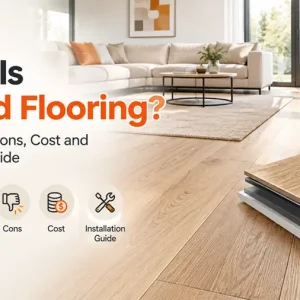
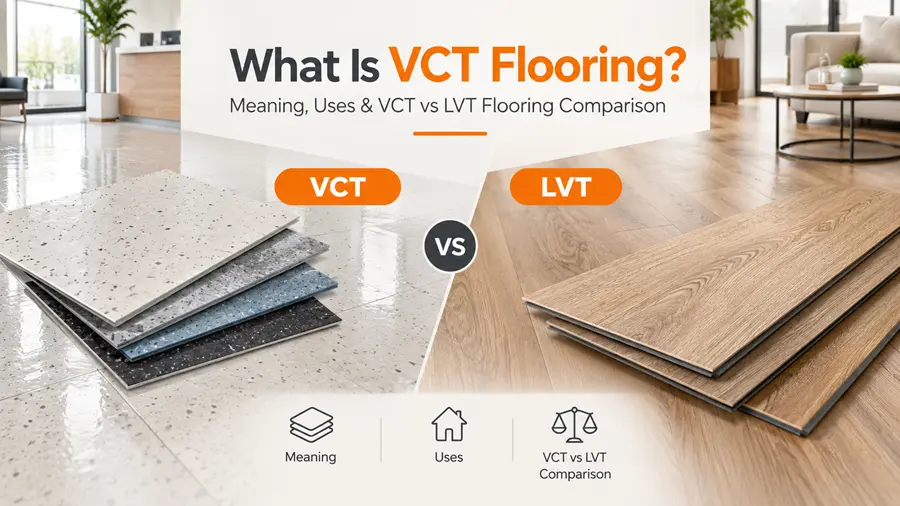
VCT flooring is a hard, low-cost floor tile built mostly from crushed limestone held together by a small amount of vinyl. VCT stands for vinyl composition tile, though many people write it as vinyl composite tile. Schools, hospitals, and grocery stores have used it for decades because it costs about $1 to $3 per square foot for material and shrugs off heavy foot traffic. The catch is upkeep. The tile arrives with no protective finish, so crews must apply floor polish after installation and renew it for the life of the floor.
That single fact, low vinyl content and no factory topcoat, explains almost everything else about this material. Read this guide by Nova Floor experts & you will see why it is cheap, why it is porous, and why it costs more to own than to buy.
Contents
What Does VCT Stand For?
VCT stands for vinyl composition tile. The official industry name comes from ASTM F1066, the standard that defines how manufacturers make and test this product. You will also see it called vinyl composite tile, and both names point to the same flooring. Installers usually just say “the tile.”
The word composition matters. It signals that vinyl is only one ingredient in a blend, not the whole product. That separates it from luxury vinyl tile, which uses vinyl as its main material.
What Is VCT Made Of?
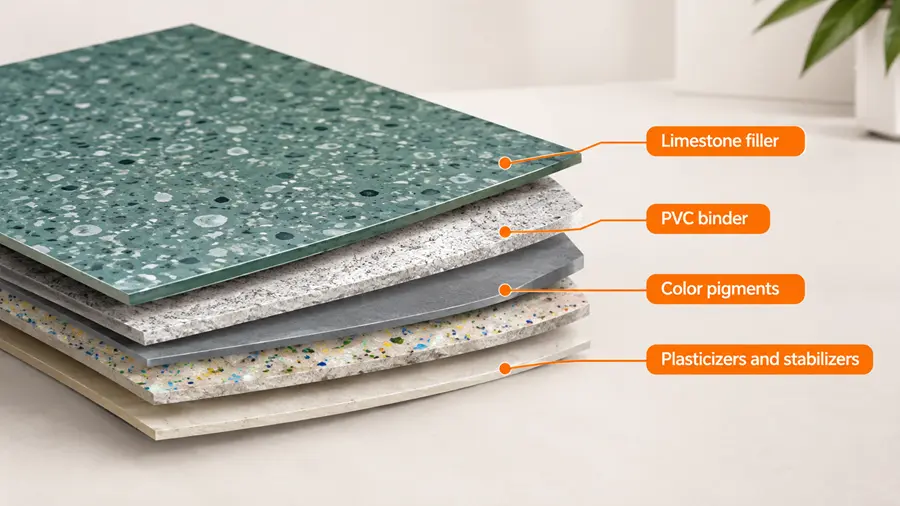
Manufacturers mix four things and press them into tiles:
- Limestone filler. Ground limestone makes up the bulk of the tile, often 80 percent or more by weight. Filler is cheap, which keeps the price low.
- PVC binder. A modest share of polyvinyl chloride holds the limestone together. Less binder means less flexibility and more brittleness.
- Color pigments. Pigments run through the full thickness of the tile, not just the surface.
- Plasticizers and stabilizers. These small additions control how the tile handles heat and pressure.
Standard tiles measure 12 by 12 inches at 1/8 inch thick, and 18 by 18 inch sizes exist for larger layouts. Because color goes all the way through, light scratches blend in instead of showing a pale line. That through-pattern construction is a real advantage that thin printed floors cannot match.
The high filler load also creates micro pores across the surface. Those pores are the reason the tile needs polish, and the reason it stains when polish wears thin.
Where People Use VCT Flooring
This tile shows up wherever budgets are tight, floor areas are large, and a cleaning crew already exists on site.
- Schools and universities. Corridors, classrooms, cafeterias, and gym approaches. Districts like the low material cost across tens of thousands of square feet, and custodial teams already own burnishers.
- Hospitals and clinics. Back of house areas, staff corridors, and utility rooms. Patient rooms and surgical suites usually move to sheet vinyl or welded LVT for seamless cleaning.
- Grocery and retail. Aisles and stockrooms, where the polished shine reads as clean and replacement tiles cost almost nothing.
- Offices and government buildings. Break rooms, copy rooms, and service corridors.
- Restaurants and light industrial. Prep areas away from standing water, plus warehouse offices.
- Homes. Basements, laundry rooms, and workshops, though most homeowners now pick luxury vinyl for living spaces.
One pattern runs through all of these. Buildings with in house maintenance staff get good value. Buildings that would have to hire an outside contractor for every refinish usually do not.
VCT Flooring Pros and Cons
Advantages
- Low purchase price. Material typically runs $1 to $3 per square foot, and installed cost lands around $2 to $5.
- Easy, cheap repairs. A damaged tile pops out and a replacement goes in for a few dollars. Facilities often store extra cartons from the original lot.
- Through-body color. Wear does not expose a different color underneath.
- Strong surface wear resistance. Limestone is hard. The tile resists abrasion from grit and shoe traffic very well.
- Good slip performance when maintained. The right finish gives a stable walking surface, which matters in schools and healthcare.
- Design freedom in layout. Solid color squares let designers create checkerboards, borders, wayfinding paths, and school logos at low cost.
- Long track record. Manufacturers have produced this tile for over half a century, so specs, adhesives, and repair methods are well understood.
Drawbacks
- No factory finish. Crews apply polish on site, and coverage varies with skill.
- Porous surface. Unprotected tile absorbs spills and stains.
- High lifetime labor cost. Stripping and refinishing eat budget every year.
- Brittle under impact. Dropped tools and hard point loads can crack it.
- Poor static load resistance. Heavy fixed equipment leaves permanent dents.
- Limited visuals. Speckled solids only. No convincing wood or stone looks.
- Slow installation. Small tiles mean more pieces, more layout, and more labor hours.
- Demanding subfloor prep. The thin, rigid tile telegraphs every bump and crack underneath.
How Durable Is VCT Flooring?
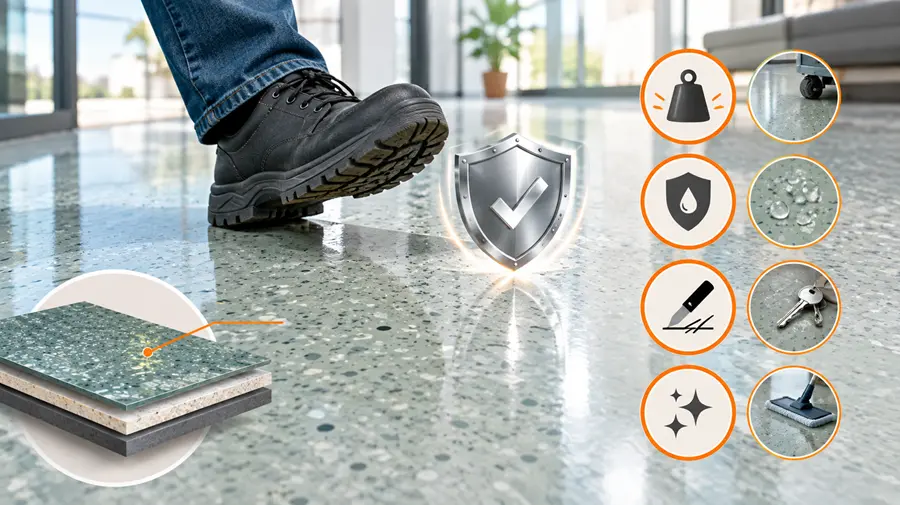
This is where most comparisons get confusing, because “durable” hides three different questions.
Surface wear. Excellent. The limestone content makes the tile very hard, and through body color hides abrasion. A well maintained floor can serve 15 to 20 years or longer in a school corridor.
Impact and flex. Weak. Low binder content makes the tile brittle. Drop a steel cart handle on it and you can chip the edge. If the slab below moves or cracks, the tile cracks with it.
Static load. Weak. Products commonly carry a static load rating near 75 psi under ASTM F970. Commercial LVT flooring often lists 250 psi or higher. That gap decides real projects. A library shelving range, a hospital bed wheel parked for weeks, or a filing system will press dents into this tile and never release them.
So the honest answer is that this floor wears well and dents badly. If your traffic is feet, it lasts a long time. If your traffic includes heavy wheels and fixed equipment, look elsewhere.
Is VCT Waterproof?
No. The tile itself will not rot or swell, but the floor as a system is not waterproof.
Water gets in through the seams between tiles, reaches the adhesive, and softens the bond. Tiles then loosen at corners. On the surface, a worn or missing finish lets liquid sit in the pores, which leaves stains that no mop will lift. Standing water near mop sinks, drinking fountains, and entry mats causes most failures.
Floor polish is the actual moisture barrier here. Let the finish go and you lose the protection.
The subfloor problem almost nobody mentions
Most failures start below the tile, not above it. Concrete slabs release moisture vapor for months or years, and that vapor collects under a non breathable floor. It then attacks the adhesive.
Before installation, test the slab. Two methods dominate:
- ASTM F2170 in situ relative humidity probes. Most adhesives cap out around 80 to 85 percent RH.
- ASTM F1869 calcium chloride test. Many specs limit emissions to about 3 to 5 pounds per 1,000 square feet per 24 hours.
Also check slab pH, since alkalinity above roughly 9 or 10 breaks down common adhesives. If numbers come back high, install a moisture mitigation coating first. Skipping these tests is the single most expensive mistake on resilient flooring jobs, and it voids most manufacturer warranties.
VCT Maintenance: What It Actually Takes
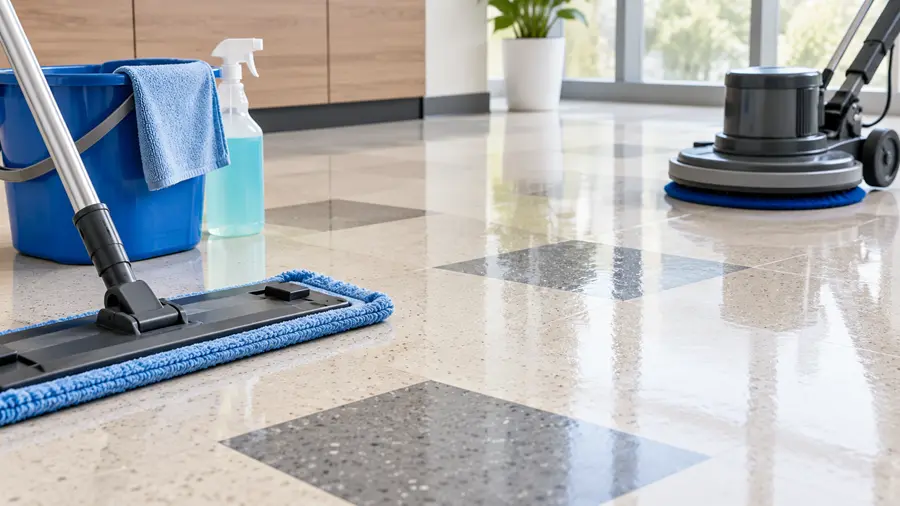
Vague advice to “wax it sometimes” hides the real commitment. Here is the full program.
At installation. Clean the tile, then apply four to five coats of floor finish. Each coat needs drying time. Budget a full day or more before anyone walks on it.
Daily. Dust mop and spot clean. Grit is the enemy, since it grinds finish away.
Weekly to monthly. Burnish with a high speed machine to restore gloss. Busy corridors may need this weekly.
Quarterly. Scrub and recoat. A machine removes the top worn layer, then crews add one or two fresh coats.
Annually, sometimes twice a year. Strip and refinish. Chemical stripper dissolves all old finish, crews rinse and neutralize, then rebuild the full coat system from scratch. This is wet, slow, and usually happens overnight or during school breaks.
Real cost. Once you count labor, finish, stripper, pads, and machine time, annual upkeep often lands between $0.75 and $1.50 per square foot. Compare that to a material price near $1.50. You can spend the purchase price of the floor every single year keeping it shiny.
That number is the whole argument. The tile is cheap to buy and expensive to own.
How Much Does VCT Flooring Cost?
- Material: roughly $1 to $3 per square foot. Basic solids sit at the low end. Premium colors and textured options reach the top.
- Installation: roughly $1 to $3 per square foot, driven by tile count, layout complexity, and subfloor condition.
- Initial finish application: roughly $0.30 to $0.75 per square foot.
- Subfloor prep: varies widely. Patching, leveling, or moisture mitigation can add $1 to $3 per square foot.
- Annual maintenance: roughly $0.75 to $1.50 per square foot.
Over ten years, maintenance usually costs several times the original purchase. Always run the math on the full period, not the invoice.
VCT vs LVT | Quick Comparison
| Factor | Vinyl Composition Tile | Luxury Vinyl Tile |
| Main material | Mostly limestone filler with a little PVC | Mostly PVC in multiple bonded layers |
| Material cost | About $1 to $3 per sq ft | About $3 to $7 per sq ft |
| Installed cost | About $2 to $5 per sq ft | About $4 to $10 per sq ft |
| Protective layer | None from the factory. Applied on site | Built in wear layer, usually 12 to 28 mil |
| Annual upkeep | Strip, recoat, burnish. High labor | Sweep and damp mop. Low labor |
| Upkeep cost | About $0.75 to $1.50 per sq ft per year | Under $0.25 per sq ft per year |
| Static load rating | Often near 75 psi | Often 250 psi or higher |
| Moisture resistance | Porous. Depends on finish | Water resistant body and sealed surface |
| Appearance | Speckled solid colors | Realistic wood, stone, concrete, and abstract visuals |
| Tile sizes | 12×12 and 18×18 inches | Planks and tiles up to 48 inches and beyond |
| Install speed | Slower. More pieces per area | Faster. Fewer, larger pieces |
| Typical service life | 15 to 20 years with full maintenance | 15 to 25 years with light maintenance |
| Repair | Swap one tile cheaply | Swap one piece, matching lot can be harder |
VCT vs LVT | The Differences That Decide Projects
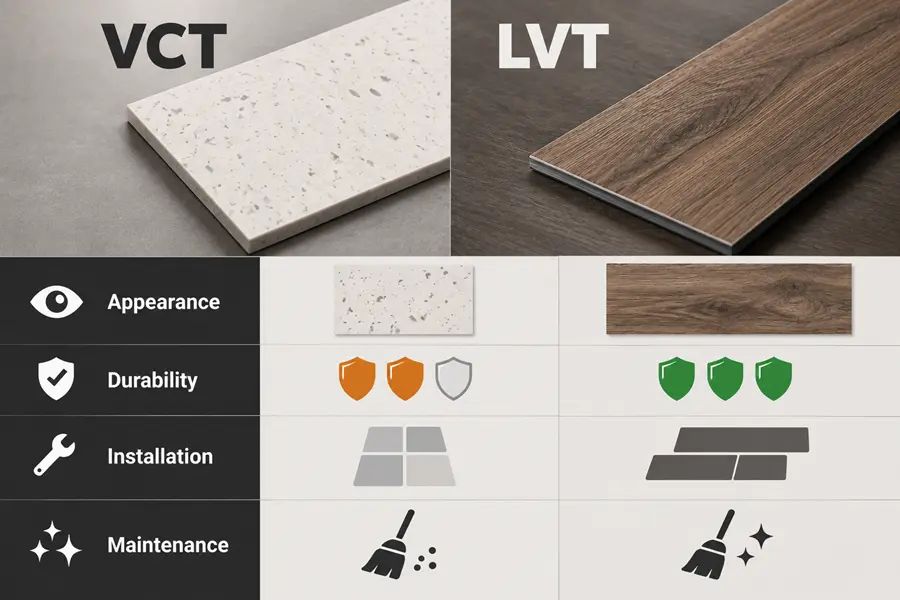 Cost
Cost
VCT usually has a lower purchase price, while LVT often costs more upfront. The better choice depends on your project’s budget, expected lifespan, and operating costs. For a large commercial space, look beyond the initial price and compare the total cost over several years.
- VCT can reduce the initial flooring budget.
- LVT usually has a higher material cost.
- Include installation, cleaning, repairs, and replacement when comparing costs.
- A 10-year cost comparison can give you a more realistic picture.
- VCT may make more financial sense when a facility already has the equipment and staff for floor finishing.
Appearance
LVT gives you far more design flexibility than VCT. Its printed design layer can recreate natural materials, while VCT has a simpler commercial look. VCT can still create attractive layouts when different colors are combined.
- LVT can replicate wood, marble, stone, terrazzo, and concrete.
- Large planks and tiles create a cleaner, more modern appearance.
- VCT is commonly available in solid and flecked colors.
- Multiple VCT colors can create borders, patterns, and wayfinding designs.
- LVT is a better option when realistic material patterns are important.
- VCT works well when a simple, practical appearance is the goal.
Durability
Both flooring types can handle demanding commercial environments, but they respond differently to traffic and impact. VCT is hard and resistant to surface wear, while LVT has a more flexible construction that can better handle impacts and rolling loads.
- VCT performs well under heavy foot traffic.
- LVT can better handle carts, beds, shelving, and wheeled equipment.
- LVT’s flexible layers help reduce damage from impacts and indentation.
- VCT is well suited to spaces where people are the main source of traffic.
- LVT is useful in hospitals, retail spaces, and other areas with frequent rolling traffic.
- Always consider the type of traffic, equipment, and load the floor will face.
Installation
Both VCT and LVT are commonly installed with adhesive over a properly prepared subfloor. Installation time can vary based on tile size, subfloor condition, and the finishing process required after the flooring is installed.
- Smaller VCT tiles require more individual pieces to be placed.
- Larger LVT planks can cover more area with fewer pieces.
- Both products need a clean, dry, and level subfloor.
- VCT is less forgiving of surface imperfections because it is thin and rigid.
- Many products require acclimation before installation. Always follow the manufacturer’s instructions.
- VCT may require additional finishing before the floor is ready for regular use.
- Large commercial projects may need extra time for installation and final preparation.
Maintenance
VCT requires a more involved maintenance routine to protect its surface and keep its appearance. LVT is generally easier to care for because many commercial products have a factory-applied protective wear layer.
VCT maintenance may include:
- Routine sweeping and mopping
- Stripping old finish
- Applying new floor finish
- Burnishing
- Periodic restoration
LVT maintenance usually includes:
- Sweeping or vacuuming
- Damp mopping
- Routine cleaning
- Occasional deep cleaning
For large facilities, the simpler LVT maintenance routine can reduce the need for specialized floor-finishing work and keep floors available for use with less disruption.
Performance in real conditions
- Moisture: premium vinyl handles spills and wet mopping better. The budget tile depends entirely on intact finish.
- Static load: premium vinyl resists dents from fixed equipment far better.
- Sound: both are hard surfaces. Neither is quiet, though thicker vinyl and attached underlayment options help slightly.
- Chemicals: the budget tile handles harsh cleaners well. Some printed floors can dull or discolor from aggressive chemicals.
- Sunlight: both can fade under long direct sun exposure. Use window film in glazed corridors.
- Repairs: the budget tile is easier and cheaper to patch, which is a genuine advantage in accident prone areas like loading docks and shops.
Which Fits Your Space?
Healthcare. Infection control favors fewer seams and no wax. Premium vinyl or sheet vinyl belongs in patient rooms, procedure areas, and corridors with bed traffic. Composition tile still works in mechanical rooms, storage, and staff back areas.
Schools. Composition tile remains common in classrooms and corridors because districts have custodial teams and tight capital budgets. If your district struggles to staff summer refinishing, switch to a polish optional product. Cafeterias and entryways deserve the tougher floor either way.
Offices. Premium vinyl usually wins. The aesthetic matters to tenants, workstation and filing loads dent soft floors, and office buildings rarely want overnight stripping crews.
High traffic retail. Either works. Grocery chains have run the cheaper tile successfully for decades because they staff nightly floor care. Smaller shops without that staffing should pay more upfront.
Warehouses and workshops. Rolling loads rule here. Pick the higher psi product, or step up to sheet goods or coatings.
Homes. Premium vinyl for anything visible. The budget tile makes sense in a garage, basement workshop, or laundry room where you value cheap replacement over looks.
One Warning for Renovations: Asbestos
Vinyl floor tile made before the early 1980s often contained asbestos, especially 9 by 9 inch tiles and the black mastic under them. Undisturbed tile is generally not a hazard. Grinding, sanding, or breaking it is.
Never dry scrape or power sand old floor tile. Test first through a certified lab, and hire licensed abatement if results come back positive. Many renovation budgets get destroyed by this discovery, so test early enough to price it correctly. Modern tile contains no asbestos.
Frequently Asked Questions
Is VCT waterproof? No. The tile resists water but the seams and adhesive do not. Floor finish provides most of the surface protection, so a floor with worn polish will absorb spills and stain.
Is VCT cheaper than LVT? Yes to buy, usually no to own. Material costs roughly a third to a half as much, but annual stripping and refinishing often close the gap within two to four years of heavy use.
Which is better, VCT or LVT? Luxury vinyl suits most projects today because it needs no wax, resists dents better, and offers realistic visuals. Composition tile still wins when the budget is fixed, the area is huge, custodial staff already exist, and the traffic is mostly foot traffic.
How long does VCT flooring last? Around 15 to 20 years when a full maintenance program runs consistently. Without regular refinishing, the surface stains and dulls within a few years.
Do you have to wax VCT flooring? Practically, yes. The tile ships with no protective coating, so bare tile stains and wears quickly. Some manufacturers offer factory finished versions that reduce, but do not fully remove, the upkeep.
Can you install VCT over an existing floor? Sometimes. The surface must be flat, firm, clean, dry, and fully bonded. Installing over loose tile, cushioned vinyl, or an untested slab leads to failure.
Does VCT work in bathrooms and kitchens? Commercial kitchens and wet rooms need sheet goods or coatings with sealed seams and coved bases. Light duty residential use is possible with strict maintenance, but better options exist.
What is the difference between VCT and linoleum? Linoleum comes from natural materials like linseed oil, wood flour, and cork dust on a jute backing. Composition tile uses limestone with a vinyl binder. Both need protective finish, and both are considered resilient flooring.
Is VCT slippery? It offers reasonable traction when properly maintained. Risk rises when the finish is too glossy, when floors are wet, or right after mopping. Good entry matting and prompt spill cleanup matter more than the product itself.
The Bottom Line
Vinyl composition tile is a proven, inexpensive commercial floor that hides its real price in labor. It suits buildings with large open areas, foot traffic, tight construction budgets, and a reliable cleaning crew.
Luxury vinyl costs more on day one and less every year after. It looks better, resists dents and moisture better, and eliminates the stripping cycle entirely.
Decide with a ten year number, not a square foot price. Count the custodial hours, the chemicals, the equipment, and the nights your building closes for refinishing. That calculation, more than anything else, points to the right floor.