Noah Williams is an interior designer and flooring expert at Nova Floor. In Dubai, he helps people pick the right floor, get it installed, and keep it looking good. He also writes simple, practical flooring and home care guides for readers in Dubai and around the world.
Carpet Hall Runner Rugs: 15 Ideas, Sizes and Placement Tips

Noah Williams
Carpet hall runner rugs do more than fill a gap in a long, plain space. They protect the floor, soften footsteps and make a hallway feel finished. The hard part is choosing well. A runner that is too wide looks like wall-to-wall carpet. One that is too short looks lost. One with no grip can slide under your feet.
This guide from Nova Floor shows you how to measure, choose the right rug size, plan placement, select durable materials, and keep your hallway rug clean. You will also find 15 hallway rug ideas for different layouts and everyday needs.
Quick answer: Measure the hallway at its narrowest point. Leave about 4 to 6 inches (10 to 15 cm) of bare floor on each side, and at least 3 inches (7.5 cm) in a very tight hallway. Make the runner about 12 inches (30 cm) shorter than the hallway. Always use a non-slip pad underneath.
Contents
What Are Carpet Hall Runner Rugs?
Carpet hall runner rugs are long, narrow floor coverings made for hallways, corridors and entryways. Most are 2 to 3 feet wide (61 to 91 cm) and 6 to 14 feet long (183 to 427 cm). They sit along the walking path, protect the floor and add colour, pattern or texture.
You will also see runners on landings, beside beds and as kitchen rugs. Hallways are the most common spot because the space is narrow and busy, and it often has very little decoration.
Rug Runner vs Carpet Runner: What Is the Difference?
In everyday shopping, both names describe the same long, narrow shape. Some sellers use “carpet runner” for plain, hard-wearing products built for heavy traffic, and “rug runner” for decorative ones. Neither term is a strict standard.
So do not rely on the name. Even the difference between a carpet and a rug comes down to how each is made and fitted. Compare the fiber, pile height, backing and edge finish. Those details tell you how the runner will behave in your hallway.
Why a Hallway Runner Is Worth It
A hallway gets steady foot traffic, and the floor underneath takes the wear. A runner helps in four ways:
- It protects hardwood, tile or vinyl from scuffs and grit.
- It softens the sound of footsteps, which helps near bedrooms.
- It adds warmth underfoot on cold floors.
- It draws the eye along the hallway and can make it look longer.
How to Measure a Hallway for a Runner Rug
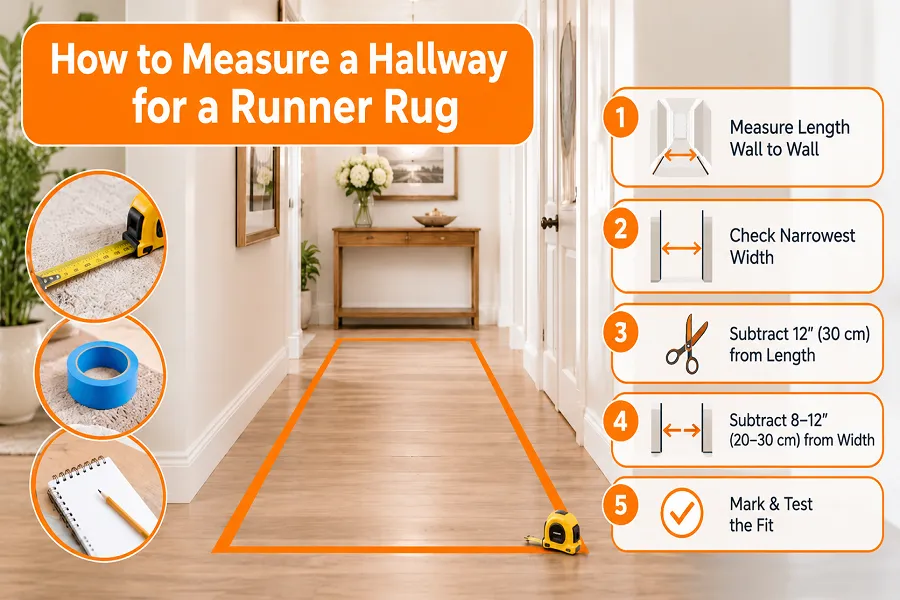
Measure before you shop. You only need a tape measure, a notepad and some painter’s tape.
- Measure the full length of the hallway, wall to wall.
- Measure the width at its narrowest point.
- Subtract about 12 inches (30 cm) from the length. This is your target runner length.
- Subtract 8 to 12 inches (20 to 30 cm) from the width. This is your target runner width.
- Mark the runner size on the floor with painter’s tape. Walk through it and open every door.
The tape test takes five minutes and saves you from a return.
Find the Right Width
Standard runners are 2 to 3 feet wide. The bare floor on each side matters more than the rug itself. Most guides suggest about 4 to 6 inches on each side. In a very narrow hallway, 3 inches is the usual minimum.
Why? A runner that touches the skirting board looks like fitted carpet and tends to get kicked up at the edges. A runner that leaves too much floor looks thin. Keep the gap even on both sides.
Find the Right Length
Do not match the exact length of the hallway. Stop about 6 inches (15 cm) short of each end or doorway, and centre the rug along the length. This gives the rug room to breathe and keeps it clear of door thresholds.
Measure Bends, Doors and Stairs Separately
If the hallway is L-shaped or T-shaped, measure each straight section on its own. Do not try to bend one rug around a corner. Matching runners for each section look neater and lie flatter.
Also note which doors swing into the hallway. You will need that information when you choose the pile height. If the hallway meets a staircase, treat the stairs as a separate job and measure the stairs for carpet on their own.
What Size Runner Rug Suits Your Hallway?
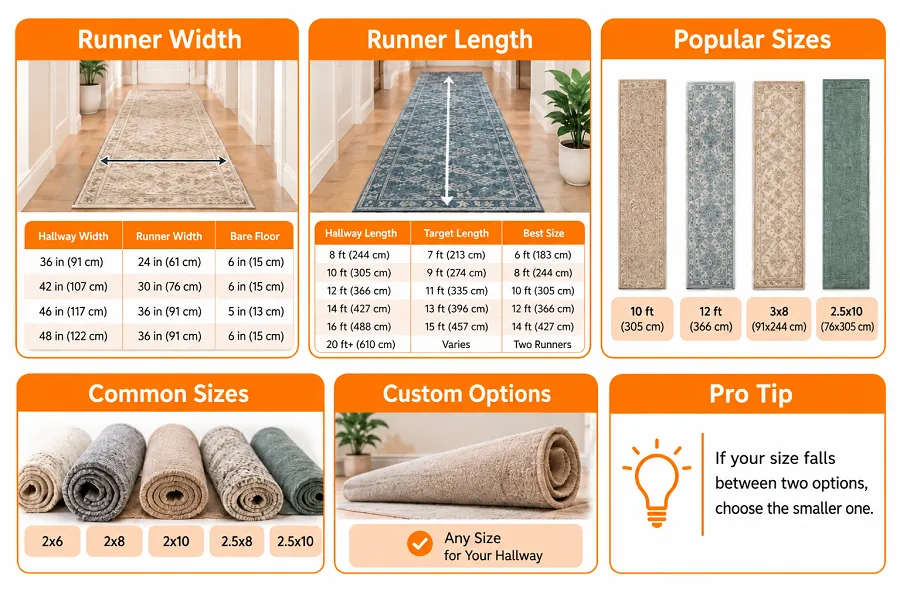
Use the tables below as a starting point, and check these standard rug sizes for other rooms. They follow the common rule of leaving bare floor at the sides and a gap at each end. Always check the maker’s listed size, because real dimensions can vary slightly.
Runner width by hallway width
| Hallway width | Runner width | Bare floor each side |
| 36 in (91 cm) | 24 in (61 cm) | 6 in (15 cm) |
| 42 in (107 cm) | 30 in (76 cm) | 6 in (15 cm) |
| 46 in (117 cm) | 36 in (91 cm) | 5 in (13 cm) |
| 48 in (122 cm) | 36 in (91 cm) | 6 in (15 cm) |
Runner length by hallway length
| Hallway length | Target length (minus 12 in) | Nearest standard runner |
| 8 ft (244 cm) | About 7 ft (213 cm) | 6 ft (183 cm) |
| 10 ft (305 cm) | About 9 ft (274 cm) | 8 ft (244 cm) |
| 12 ft (366 cm) | About 11 ft (335 cm) | 10 ft (305 cm) |
| 14 ft (427 cm) | About 13 ft (396 cm) | 12 ft (366 cm) |
| 16 ft (488 cm) | About 15 ft (457 cm) | 14 ft (427 cm) |
| 20 ft or more (610 cm) | Varies | Two matching runners or a custom length |
If your target falls between two sizes, choose the smaller one. A slightly short runner looks planned. A runner that is too long gets in the way of doors.
10 Foot and 12 Foot Runner Rugs
A 10 foot runner rug (also written as a 10 ft runner rug) suits a hallway of about 11 to 12 feet. A 12 foot runner rug suits a hallway of about 13 to 14 feet. These are popular long runner rugs, and they are often easy to find in 2 to 3 foot widths.
3×8 Runner Rug and Other Common Sizes
A 3×8 runner rug is 3 feet wide and 8 feet long (91 by 244 cm). Listings usually give width first, but check each one. This size suits a hallway about 4 feet wide and 9 to 10 feet long.
Other common sizes include 2×6, 2×8, 2×10, 2.5×8 and 2.5×10. Narrow hallway rugs in the 2 to 2.5 foot range work well in older homes and apartments with tight corridors.
Custom Runner Rugs for Unusual Hallways
Custom runner rugs help when your hallway is very long, very narrow or oddly shaped. You choose the width and length instead of settling for a stock size. Before you order, ask about three things: lead time, edge finishing and which fibers are available in custom sizes.
For long hallway runners beyond 14 feet, you often have two choices. You can order one custom piece, or you can use two matching runners (covered in idea 8 below).
Where to Place a Runner Rug in a Hallway
Centre the Runner and Keep Walking Space Clear
Centre the runner across the width of the hallway. If furniture sits on both sides, centre it between the pieces. Keep the middle path clear so people can walk without stepping on an edge.
Leave the bare floor at both ends. That small border keeps the rug away from doorways and makes the layout look intentional.
Check Door Clearance and Pile Height
Walk the hallway and open each door. Doors that swing into the hallway can catch on a thick pile. Many guides point to low or medium pile, or a flatweave. One guide suggests a pile of about 0.25 to 0.5 inch (6 to 13 mm) for this reason.
If a door still catches, start the runner just past the door’s swing. You can also pick a thinner rug and secure it with tape instead of a thick pad.
Placing a Runner Over Carpet or Hard Floors
Hard floors such as wood, tile and vinyl give a runner nothing to grip, so a pad matters most there. Over existing carpet, use a thin grip pad made for rugs over carpet. A thick pad can bunch up against carpet fibers and make the runner ripple.
Best Materials for Carpet Hall Runner Rugs in High-Traffic Hallways
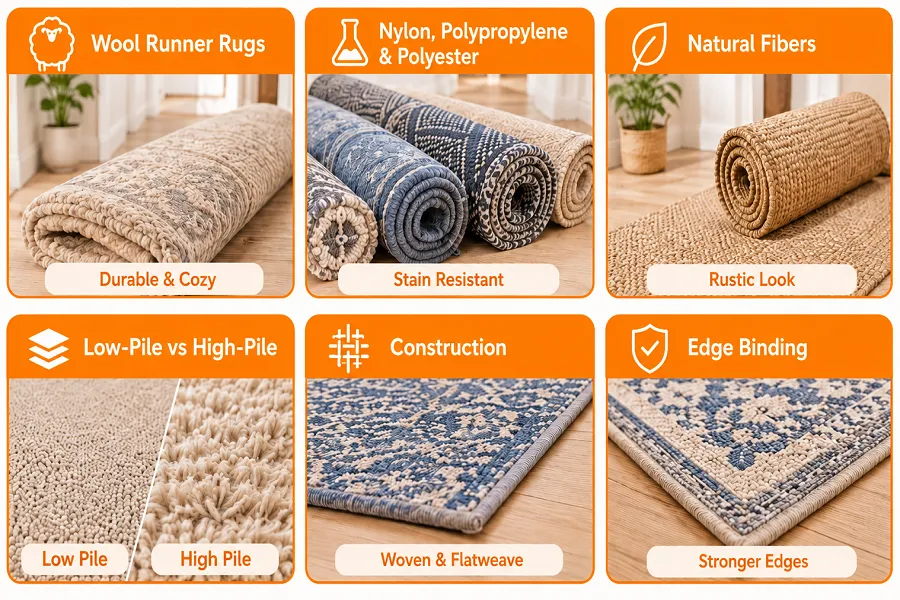
A hallway sees more steps than most rooms. The fiber decides how well the runner holds its shape and colour. The table gives general guidance, so always check the fiber label on the product.
| Fiber | Wear resistance | Stain resistance | Good to know |
| Wool | Springs back well | Good if spills are blotted fast | Natural fiber. May shed a little at first |
| Nylon | Strong and resists crushing | Good | A common choice for hard-wearing carpet |
| Polypropylene | Hard-wearing | Good | Often feels firmer. Many products resist fading |
| Polyester | Moderate | Good | It feels soft. May flatten along the main path |
| Jute and other natural fibers | Moderate | Low | Textured look. Avoid damp entryways |
Wool Runner Rugs: Good for Hallways?
Yes, in most homes. Wool fibers have a natural crimp that helps the pile spring back after people walk on it. A wool runner rug also hides daily wear well, and carpet runners wool rugs are a common pick for busy family hallways.
There are trade-offs. Wool usually costs more, it can shed early on, and it needs quick action on spills. In a very wet entryway, a synthetic fiber may be easier to live with.
Nylon, Polypropylene and Polyester
Synthetic fibers suit busy hallways because they are easy to care for. Nylon and polypropylene are the usual hard-wearing choices, and a nylon vs polyester carpet comparison helps if you are torn between synthetics. Polypropylene is also known for resisting stains and fading. Polyester feels soft but may flatten in the main walking line over time.
Natural Fibers and Where They Struggle
Jute, sisal and seagrass bring a rustic, textured look. They work in dry hallways. They do not like moisture, and raw jute soaks up water quickly. They can also feel rough underfoot. Keep them away from damp entry areas.
Low-Pile vs High-Pile Hallway Runners
Pile height is how tall the fibers stand. Pile density is how closely they are packed. Both affect comfort and care.
Low-pile hallway rugs are easier to vacuum, lie flatter and clear doors more easily. They also reduce the chance of tripping. High pile feels softer, but it traps dirt, catches doors and can be hard to keep flat. For most hallways, low pile with a dense weave is the safer pick.
Construction and Edge Binding
Woven and flatweave runners lie flat from day one, which helps in a narrow, busy space. Check the backing too. Some runners come with a built-in non-slip backing. Others need a separate pad.
Look at the edges. Bound or finished edges resist fraying better than raw ones. If a runner is cut to size, ask how the edges are sealed, since edge binding and stitching keeps cut edges from fraying. Good edge binding protects the carpet edging where wear shows first.
How to Stop a Hallway Runner From Slipping
Runners are light and sit in busy places, so they move easily. A shifting rug is a trip hazard, so fix it before you walk on it every day.
Rug Pad, Rug Tape or Grip: Which to Use
- Rug pad: The best all-round option, also called rug underlay. It adds grip, a little cushion, floor protection and some sound dampening. Use a rubber or felt-and-rubber pad on hard floors. Use a thin grip pad over carpet.
- Rug tape: Useful when a pad is too thick for the doors. Use double-sided tape and test a small spot first, because some floors can show residue when the tape comes off.
- Built-in backing: A hallway runner rug non slip option can help, but check whether the backing suits your floor. Gel backing grips well on hard floors but works less well on thick carpet.
Fix Curling Corners and Trip Hazards
Corners that curl up are a trip risk. Press them flat, add corner grips or tape, or replace the rug if it will not settle. Check the edges often in homes with children or older adults. Choose low pile, secure the whole runner, and walk the hallway once after fitting.
15 Carpet Hall Runner Rug Ideas for Different Hallways
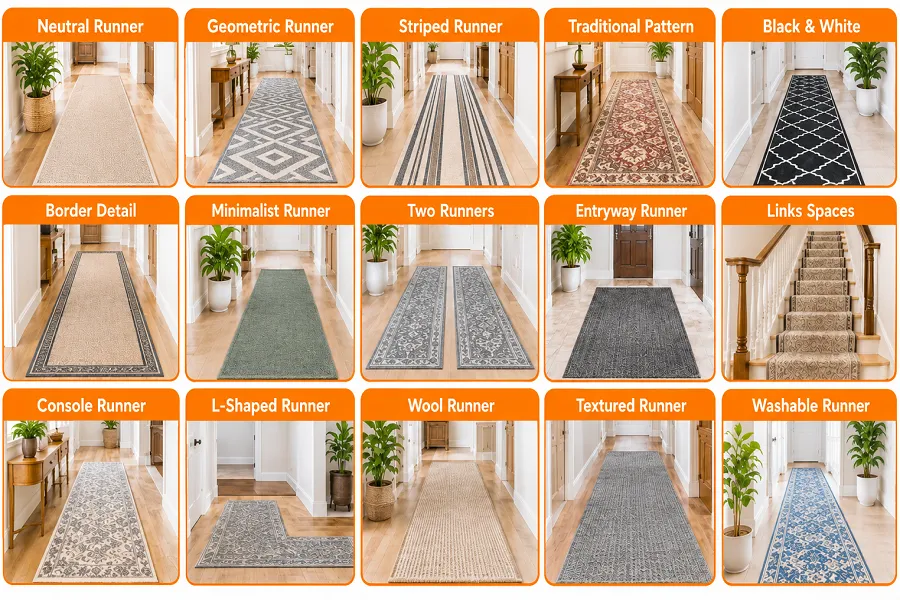
Choose by the problem you need to solve, not only by looks. These ideas fall into three groups: style, layout and everyday performance.
Style Ideas
1. Neutral Runner for a Narrow Hallway
Best for: narrow hallways, small apartments and rooms with strong colour at either end.
Soft beige, stone or grey tones keep a tight space calm. Low contrast with the floor makes the hallway feel wider. Choose a 2 foot width and a quiet pattern. It suits small apartments and rooms with strong colour at either end.
2. Geometric Runner for a Modern Home
Best for: modern homes and busy hallways that need pattern with order.
Squares, diamonds and lines add order. Repeating shapes show off the length of the hallway and hide small marks. In a narrow space, pick a small or medium pattern, because large shapes get cut off at the edges.
3. Striped Runner That Guides the Eye
Best for: long, narrow hallways that should feel longer and more guided.
Stripes that run along the hallway pull the eye forward. Thin stripes feel calm. Bold stripes feel lively. Striped hallway runners also give people a clear line to walk along.
4. Traditional Patterned Runner for Classic Interiors
Best for: classic interiors, wood floors and homes with framed art.
Medallions, vines and florals suit wood floors, framed art and classic furniture. Busy patterns hide dirt well. If the walls already have detail, choose muted colours so the rug does not compete.
5. Black and White Runner for Contrast
Best for: pale floors, plain walls and hallways that need a bold, high-contrast look.
A black and white runner stands out on pale floors and plain walls. A black runner rug or black carpet runner looks sharp, but it shows lint and dust, so brush or vacuum it often. A mixed pattern hides dust better than solid black.
6. Border-Detail Runner That Frames the Floor
Best for: tile or wood floors and long hallways that need neat, defined edges.
A border works like a picture frame. It gives the rug neat edges and makes it look finished on tile or wood. Wide borders suit long hallways. In a narrow hallway, choose a thin border.
7. Minimalist Plain Runner for Clean Lines
Best for: minimal homes where art, doors or lighting should take the lead.
A solid colour or fine texture lets doors, lighting and wall art lead the room. To keep it from looking flat, choose a subtle weave or flatweave texture.
Layout Ideas
8. Two Matched Runners for a Long Hallway
Best for: hallways over 20 feet and homes that want easier cleaning and replacing.
In a hallway over about 20 feet, two runners can be easier to buy, move and clean than one huge piece. Match the fiber, style and colour family. Leave about 6 to 12 inches between them, and never let the gap fall in a doorway, where tripping is most likely.
9. Entryway Runner That Clears the Door
Best for: front doors, entryways and homes with muddy or sandy shoes.
An entryway carpet runner meets wet shoes and grit. A dark or busy pattern hides dirt better than a pale one. If the front door swings inward, pick a thin flatweave or start the runner past the swing.
10. Runner That Links the Hallway and Staircase
Best for: multi-level homes with a staircase and an upstairs landing.
Using the same fiber and tone for the hallway and the stair runner creates a smooth look from floor to floor. Keep them as two separate pieces, with a few inches of bare floor at the top of the stairs. Stair runners need proper fixing, so never use a loose rug on steps.
11. Runner Beside a Console or Bench
Best for: hallways with a console table, shoe bench or other furniture.
When furniture stands in the hallway, follow one rule: the front legs sit fully on the runner or fully off it. If they sit off, leave a few inches so the furniture and rug do not touch. Keep the walking path clear.
12. Separate Runners for an L-Shaped Hallway
Best for: L-shaped and T-shaped hallways with one or more turns.
Measure each straight section, then use matching runners for each one. This avoids bunching at the corner and lets you replace one piece if it wears out first.
Performance Ideas
13. Wool Runner for a Busy Family Hallway
Best for: busy family hallways with daily foot traffic.
A dense, low-pile wool runner copes well with daily traffic and hides wear. Add a good pad. Blot spills quickly, and expect a little shedding in the first weeks.
14. Textured Low-Pile Runner for Easy Vacuuming
Best for: homes that vacuum often and hallways beside bedrooms or the kitchen.
A tight loop or flatweave hides footprints and vacuums easily. It also lies flat, which helps doors pass over it. This is a good choice for hallways that connect to bedrooms, a kitchen or the front door.
15. Washable Runner for Pets and Children
Best for: families with pets or children, and entrances that see a lot of mud.
Machine washable runner rugs suit homes with children, pets or muddy shoes. Washable rug runners and washable carpet runners differ in how they are made, so read the care label. Check the washing machine size and the drying instructions. Some thin washable rugs still need a pad.
How to Choose Colours and Patterns for Hallway Runner Rugs
Light vs Dark Runners and Dirt
Light colours brighten a hallway and make it feel wider, but they show marks faster. Dark colours hide dirt, but they show dust and lint. Mid-tones and mixed patterns usually give the best balance in high-traffic spaces.
Pattern Scale in a Narrow Space
In a narrow hallway, a very large pattern gets cropped and looks messy. Small to medium patterns look tidier. Stripes and borders can also help the hallway look longer and more organised.
Match Walls, Doors and Nearby Rooms
Look at the wall colour, the floor and the rooms at each end. If your walls are grey, these carpet colours that go with grey walls are a good start. Pick one colour from the nearby rooms and repeat it in the runner. Neutral colours calm a busy space. Contrasting colours add energy, so use them when the rest of the hallway is quiet.
How to Clean and Maintain a Hallway Carpet Runner
The right cleaning method depends on the fiber, so read the care label first.
Routine Vacuuming and Rotation
Vacuum the runner often, since hallways collect grit. Use a brush attachment or suction-only setting along the edges, because rotating beaters can fray them. Lift the rug now and then to vacuum the floor and the pad underneath. If the design allows it, turn the runner end to end to even out wear.
Spot Cleaning and Stain Removal
Blot spills right away with a clean cloth. Do not rub, because rubbing pushes the stain into the fibers. For wool, start with cold water and a soft brush. Full steps to clean wool carpet cover tougher marks. Test any cleaner on a hidden corner first. Keep water away from jute and other natural fibers.
Shedding, Wear and Edge Fraying
New wool can shed for a few weeks, and gentle vacuuming usually helps. Trim loose threads with scissors instead of pulling them. Frayed edges can often be repaired by a rug specialist. To limit fading, avoid long direct sun on the runner if the hallway has a window.
When to Use a Professional
Call a cleaner for heavy soiling, very long runners or valuable wool and hand-made rugs. Follow the maker’s care guidance so you do not void any warranty.
Hallway Runner Checklist Before You Buy
- Measure the width at the narrowest point and the length wall to wall.
- Leave about 4 to 6 inches of bare floor on each side, and 3 inches at minimum in tight spaces.
- Make the runner about 12 inches shorter than the hallway.
- Pick a low-pile, dense runner and check door clearance.
- Choose a fiber that suits the traffic, such as wool, nylon or polypropylene.
- Plan a rug pad or tape that matches the floor.
- Check the edges, backing and care label.
FAQs
What is a hallway runner rug?
A hallway runner rug is a long, narrow rug made for hallways, corridors and entryways. Most are 2 to 3 feet wide and 6 to 14 feet long. It protects the floor from wear, softens footsteps and adds colour or pattern to a plain space.
What size runner rug is best for a hallway?
Measure the hallway width at its narrowest point, then subtract about 8 to 12 inches in total. That leaves roughly 4 to 6 inches of bare floor on each side. For length, subtract about 12 inches from the hallway length and choose the nearest standard size at or below that.
How much space should be left around a hallway runner?
Leave about 4 to 6 inches (10 to 15 cm) of bare floor on each long side. In a very narrow hallway, 3 inches is the usual minimum. Stop about 6 inches short of doorways at each end, and check that doors swing open without catching the rug.
Do wool runner rugs suit hallways?
Yes. Wool suits busy hallways because its natural crimp helps the pile spring back under foot traffic. It needs prompt spill care and regular vacuuming. In very damp entryways, a synthetic fiber such as polypropylene may cope better.
How do you keep a hallway runner from moving?
Put a non-slip pad under the whole runner. Use a rubber or felt-and-rubber pad on hard floors. On carpet, choose a thinner grip pad made for rugs over carpet, because a thick pad can bunch. If a pad makes the rug too thick for doors, use rug tape.
Should a hallway runner be the same length as the hallway?
No. Leave about 6 inches of bare floor at each end so the runner looks centered and does not meet the doorways. In hallways over 20 feet, two matching runners often work better than one very long runner.
What type of carpet runner is best for high-traffic areas?
Choose a dense, low-pile runner in wool or a hard-wearing synthetic such as polypropylene or nylon. These fibers resist crushing and stains well. A mid-tone or patterned design hides dirt better than a plain pale one, and a pad reduces wear.
How do you clean a hallway carpet runner?
Vacuum regularly. Use a brush attachment or suction-only setting on edges to avoid fraying. Blot spills straight away with a clean cloth, and check the care label before using any cleaner. For wool, start with cold water and a soft brush.
Final Thoughts
Good carpet hall runner rugs come down to a few simple choices. Measure the hallway, leave bare floor around the edges, pick a fiber that suits the traffic, and always secure the rug with a pad or tape. Then choose a colour and pattern that fit your home.
If you want help with fibers, sizes or custom lengths, the Carpet Land team can guide you toward a runner that fits your hallway, and a guide to choosing a carpet for your home covers fiber and style in more detail.

Noah Williams
Interior Designer & Flooring Expert
Related Posts