Noah Williams is an interior designer and flooring expert at Nova Floor. In Dubai, he helps people pick the right floor, get it installed, and keep it looking good. He also writes simple, practical flooring and home care guides for readers in Dubai and around the world.
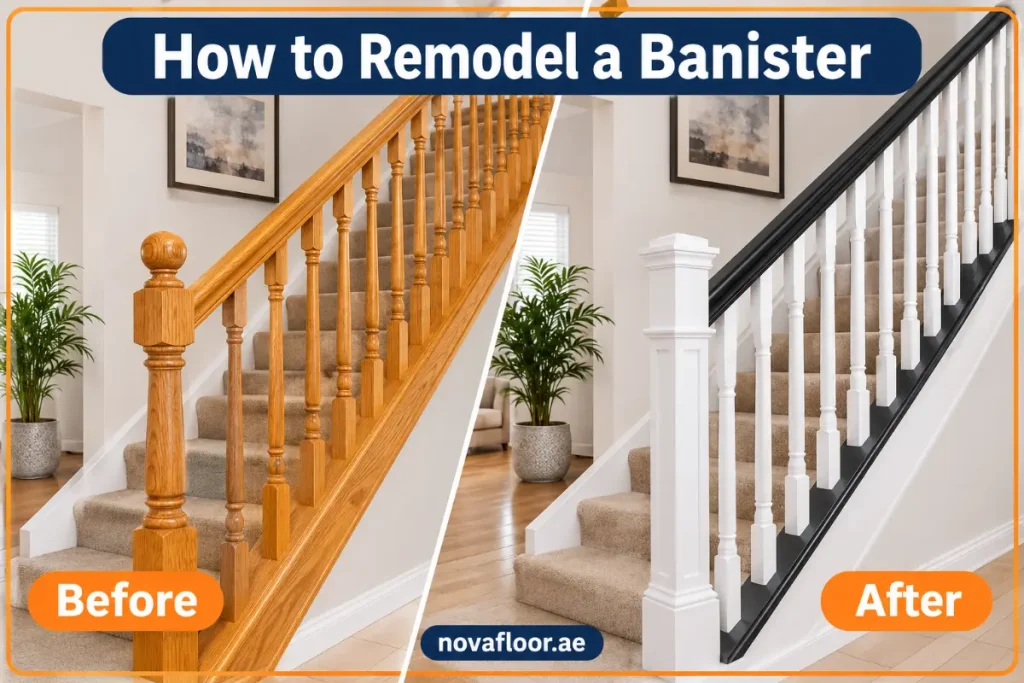
How to Remodel a Banister: 10 Ways to Upgrade Your Stair Railing on a Budget
Noah Williams
Your staircase is often the first thing guests see when they walk in. If it still has a worn honey-oak rail, brassy iron spindles or a chunky ball-top newel post, the whole entrance looks older than it is. The good news: you rarely need a new staircase. This guide shows you how to remodel a banister step by step, with 10 upgrades that range from a weekend of paint to a full baluster swap.
Quick answer: To remodel a banister on a budget, first check that the rail and newel posts are solid. Then pick the smallest change that fixes what you dislike: paint or stain the existing parts, swap only the balusters, replace the handrail, or modernise the newel post. Most cosmetic updates cost AED 150–2,400 (USD 40–650) as DIY projects, while a full professional replacement usually starts around AED 4,400 (USD 1,200).
For every idea below you get the tools, the steps, a realistic cost in AED and USD, and a clear note on when to call a professional.
Contents
How Do You Remodel a Banister? The 5-Step Plan
Remodelling a banister means changing how the handrail, balusters and newel posts look, without rebuilding the stairs. Follow this order and you avoid the two classic mistakes: painting over a wobbly rail, and buying parts that don’t fit.
- Test it. Push hard on the newel post and rail. If anything moves more than a few millimetres, fix the fixings before you change the look.
- Name what you dislike. Is it the colour, the spindle style, the rail shape or the post? Most people only dislike one or two parts.
- Pick the smallest change that fixes it. Paint fixes colour. New balusters fix style. A new newel cap fixes a dated post.
- Measure everything. Note the rail height, baluster spacing, number of balusters and the length of the rail.
- Prep well, then work top to bottom. Clean, sand and protect the treads before you paint or stain anything.
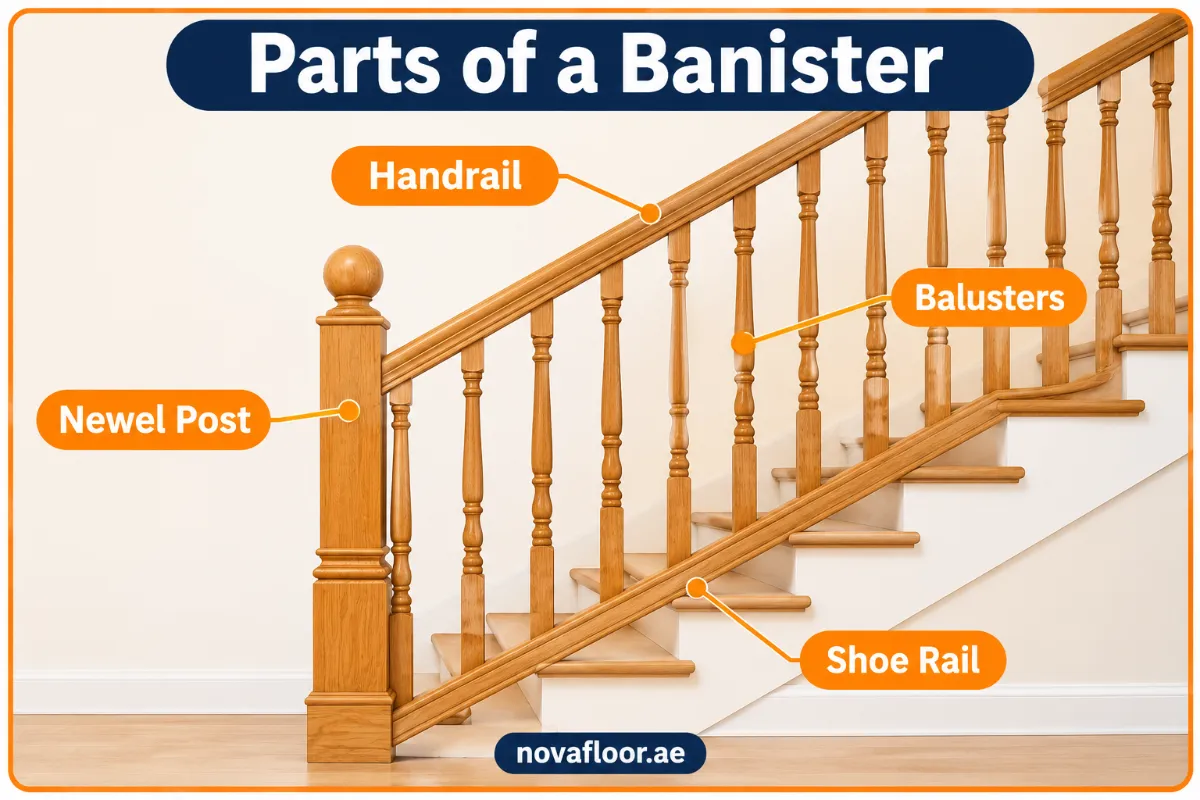
Parts of a banister (know these before you shop)
Many guides mix up these terms. Here’s what each part does.
| Part | What it is | Can you update it on its own? |
| Banister | The whole railing system: handrail, balusters and newel posts together | Yes, part by part |
| Handrail | The sloped rail you hold as you climb | Yes: paint, stain or replace |
| Balusters (spindles) | The vertical bars between the rail and the stairs. “Spindle” usually means a turned, rounded baluster. | Yes: paint or swap |
| Newel post | The thick post at the bottom, top or turns that anchors the rail | Yes: paint, cap, wrap or replace |
| Shoe rail | A grooved strip on the floor or a half wall that holds the bottom of the balusters | Yes: paint or replace |
| Stringer / skirt board | The board running along the side of the stairs | Yes: paint or clad |
| Treads and risers | The steps you stand on and the vertical faces between them | Yes, though that’s a stair update, not a banister one |
| Fillets | Small wood spacers between balusters in a grooved rail | Replaced along with balusters |
| Volute | The curl at the bottom of some handrails | Hard to change; usually kept |
Can You Update a Stair Railing Without Replacing It?
Yes. If the rail and posts are solid, you can update a stair railing without replacing it by painting, staining, swapping the balusters or capping the newel posts. A full replacement only makes sense when the structure is loose, damaged or badly out of line with safety rules.
Use this table to decide how far to go.
| Your situation | Best approach | Typical DIY budget |
| Solid rail, you just hate the colour | Paint or two-tone finish (ideas 1 and 2) | AED 150–550 (USD 40–150) |
| Solid rail, worn or orange wood | Restain or gel stain (idea 3) | AED 150–550 (USD 40–150) |
| Good rail, dated spindles | Replace balusters only (idea 4) | AED 550–2,400 (USD 150–650) |
| Rail is cracked, sticky or the wrong shape | New handrail (idea 5) | AED 300–1,100 (USD 80–300) |
| Chunky or ornate newel post | Cap, wrap or box out the post (idea 6) | AED 75–450 (USD 20–120) |
| Post or rail wobbles, rot, missing fixings | Repair first, then update. Often a pro job. | Get a quote |
| You want glass, cable or a new layout | Full replacement by a professional | From about AED 4,400 (USD 1,200) |
In short, start cheap. You can always paint first and swap the balusters next year.
10 Ways to Upgrade Your Stair Railing on a Budget
The ideas run from cheapest and easiest to the most involved. Each one lists the cost, the time and how hard it is.
1. Paint the Whole Banister
Cost: AED 150–450 (USD 40–120) DIY · Time: 2–4 days with drying · Difficulty: Easy
Paint is the fastest way to update a stair railing without replacing it. White, soft black or a colour that matches your door trim can make a 20-year-old banister look new.
You’ll need: sugar soap or degreaser, 120- and 220-grit sanding sponges, wood filler, painter’s tape, drop cloths, a bonding primer, enamel paint, a 50 mm angled brush and a small foam roller.
- Degrease. Handrails carry years of skin oils, and paint won’t grip them. Scrub the rail twice.
- Scuff-sand. Go over every surface with 120 grit, then 220. You only need to dull the shine, not reach bare wood.
- Fill and tape. Fill dents and old nail holes. Tape the treads, walls and floor.
- Prime. On oak, use a shellac-based or oil-based primer. Oak contains tannins that can bleed yellow through water-based primer.
- Paint two thin coats. Use a durable enamel in satin or semi-gloss so it wipes clean. Sand lightly with 220 grit between coats.
- Let it cure. Check the can. Many enamels feel dry in hours but need several days before heavy hand use.
Pro tip: Short on time? Paint only the handrail and newel posts and leave the balusters. It’s far less work than cutting in around 40 spindles.
UAE tip: Paint with the AC running and a window open for airflow. High humidity slows drying, so avoid days when the house is closed up and damp. Low-VOC enamels from local brands such as Jotun are easy to find.
2. Go Two-Tone: Dark Rail, Light Balusters
Cost: AED 185–550 (USD 50–150) DIY · Time: 3–5 days · Difficulty: Easy to moderate
A two-tone banister adds depth without the cost of new parts. It’s one of the most popular indoor stair railing ideas, because it works in both classic and modern homes.
| Handrail | Newel posts | Balusters | Risers | Best for |
| Stained wood | Stained wood | White | White | Traditional and transitional homes |
| Black | White | White | White | Modern classic, softer contrast |
| Black | Black | Black | White | Bold modern homes with other black accents |
| Stained wood | White | Black metal | White | Modern farmhouse |
Paint the balusters first. Then tape their tops and paint or stain the rail. A black rail looks best when it repeats something else in the space, such as black window frames, a dark front door or dark furniture. In a small, all-white entrance, a soft charcoal is often kinder than pure black.
3. Restain or Gel-Stain the Handrail
Cost: AED 150–550 (USD 40–150) DIY · Time: 3–5 days · Difficulty: Easy to moderate
If you like wood but not the orange tone, change the stain instead of covering it. You have two options.
- Full refinish: Strip or sand to bare wood, stain, then seal with two or three coats of polyurethane. It’s the best result, but slow and messy on turned spindles.
- Gel stain (no stripping): Gel stain sits on top of the old finish, so a light scuff-sand is enough. It’s the better choice for most DIYers.
Gel-stain steps:
- Clean the rail and scuff it with 220 grit.
- Wipe it with a deglosser or mineral spirits and let it dry.
- Wipe on a thin coat with a rag or foam brush, following the grain.
- Let it dry for about 24 hours (check the can), then add a second coat if you want it darker.
- Seal with two or three coats of satin polyurethane. A handrail gets heavy use, so don’t skip the topcoat.
Always test on a hidden spot, such as the underside of the rail. Stains and strippers give off strong fumes, so keep the space ventilated. If you’re also refinishing the treads, match them to your floor. Our guide on how to refinish hardwood floors covers the sanding and sealing steps.
4. Replace Only the Balusters
Cost: AED 550–2,400 (USD 150–650) DIY · AED 3,300–9,200 (USD 900–2,500) hired out · Time: 2–4 days · Difficulty: Moderate
Swapping the balusters gives you the biggest visual change for the money. You keep the handrail and posts, and only the vertical bars change: wood to black iron for a modern look, or ornate iron to simple wood for a calmer one. Individual balusters typically cost USD 3–17 (AED 11–62) each (HomeAdvisor). A typical staircase has 30 to 65 of them.
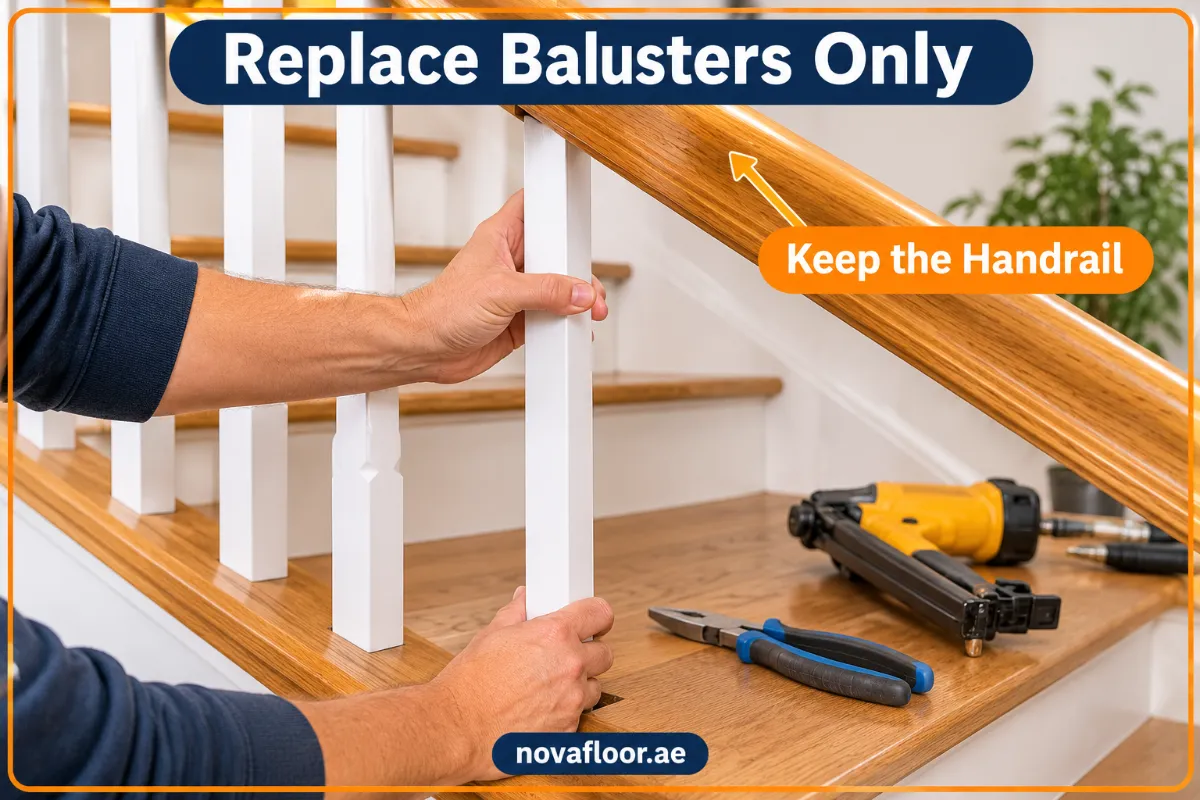
You’ll need: a reciprocating saw (with metal blades for iron), pliers, a drill with a Forstner bit, a mitre saw, a tape measure, a sliding bevel, wood glue or epoxy, a pin nailer and a level.
- Count and measure. Balusters on each step are different heights, so measure every position. Note the hole size in the rail and treads.
- Remove the old ones. Cut each baluster in the middle, then twist out the top and bottom halves. Pliers help break old glue.
- Clean or resize the holes. Drill them clean, or slightly larger with a Forstner bit if your new balusters have thicker pins.
- Paint first. Paint the rail and the new balusters before you install them. It saves hours of cutting in.
- Cut one at a time. Measure, cut, test-fit, then cut the next. Square-topped balusters need the top cut to the stair angle.
- Fix them in. Push the top into the rail hole first, then drop the bottom pin into the tread. Glue both ends and add a pin nail at the top. Iron balusters usually sit in a metal shoe with a set screw, plus epoxy in the hole.
Pro tip: Keep the old spacing so you can reuse the holes, as long as the gaps stay under 100 mm. Any holes you no longer need can be filled with wood plugs, or with colour-matched epoxy putty and a wood-grain marker.
5. Replace or Upgrade the Handrail
Cost: AED 300–1,100 (USD 80–300) DIY · AED 1,500–4,400 (USD 400–1,200) hired out · Time: 1–3 days · Difficulty: Moderate to hard
Replace the handrail if it’s cracked, splintered, too chunky to grip or a curly profile you can’t paint away. A slim, rounded rail of 32–51 mm in diameter is the easiest to hold.
- Support the rail and cut or release the baluster tops.
- Find the rail-to-newel fixing. It’s often a rail bolt or screws hidden under a wood plug.
- Lift the old rail out and use it as a template for length and angle.
- Cut the new rail at the same angles. Pre-drill the screw holes at an upward angle and countersink them so the screws sit flush.
- Fix the rail to the newel posts, refit the balusters and add fillets (spacers) if the rail has a groove underneath.
If your stair has a wall on one side, a wall-mounted rail is often all you need, and it’s a much easier DIY job. See the step-by-step guide below on how to install a stair railing to the wall.
6. Modernise the Newel Post
Cost: AED 75–450 (USD 20–120) DIY · Time: 1–2 days · Difficulty: Easy to moderate
A bulky, ball-topped newel post dates a staircase faster than anything else. You can fix it in three ways.
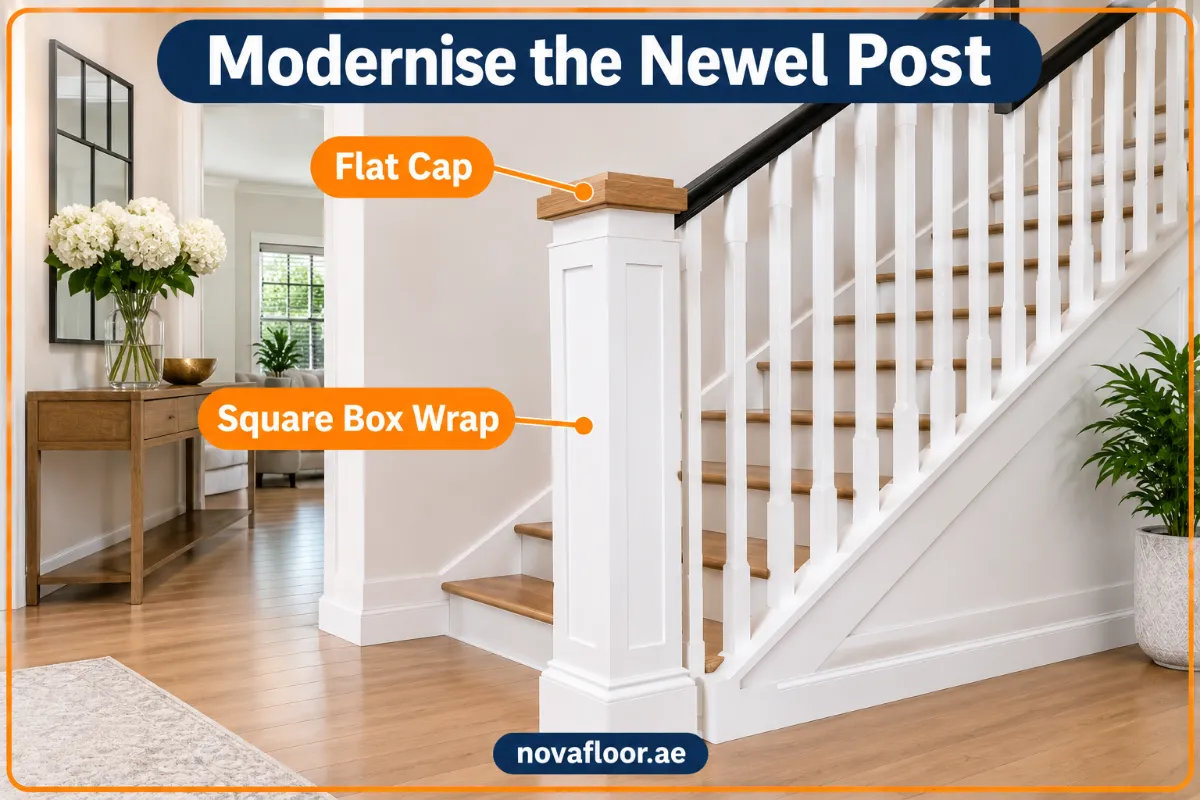
- Cut and cap: Saw off the ball top with a flush-cut saw or an oscillating multi-tool. Sand the top flat and glue on a simple square cap.
- Box it out: Build a square box around the old post with 12–18 mm MDF or pine. It turns a turned post into a clean, modern one.
- Replace it: Swap in a new post. Leave this to a carpenter, because the newel post holds the whole banister steady.
Steps to box out a newel post:
- Check that the post is rock solid. Never wrap a wobbly post; fix the fixings first.
- Measure the widest point of the post and cut four panels to fit around it.
- Glue and pin-nail the panels around the post, overlapping at the corners.
- Notch the bottom panels around the tread nosing, or scribe them to fit.
- Add a base trim and a flat cap with a 10–15 mm overhang.
- Fill the seams and nail holes, sand, prime and paint.
UAE tip: MDF swells if it gets wet. Near an entrance or a wet area, seal every cut edge with primer, or use moisture-resistant MDF or primed pine instead.
7. Cover the Stair Railing Instead of Rebuilding It
Cost: AED 185–1,100 (USD 50–300) DIY · Time: 1–3 days · Difficulty: Easy to moderate
If a part is solid but ugly, cover it. Here’s how to cover a stair railing, part by part.
| Part to cover | How | Good for |
| Metal handrail | A snap-on PVC or vinyl handrail cap | Scratched or cold metal rails |
| Turned newel post | A box wrap (see idea 6) | Dated, curvy posts |
| Solid half wall (pony wall) | Wooden wall panels or slats on the faces, with a wood cap on top | Plain plaster half walls |
| Side of the stairs (stringer) | Paint it to match the trim, or clad it in timber | Messy, patched or mismatched sides |
| Worn treads under the railing | A stair carpet or new tread cladding in engineered wood | Treads that make a new railing look old |
Covering works best on pony walls. A panelled half wall with a solid wood cap reads as a deliberate design choice, not a cover-up. Browse our full range of wall panels for textures that suit a stairwell.
8. Switch to Horizontal or Modern Metal Railing
Cost: About AED 3,000–10,000 (USD 800–2,700) hired out · Time: 2–5 days · Difficulty: Pro job
Horizontal bars, flat-bar steel and slim cable railings give a clean, modern look, and they suit many UAE villas with open-plan stairwells. Treat this as a replacement, not a quick update, because the new railing needs new fixings and a fabricator.
- Material: Choose powder-coated steel or aluminium. In homes near the coast, 316-grade stainless steel holds up better against salty air.
- Price guide: Simple metal handrails cost about AED 200–500 per metre in the UAE, before any infill panels or bars (UAE fabricator price listings).
- Safety first: Horizontal bars can work like a ladder for small children. If you have kids who climb, keep vertical balusters or choose a solid or glass infill.
9. Add Glass or Acrylic Panels
Cost: AED 370–1,500 (USD 100–400) for DIY acrylic on a short run · AED 7,300–22,000 (USD 2,000–6,000) for professional glass · Difficulty: Moderate (acrylic) to pro (glass)
Glass makes a staircase feel open and lets light through. It’s one of the most expensive types of railings for stairs, because of both the materials and the labour.
- Acrylic retrofit: On a short landing or a few steps, you can fit clear acrylic panels between existing posts with clamps or channels. Use thick, impact-rated sheet and fix it on all edges.
- Glass: Always hire a specialist. Guard glass must be safety glass, usually toughened and laminated, and most rules need a handrail on top unless the panels are laminated. In Dubai, the authorities point to the UAE Fire and Life Safety Code for glass in handrails and guards.
10. Cheap Stair Railing Ideas Under AED 500
Not ready for a big project? These small add-ons each cost under AED 500 (about USD 135), and most take an afternoon.
- Paint the risers and stringer white. This frames the wood treads and makes the railing look sharper. About AED 100–200.
- New newel caps. Flat, square caps modernise posts for about AED 40–150 each.
- Decorative tread brackets. Small scroll or square brackets on the side of each step add detail for about AED 15–40 each.
- LED step lights. Plug-in or battery motion-sensor strips under the rail or along the treads add style and make night-time trips safer. From about AED 100.
- A stair runner. A carpet runner softens noise, adds grip and ties the new railing colour into the floor. See our carpet hall runner ideas for pattern inspiration.
- New wall-rail brackets. Swap shiny brass brackets for matt black ones. About AED 20–60 each.
Types of Railings for Stairs: Which One Fits Your Home?
Wood and painted metal are the cheapest railing types to update. Glass and custom metal cost the most. If you’re planning more than a railing update, our guide to the types of staircases explains how the stair shape affects your railing choice.
| Railing type | Look | Relative cost | Upkeep | DIY-friendly? |
| Wood (oak, ash, pine, MDF parts) | Warm, classic, easy to paint or stain | Low | Repaint or reseal every few years | Yes |
| Wrought iron / steel balusters with wood rail | Traditional to modern, depending on the profile | Low to medium | Touch up chips; watch for rust in damp spots | Yes, for baluster swaps |
| Horizontal metal bars | Clean, modern | Medium | Low; powder coat lasts well | No, needs a fabricator |
| Cable | Slim, open, good for narrow stairs | Medium to high | Re-tension cables now and then | No |
| Stainless steel | Sleek, contemporary | Medium to high | Low; wipe clean | No |
| Glass (toughened / laminated) | Open, bright, minimal | High | Frequent cleaning for fingerprints | No |
| Acrylic panels | Glass look on a budget | Low to medium | Scratches more easily than glass | Yes, short runs only |
| Solid half wall (pony wall) | Solid, sculptural, private | Low to medium | Repaint | Yes, for panelling or capping |
For a narrow staircase, choose a slim rail with simple balusters or cable, and mount any wall rail close to the wall. That keeps the most passing space.
How to Install a Stair Railing to the Wall
A wall-mounted handrail is one of the easiest safety upgrades you can make. It’s also a smart addition on stairs that have a banister on one side only. The key is fixing the brackets into something solid.
Cost: AED 150–750 (USD 40–200) for a rail kit and brackets · Time: 2–3 hours · Difficulty: Easy to moderate
You’ll need: a handrail, brackets (one for every 1–1.2 m of rail, plus one near each end), a spirit level, a chalk line or long straightedge, a tape measure, a drill, the right fixings for your wall, a stud or pipe detector and a pencil.
- Check what’s behind the wall. Most UAE homes have block or concrete walls. They hold a handrail well with masonry plugs or anchors and a masonry bit. Gypsum partition walls are hollow, so find the metal studs or use heavy-duty cavity anchors rated for the load. Scan for pipes and cables before drilling.
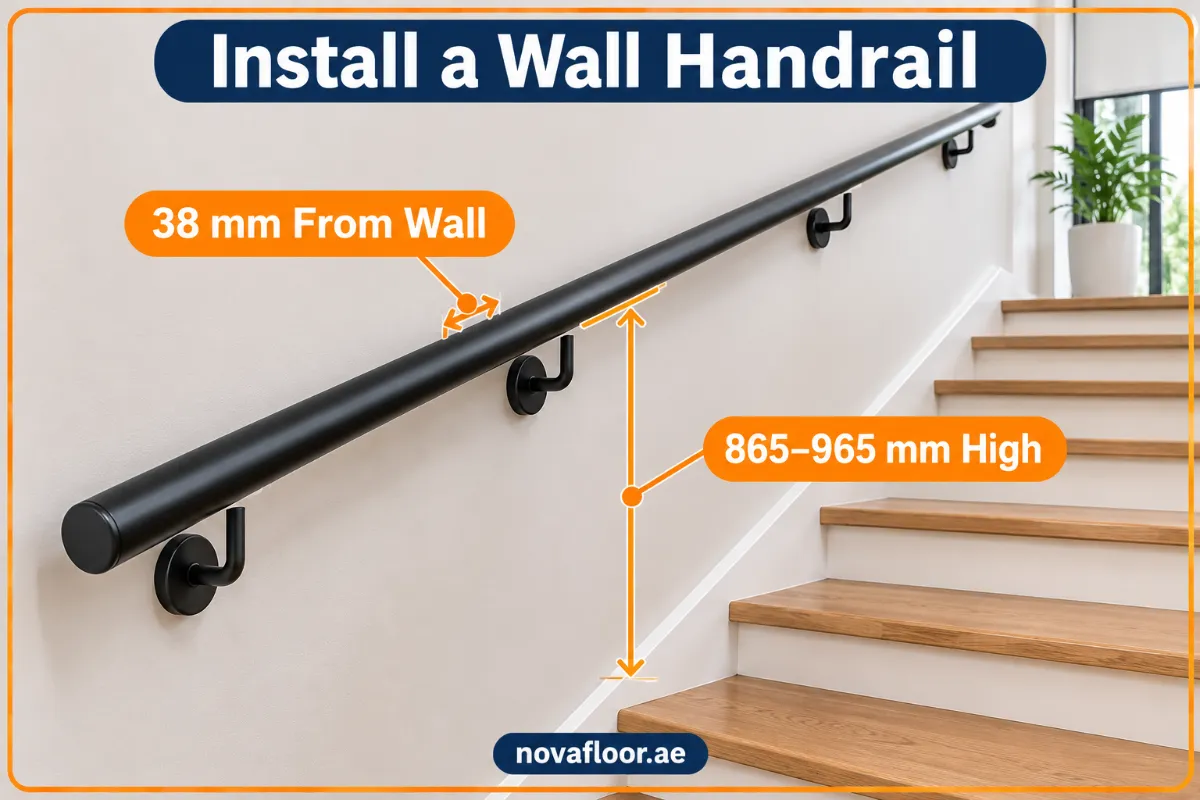
- Mark the height. Measure 865–965 mm (34–38 in) straight up from the front edge (nosing) of the bottom step and the top step. Mark both points.
- Join the marks. Snap a chalk line or draw along a straightedge between them. This is the top of your rail.
- Place the brackets. Hold a bracket with the rail sitting on it, so the rail top meets the line. Mark the bracket holes. Space the brackets no more than about 1.2 m apart.
- Drill and fix. Drill, insert the plugs or anchors, and screw the brackets on tight.
- Cut and mount the rail. Cut the rail to length, then screw it to the brackets from underneath.
- Finish the ends. Add end caps, or better, wall returns that curve the rail back into the wall so sleeves and bag straps can’t catch.
- Test it. Pull and lean on the rail with your full weight. It should not flex or move.
Leave at least 38 mm (1½ in) between the rail and the wall so knuckles don’t scrape.
Stair Railing Safety Rules to Check Before You Start
A banister update must stay at least as safe as the one it replaces. The numbers below are common benchmarks from the US International Residential Code (IRC), which many DIY guides use, alongside Dubai guidance on guard openings. Your local rules come first.
| Check | Common benchmark | Why it matters |
| Handrail height | 865–965 mm (34–38 in) above the stair nosing (International Residential Code) | Easy to grab at the right moment |
| Guard height at landings and open edges | At least 914 mm (36 in) (International Residential Code); often higher in other codes | Stops falls over the side |
| Gaps between balusters | Under 100 mm (Dubai Development Authority guard guidance), close to the IRC’s 4-inch sphere rule | A small child’s head can’t fit through |
| Rail grip size | Round rails about 32–51 mm across | Your hand can wrap around it |
| Gap from the wall | At least 38 mm (1½ in) | Room for knuckles |
| Newel posts | No movement when you push hard | The post holds the whole banister |
| Climbable designs | Avoid horizontal bars where small children live | Horizontal bars work like a ladder |
In the UAE: Villas in Dubai follow the Dubai Building Code (2021), with villa rules in Part K. Abu Dhabi, Sharjah and the other emirates have their own authorities. Painting, staining or a like-for-like baluster swap is cosmetic. If you change the railing’s structure, height or layout, check with your landlord, building management or master developer first, because some communities need a no-objection certificate (NOC) before works start.
One more safety point: strippers, stains and enamels release strong fumes. Ventilate well, wear a mask and gloves, and keep children and pets away until the finish is dry.
How Much Does It Cost to Remodel a Banister?
A DIY banister remodel usually costs AED 150–2,400 (USD 40–650). Professional railing installation averages about USD 900, or AED 3,300 (HomeAdvisor). A standard full replacement runs USD 1,200–4,000, or about AED 4,400–14,700 (US renovation cost guides).
| Upgrade | DIY (materials) | Hired out (supply + labour) |
| 1. Paint the banister | AED 150–450 (USD 40–120) | AED 1,100–2,950 (USD 300–800) |
| 2. Two-tone finish | AED 185–550 (USD 50–150) | AED 1,300–3,300 (USD 350–900) |
| 3. Restain or gel stain | AED 150–550 (USD 40–150) | AED 1,100–3,300 (USD 300–900) |
| 4. Replace balusters (30–65) | AED 550–2,400 (USD 150–650) | AED 3,300–9,200 (USD 900–2,500) |
| 5. New handrail | AED 300–1,100 (USD 80–300) | AED 1,500–4,400 (USD 400–1,200) |
| 6. Newel post update | AED 75–450 (USD 20–120) | AED 550–1,850 (USD 150–500) |
| 7. Cover or panel the railing | AED 185–1,100 (USD 50–300) | AED 1,100–5,500 (USD 300–1,500) |
| 8. Horizontal or modern metal | Not a DIY job | AED 3,000–10,000 (USD 800–2,700) |
| 9. Acrylic or glass panels | AED 370–1,500 (USD 100–400), acrylic only | AED 7,300–22,000 (USD 2,000–6,000) |
| 10. Small add-ons | Under AED 500 (USD 135) | Rarely needed |
| Wall-mounted handrail | AED 150–750 (USD 40–200) | AED 550–1,500 (USD 150–400) |
These are estimates built from 2025–2026 US cost guides, UAE supplier listings and real makeovers. Prices change with your stair length, materials and location, so get two or three written quotes with materials and labour listed separately. Planning a bigger refresh? See our breakdown of what a home remodel costs and our flooring cost guide for Dubai if the treads are getting new flooring too.
Update Stair Railing Before and After: 3 Real Makeovers
These three published DIY makeovers show what each budget level really buys.
| Makeover | What changed | Reported cost | Lesson |
| Oak banister to all-white | New handrail, square balusters at about USD 5 each, newel post boxed out in scrap MDF, alkyd paint | About USD 150 (AED 550), DIY over a few weeks | Reusing the old post and cheap square balusters keeps costs tiny |
| Iron balusters to painted wood | 65 iron balusters swapped for painted wood ones; rail and posts kept and painted | About USD 700 (AED 2,570), DIY | Paint the rail before fitting new balusters, and keep the old spacing |
| Ornate iron to black tapered wood | Custom tapered balusters, rail filled and painted glossy black, stringer painted white | About USD 1,600 (AED 5,875) with professional install, in 2020 | Old baluster holes under the rail need filling, so plan for it |
The pattern is clear: every one of these owners kept the original rail or post, and that’s where most of the savings came from.
6 Banister Remodelling Mistakes to Avoid
- Skipping the degreasing step. Paint peels first where hands touch the rail most.
- Using water-based primer on bare oak. Tannins bleed through as yellow stains. Use a shellac- or oil-based primer.
- Painting after the new balusters go in. Paint the rail and balusters first, then install them, then touch up.
- Ordering balusters before you measure every step. Heights change along the stair, so measure each position.
- Choosing black without a reason. A black rail needs other dark accents nearby, or it can look harsh.
- Not protecting the treads. Cover them well. If drips do land on wood, our guide on how to remove paint from hardwood floors can rescue them.
Frequently Asked Questions
Can you update a stair railing without replacing it?
Yes. If the handrail and newel posts are solid, you can paint or stain them, swap only the balusters, or cap and box out the newel posts. These updates cost a fraction of a full replacement and keep the original structure in place.
How much does it cost to remodel a banister in the UAE?
A DIY banister remodel usually costs AED 150–2,400 (USD 40–650), depending on whether you paint, stain or replace the balusters. Professional work typically starts around AED 1,100 (USD 300) for painting and from about AED 4,400 (USD 1,200) for a full replacement.
Is it cheaper to paint or stain a banister?
The materials cost about the same, roughly AED 150–550 (USD 40–150). Painting is usually faster and hides more damage. Staining keeps the wood grain but needs more careful sanding, unless you use a gel stain over the old finish.
Can I replace balusters without removing the handrail?
Yes. Cut each old baluster in the middle and twist the halves out. Then push each new baluster’s top into the rail hole first and drop its bottom pin into the tread. Glue both ends and add a pin nail at the top.
What is the cheapest way to update a stair railing?
Painting the handrail and newel posts is the cheapest update, often under AED 300 (USD 80) in materials. Painting the risers and stringer white, adding new newel caps or fitting a stair runner are other low-cost changes.
What is the correct height for a stair handrail?
Most codes place a stair handrail 865–965 mm (34–38 in) above the front edge of the steps. Gaps between balusters should stay under 100 mm. In the UAE, check the rules for your emirate, such as the Dubai Building Code for villas.
Start Small, Then Build On It
The best banister remodel is usually the smallest one that fixes what bothers you. Paint this month, change the balusters next year, and keep the solid parts you already have. Once the railing looks new, worn treads stand out, so plan the stairs as one project.
Nova Floor supplies stair carpets, runners, wood flooring and wall panels across the UAE. Take a look at our recent projects, or contact our team to plan the finishing touches for your staircase.

Noah Williams
Interior Designer & Flooring Expert