

Marble looks expensive because it is. It also behaves differently from every other floor in your house. Most marble damage does not come from neglect. It comes from people cleaning it the way they clean tile.
This guide by Nova Floor shows you the safe method, the common mistakes, and the exact fix for each type of damage.
Contents
The Short Answer
Sweep or dust mop first. Mop with warm water and a pH neutral stone cleaner. Wring the mop until it feels barely damp. Rinse with clean water. Dry the floor immediately with a microfiber cloth.
Never use vinegar, lemon juice, bleach, ammonia, or supermarket bathroom cleaners. These etch marble on contact.
That routine handles 90 percent of marble floor care. The rest of this guide covers the other 10 percent, which is where people usually get into trouble.
Why Marble Needs Different Treatment
Marble is calcium carbonate. Acid dissolves calcium carbonate. That is the whole problem in one sentence.
Marble is also porous. Liquids soak in instead of sitting on top. And marble is soft compared to granite or porcelain, so grit under your shoes acts like sandpaper.
Three vulnerabilities, three different types of damage:
| Damage | Cause | How it looks |
| Etching | Acid contact | A dull, lighter, chalky mark |
| Staining | Liquid absorbed into pores | A darker patch |
| Scratching | Grit and abrasion | Fine lines that catch the light |
Each one needs a completely different fix. Treating an etch like a stain wastes your afternoon.
Check Your Floor First (Two Minutes)
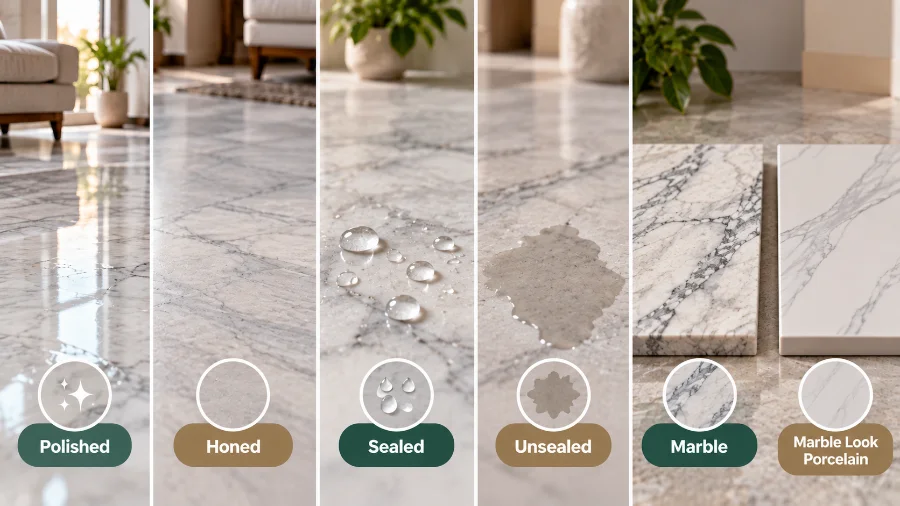
Before you clean anything, learn what you actually have.
Polished or honed? Stand up and look at a lamp reflection on the floor. A sharp reflection means polished. A soft glow with no clear reflection means honed. Honed marble hides scratches and etches far better. It also will never look glossy, so do not try to force shine onto it.
Sealed or unsealed? Put a few drops of water on the floor in a low traffic corner. Wait 15 minutes. If the marble darkens under the water, your sealer has worn off. If the water still beads, you are protected.
Marble or marble look porcelain? Look at four or five tiles side by side. Real marble has a different vein pattern in every tile. Porcelain repeats its pattern every few tiles. Porcelain needs none of the caution below.
Tools and Products You Need
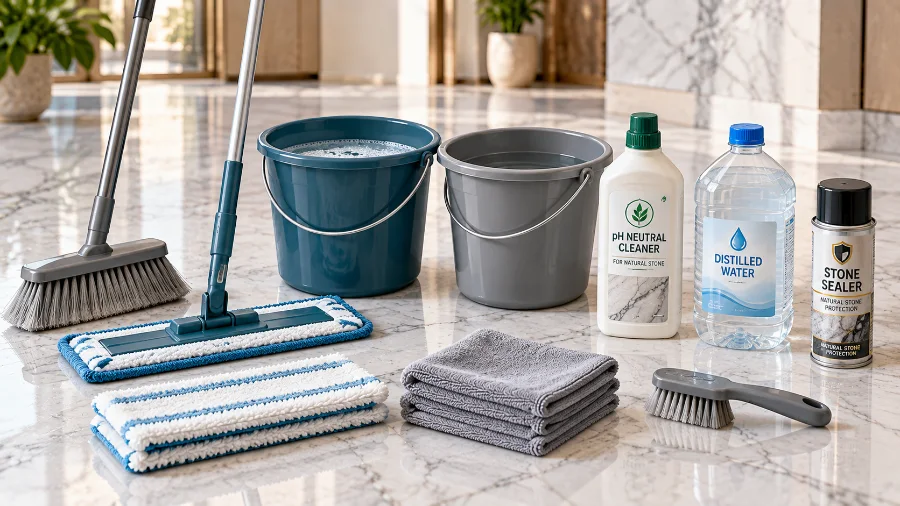
Keep this list short and buy quality once:
- Soft bristle broom or a microfiber dust mop
- Two buckets, one for cleaner and one for rinse water
- Flat microfiber mop with at least two spare pads
- pH neutral cleaner labelled for natural stone
- Several dry microfiber cloths for drying
- Distilled water if your tap water is hard
- Soft nylon grout brush
- Penetrating stone sealer
Check the label before you buy any cleaner. If the bottle does not state its pH and does not say it is safe for natural stone, put it back.
How to Clean Marble Floors | The Daily Routine
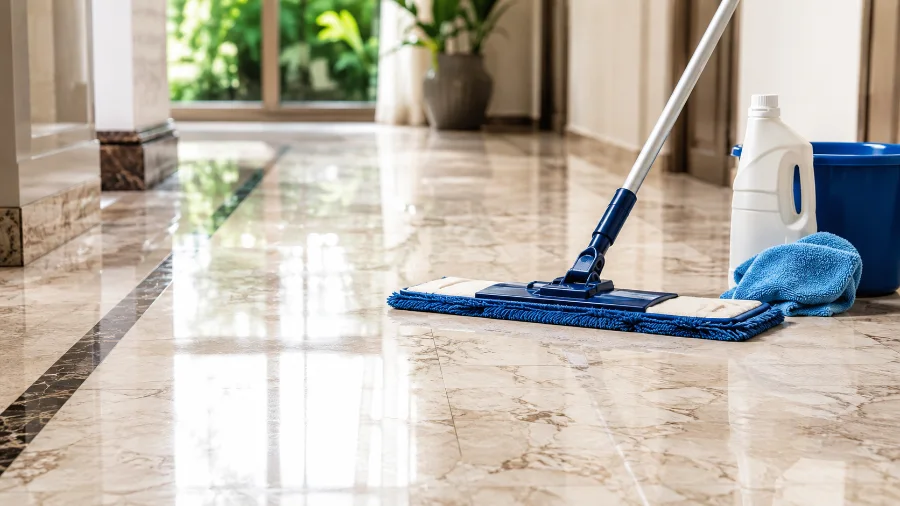
Daily care is short. It is also the part that protects your floor most.
Dust mop every day. Grit is the real enemy. A single grain of sand under a shoe grinds a fine scratch into the surface. A microfiber dust mop lifts it away without pushing it around.
Blot spills within seconds. Do not wipe. Wiping spreads the liquid over more stone. Press a dry cloth straight down and lift. Red wine, coffee, juice, and salad dressing start damaging marble in under a minute.
Use mats at every entrance. A good entry mat catches most of the grit before it reaches the stone.
Put felt pads under furniture legs. Replace them once a year. They compress and collect grit over time.
Daily damp mopping is optional. If your floor sees light traffic, plain warm water on a barely damp microfiber pad is enough between weekly cleans.
Weekly Deep Cleaning, Step by Step
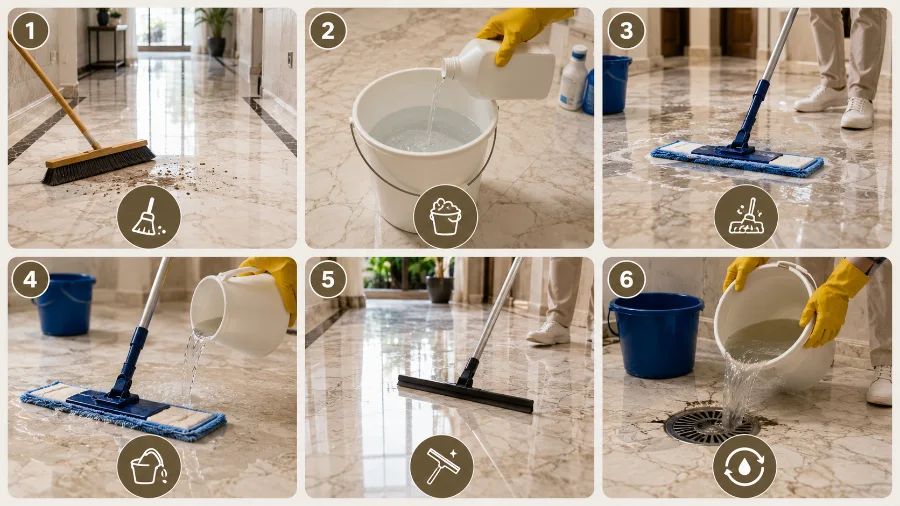
Do this once a week in busy areas and every two weeks elsewhere.
- Clear and sweep. Move rugs and small furniture. Dust mop the whole floor, including edges and corners where grit collects.
- Mix your solution. Fill one bucket with warm water and the amount of pH neutral stone cleaner the label specifies. More cleaner does not clean better. It leaves residue. Fill the second bucket with plain warm water for rinsing.
- Test in a hidden spot. New product, hidden corner, five minutes. Every time.
- Mop in sections. Work in areas of about six feet by six feet. Start at the corner farthest from the door. Dip, wring hard, and mop in an S pattern so you pull dirt forward instead of pushing it back and forth.
- Rinse the same section. Wring a clean pad in the rinse bucket and go over the area again. This step removes the cleaner film that causes streaks and dullness.
- Dry immediately. Run a dry microfiber cloth or dry mop over the section before you move on. Do not let marble air dry. Evaporating water leaves mineral spots.
- Change your water. Once the cleaning bucket looks grey, dump it. Dirty water redeposits soil.
Rinse and wring your pad often. A loaded pad smears rather than cleans.
How to Clean Marble Floors Without Streaks
Streaks are almost always residue, not technique. Track down which residue you have.
Too much cleaner. The most common cause. Excess product dries into a film that catches light. Cut your dose in half and add a rinse pass.
Soap based cleaners. Dish soap and general purpose floor cleaners leave a waxy film on stone. That film builds up over months and dulls the whole floor.
Hard water. Calcium and magnesium in tap water dry into a faint white haze. If you live in a hard water area, use distilled water for the rinse bucket. The difference is immediate.
A dirty mop pad. One pad cannot clean a whole house. Swap pads every two rooms.
Cleaner drying before you wipe. Work in small sections. If the solution dries on the stone, it will streak no matter what you do next.
Fix an existing film: mop the floor with plain warm distilled water only, no product at all. Rinse, dry, and repeat twice. Most cleaner buildup lifts after two or three plain water passes.
How to Clean Marble Floors Naturally
Natural cleaning works well on marble, as long as you understand which pantry ingredients are safe and which are not.
What genuinely works:
- Plain warm water. For everyday cleaning this is the best natural cleaner there is. Marble does not need chemistry to remove dust.
- Distilled water. Removes streaking with zero product.
- A few drops of mild, unscented dish soap in a full bucket. Fine occasionally. Rinse thoroughly afterwards.
- Cornstarch. Excellent at pulling fresh oil out of stone before it becomes a stain.
- 3 percent hydrogen peroxide. Safe on light coloured marble for organic stains and mildew. Test first. It can lighten dark stone.
What people believe works but does not:
- Vinegar. Acidic. Etches marble in under a minute. It appears in countless natural cleaning guides and it will ruin your floor.
- Lemon juice. Same problem, faster.
- Baking soda as a routine cleaner. This one needs a proper explanation, because almost every article recommends it.
Baking soda is mildly abrasive and alkaline. Used as a short poultice on a specific stain, it is acceptable. Used as a regular scrub or all over cleaner, it slowly dulls polished marble and strips your sealer. If you do use it on a stain, reseal that patch afterwards.
Skip these too: essential oils (many are acidic), castile soap (heavy film), and any recipe that combines vinegar with anything.
How to Clean Marble Floors in Bathrooms
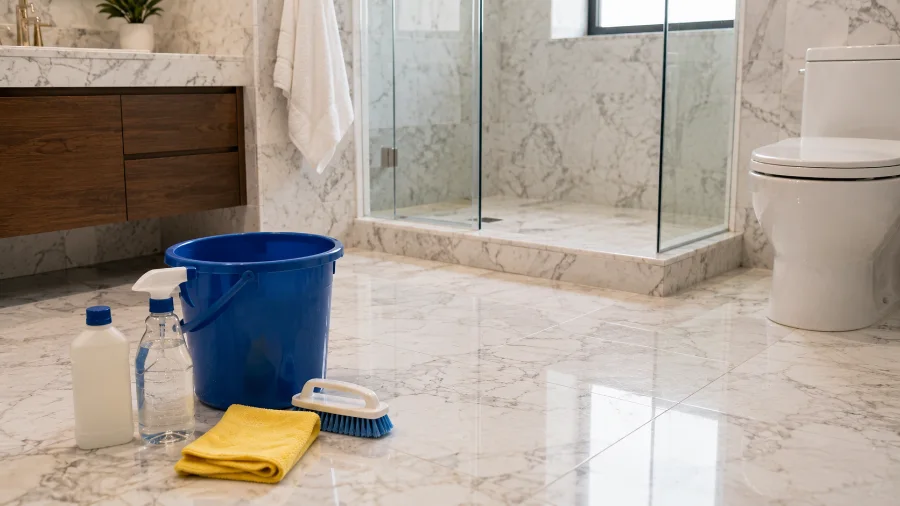
Bathrooms create three problems at once: standing water, soap, and humidity.
Hard water spots. Minerals dry onto the stone and leave a chalky white film. Buff first with a dry microfiber cloth, since light deposits come off with friction alone. For real buildup you need a soap film and hard water remover made specifically for natural stone. These are non acidic. Never reach for a limescale product from the supermarket. Those work by being strongly acidic and will destroy the finish.
Soap scum. Bar soap causes far more scum than liquid body wash. Switching soap is a genuine fix, not a workaround. To remove existing scum, run a hot shower with the door closed for five minutes. The steam softens the waxy layer. Then wipe with a stone safe cleaner and a soft cloth.
Mildew in corners and grout. Spray 3 percent hydrogen peroxide, wait ten minutes, and scrub gently with a nylon brush. Never mix bleach with ammonia. That combination produces toxic gas.
Standing water near the shower and tub. This is what actually damages bathroom marble over time. Keep a small squeegee in the shower. Run the extractor fan during your shower and for 30 minutes afterwards. Put a washable mat where you step out.
Marble shower floors need sealing more often than any other floor in your house. Test them twice a year.
How to Clean Marble Floors and Grout
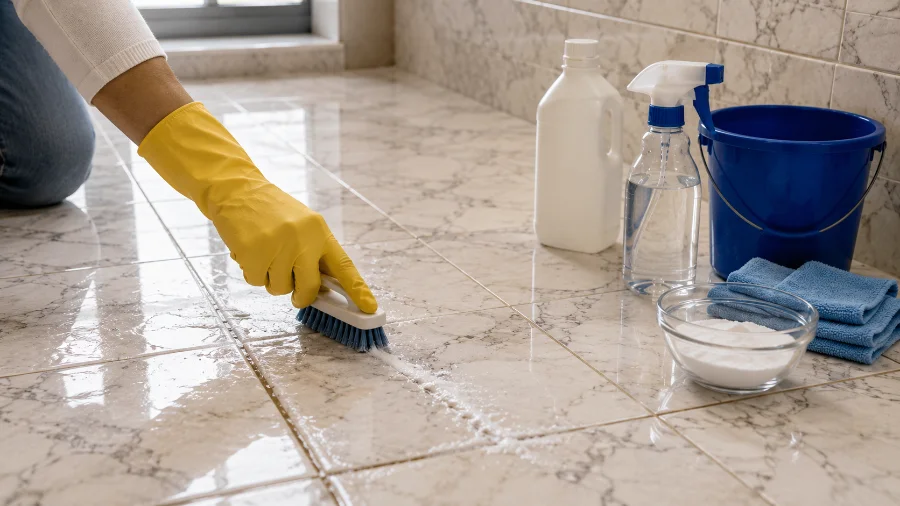
Grout is where most marble floors get damaged, because most grout cleaners are acidic. The cleaner does its job on the grout and etches the marble on either side of it.
Safe method:
- Sweep, then damp mop the floor so you are not grinding dry soil into the joints.
- Make a thick paste from baking soda and water. For stubborn discolouration on light grout, mix the baking soda with 3 percent hydrogen peroxide instead. Mix it fresh. The reaction fades if it sits.
- Apply the paste along the grout lines with a small brush or an old toothbrush. Keep it off the marble face as much as you can.
- Leave it 5 to 10 minutes. Do not let it dry out completely.
- Scrub with a soft nylon brush using light pressure and small circles. Force is not what lifts the soil. Dwell time is.
- Rinse well, ideally with distilled water.
- Dry the whole area with a microfiber cloth straight away.
Never use on marble grout: acidic grout cleaners, oxalic or sulfamic acid products, chlorine bleach on coloured grout, wire brushes, or steel wool.
Seal your grout after a deep clean. Sealed grout stays cleaner and needs scrubbing far less often.
Removing Stains From Marble Floors
A stain sits inside the stone, so surface scrubbing will never reach it. You need a poultice, which is a paste that draws the stain back out.
Identify the stain first:
| Stain type | Examples | Treatment |
| Oil based | Cooking oil, grease, cosmetics, tar | Poultice with acetone or mineral spirits |
| Organic | Coffee, tea, wine, fruit, food | Poultice with 12 percent hydrogen peroxide plus a few drops of ammonia |
| Biological | Mould, mildew, algae | Dilute hydrogen peroxide or ammonia in water |
| Ink | Pen, marker | Light marble: hydrogen peroxide. Dark marble: acetone |
| Rust | Metal furniture legs, nails, cans | Rust poultice made for stone only. Never use acid rust removers |
| Paint | Splashes and drips | Scrape carefully with a plastic blade, then lacquer thinner on small spots |
How to apply a poultice:
- Wet the stained area with distilled water. Damp stone releases stains more easily.
- Mix your absorbent material, which can be talc, baking soda, or shredded white paper towel, with the chosen chemical. Aim for the thickness of peanut butter.
- Spread it about a quarter inch thick over the stain. Extend it an inch past the edges.
- Cover with plastic wrap. Tape the edges down. Poke a few small holes so it dries slowly.
- Leave it 24 to 48 hours.
- Let the paste dry fully, then scrape it off with a plastic scraper.
- Rinse with distilled water and buff dry.
Deep stains often need three or four applications. Each round pulls out a little more. Stop after five attempts and call a stone restoration professional.
Two things to know: a poultice can dull polished marble, so you may need to polish that patch afterwards. And it strips sealer, so reseal the area once it has dried for 24 hours.
Rust stains are the hardest of all. Old rust often never fully leaves the stone.
Etching: Why It Is Not a Stain
This is the distinction almost every guide skips.
A stain is darker than the surrounding stone. An etch is lighter and duller. Crouch down and look across the mark at a low angle. If it catches light differently from the marble around it but is not discoloured, that is an etch.
Etching is not dirt. The acid has physically dissolved a shallow layer of stone. No cleaner will remove it, because there is nothing sitting there to remove. You have to restore the surface.
Common causes: spilled wine or juice, vinegar based cleaners, toilet and tub cleaners, hair products, pet urine left overnight, and acidic drinks knocked over and forgotten.
Fixing light etching yourself:
Buy a marble etch remover, sold as a polishing compound or powder for calcite stone. Apply a small amount to the etched spot. Add a few drops of water. Buff it in circles with a damp cloth for two or three minutes. The mark should fade and the shine should return.
Repeat once if needed. This works on shallow etches only.
When to call a professional: deep etches, large etched areas, etching on honed marble, or anything you can feel with your fingertip. Those need machine honing with diamond abrasives.
Important: sealing does not prevent etching. Sealer blocks absorption. It does not stop an acid from reacting with the stone surface. Anyone who tells you otherwise is selling something.
How to Clean Marble Floors to Shine
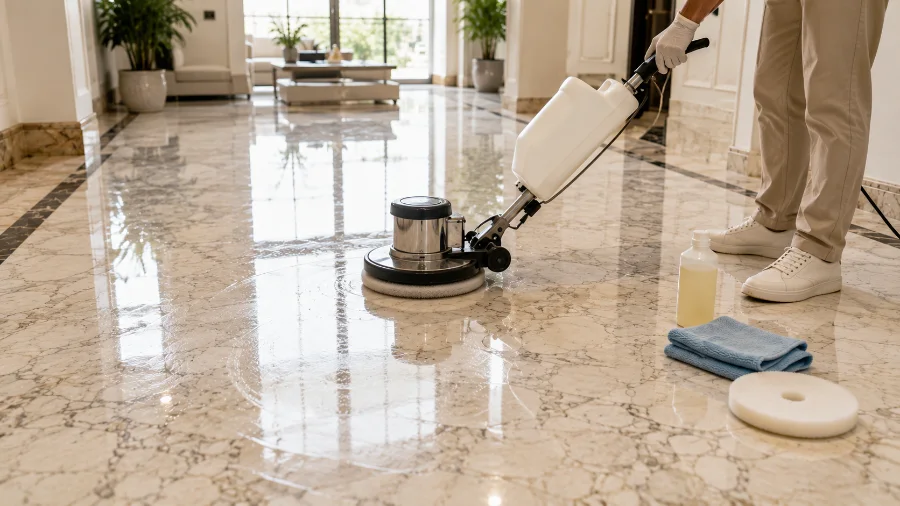
Work through these in order. Most dull floors are not damaged. They are coated.
Step 1: Rule out film. Mop with plain distilled water, rinse, and dry. If the shine improves, your problem was cleaner residue and you are done.
Step 2: Dry buff. Go over the dry floor with a clean microfiber cloth or a buffing pad on a floor machine. This alone restores a surprising amount of gloss.
Step 3: Use marble polishing powder. These powders use tin oxide or aluminium oxide. Mix with water to a slurry, work two or three square feet at a time with a felt pad, then rinse and dry. Do this once or twice a year at most.
Step 4: Book professional diamond polishing. A technician hones the surface with progressively finer diamond abrasives, then polishes to your chosen finish. Most homes need this every three to five years.
Never use floor wax, acrylic sealers, or topical shine products on marble. They build up, yellow over time, and become dangerously slippery. They also trap dirt underneath, and removing them later costs more than the original polish.
If your floor is honed, none of this applies. Honed marble is meant to be matte. Keep it clean, keep it sealed, and let it be.
What Never to Use on Marble Floors
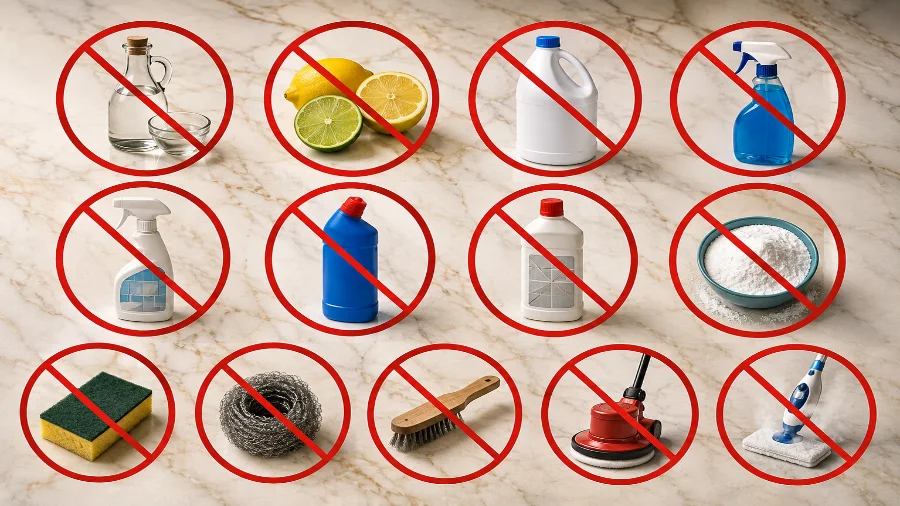
Print this and stick it inside a cupboard door:
- Vinegar and any vinegar based cleaner
- Lemon, lime, or any citrus cleaner
- Bleach and chlorine products
- Ammonia and glass cleaners
- Bathroom, tub, and tile cleaners
- Limescale and rust removers
- Acidic grout cleaners
- Scouring powders and cream cleansers
- Abrasive pads, scouring pads, and steel wool
- Wire brushes
- Floor wax and acrylic polish
- Steam mops, especially on unsealed marble
On steam mops: heat plus forced moisture drives water into the pores and can damage the sealer. Some manufacturers permit them on sealed marble at the lowest setting. Given how easy dry mopping is, the risk is not worth it.
Sealing Marble Floors
What sealing does: it fills the pores so liquids sit on top long enough for you to wipe them up.
What sealing does not do: stop etching, stop scratching, or make the floor bulletproof.
Test before you seal. Drop water on the floor in several spots, including the busiest walkway. Wait 15 minutes. Darkening means it is time to reseal. Beading means wait.
Test annually. High traffic entryways and bathroom floors deserve a check every six months.
Choose a penetrating sealer, also called an impregnating sealer. It cures inside the stone and changes nothing about the look. Avoid topical coatings on floors entirely.
How to apply:
- Deep clean the floor and let it dry for 24 hours. Sealing over dirt locks the dirt in.
- Apply the sealer evenly with a lint free applicator, working in sections.
- Let it soak in for the time on the label, usually 5 to 15 minutes.
- Wipe off all excess before it dries. Leftover sealer dries into a haze that is difficult to remove.
- Apply a second coat if the label recommends one.
- Keep off the floor for 24 to 48 hours while it cures.
Typical frequency: residential marble floors need resealing every one to two years. High traffic and commercial floors need it every six to twelve months. Some dense marbles barely absorb anything and rarely need sealing at all.
Let the water test decide, not the calendar.
Long Term Marble Floor Maintenance
| Frequency | Task |
| Daily | Dust mop. Blot spills immediately. |
| Weekly | Damp mop with pH neutral cleaner, rinse, dry. |
| Monthly | Clean grout lines. Check and replace felt pads. Wash entry mats. |
| Every 6 months | Water test high traffic areas and bathrooms. Inspect for etching. |
| Yearly | Water test the whole floor. Reseal if needed. Polish lightly if dull. |
| Every 3 to 5 years | Professional honing and polishing. |
Habits that add years to a marble floor:
Take shoes off indoors. Heels and grit cause most of the scratching. Trim pet nails. Lift furniture instead of dragging it. Use coasters and trays under anything that can spill. Rotate rugs every few months so the stone underneath ages evenly, since covered marble can hold its colour differently from exposed marble.
Frequently Asked Questions
Can I use dish soap on marble floors? Occasionally and heavily diluted, yes. A few drops in a full bucket, followed by a proper rinse. Used regularly it leaves a film that dulls the stone. A pH neutral stone cleaner is the better default.
Is vinegar safe on marble if I dilute it? No. Dilution slows the reaction but does not stop it. Even weak acid etches calcium carbonate.
Why does my marble floor look cloudy after mopping? Almost always cleaner residue or hard water minerals. Mop twice with plain distilled water and dry with microfiber.
Can I use a robot vacuum on marble? Yes. Use hard floor or mop only mode. Check the wheels and brushes regularly for trapped grit, which is what causes fine scratches.
How do I get scratches out of marble floors? Very light surface scratches sometimes respond to marble polishing powder. Anything you can feel with a fingernail needs professional honing.
Does sealing make marble shiny? No. Penetrating sealers protect without changing appearance. Shine comes from polishing, which is a separate process.
How much does professional marble restoration cost? It varies widely by region, floor size, and condition. Get two or three quotes and ask each company for photos of previous work on floors like yours.
My marble floor turned yellow. What happened? Usually old wax or acrylic polish that has aged. Sometimes iron in the stone oxidising after long term moisture exposure. Both need professional assessment, since the fixes are completely different.
Final Thought
Marble rewards routine and punishes shortcuts. A soft mop, warm water, a stone safe cleaner, and a dry cloth will keep a marble floor looking good for decades.
The single most valuable habit is the fastest one. Blot spills the moment they happen. Almost every serious marble problem starts with a spill that nobody noticed until the next morning.