Noah Williams is an interior designer and flooring expert at Nova Floor. In Dubai, he helps people pick the right floor, get it installed, and keep it looking good. He also writes simple, practical flooring and home care guides for readers in Dubai and around the world.
30 Kitchen Backsplash Ideas for 2027 | Modern, Unique & Easy DIY Styles
Noah Williams
Your backsplash covers a small wall, but it does a lot of work. It blocks grease, water, and sauce. It also sits at eye level, so it shapes how the whole kitchen feels.
The good news is that it is one of the more affordable kitchen upgrades. A typical project costs about $600 to $1,300, with a national average near $1,000 including installation.
This guide covers 30 distinct backsplash ideas. For each one, you will learn where it works best, which cabinets and countertops suit it, and what can go wrong. You will also find a materials comparison, cost ranges, care tips, and the mistakes that cause most regrets.
A note on “2027”: nobody has 2027 data yet. This guide uses the latest survey data from 2026 and labels any forecast clearly as a prediction.
Contents
The Short Answer: Which Backsplash Should You Choose?
If you want a safe, long-lasting choice, pick ceramic or porcelain tile in a simple shape and a neutral color. If you want the most current look, consider a slab backsplash, handmade-look zellige, or a green or blue tile. If you are on a tight budget or rent your home, look at peel-and-stick tile or a fresh coat of grout.
Whatever you choose, start with your countertop. The countertop is the bigger, costlier surface, so the backsplash should support it rather than compete with it.
What the Data Says Heading Into 2027
Two major 2026 industry surveys give the clearest picture of where backsplashes are going.
A national U.S. survey of renovating homeowners found that tile still leads as the top backsplash material at 72%. Slab backsplashes rose to 28%, up from 24% the year before. The same survey found that wood became the most popular cabinet color in renovated kitchens at 29%, edging past white at 28%. That matters because most backsplash advice still assumes white cabinets.
A second survey of 634 kitchen professionals across North America looks further ahead. It covers the styles, colors, and materials expected to shape the next three years. One finding stands out: the backsplash ties with wallpaper as the top place for new statement colors, at 60%.
Our 2027 Outlook (Prediction)
The following is our forecast, not survey data. Because the professional survey spans three years, its findings likely extend into 2027. We expect slab and large-format backsplashes to keep gaining share. We expect more backsplashes designed around wood cabinets, with warm whites, greens, and earthy tones. And we expect color to keep moving onto the backsplash while cabinets and counters stay neutral.
How to Choose a Kitchen Backsplash in 5 Steps
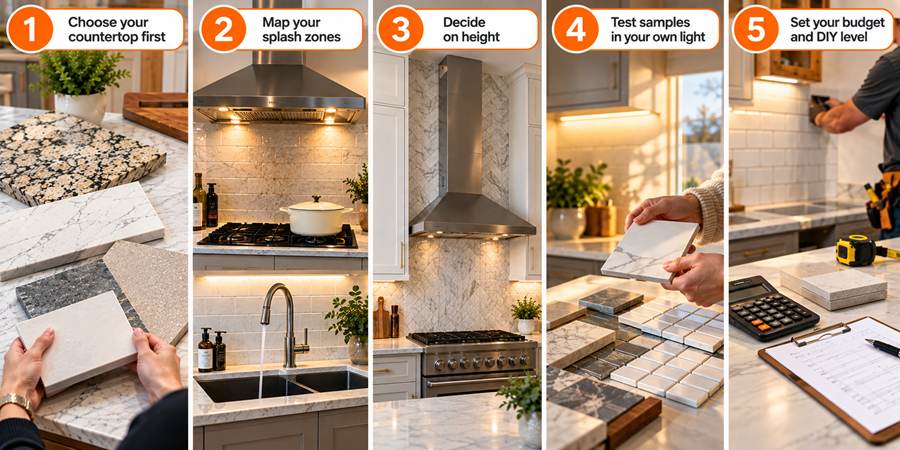
- Choose your countertop first. A busy granite or a heavily veined quartzite needs a quiet backsplash. A plain quartz counter leaves room for pattern or color.
- Map your splash zones. The wall behind the cooktop faces heat and grease. The sink wall faces water. Choose tougher, easy-wipe materials for those two zones.
- Decide on height. A standard backsplash runs from the counter to the bottom of the upper cabinets. On walls with open shelves, a range hood, or no upper cabinets, consider taking it to the ceiling.
- Test samples in your own light. Check samples in morning light, evening light, and under your under-cabinet LEDs. That is when texture and grout color show their true character.
- Set your budget and DIY level. Simple layouts with standard tile are realistic for a careful DIYer. Slabs, glass panels, and natural stone usually need a pro.
Backsplash Materials Compared
The table gives a general guide. Relative cost reflects typical material and installation effort, not exact prices.
| Material | Look | Upkeep | DIY friendliness | Relative cost | Main watch-out |
| Ceramic tile | Classic, wide color range | Low | High | Low | Grout lines need cleaning |
| Porcelain tile or panels | Stone, concrete, or wood looks | Very low | Medium (large panels: low) | Low to high | Large panels need a flat wall and a pro |
| Natural stone (marble, limestone) | Luxurious, unique veining | High | Low to medium | Medium to very high | Acids etch the surface |
| Quartz or quartzite slab | Seamless, no grout | Low | Low | High to very high | Outlet cutouts and seams need planning |
| Glass tile or panel | Glossy, reflective | Low | Medium (panels: low) | Medium to high | Shows smudges; edges can chip |
| Stainless steel or metal | Pro-style, industrial | Low to medium | Low to medium | Medium to high | Scratches and fingerprints |
| Zellige or handmade tile | Irregular, artisanal | Medium | Medium | Medium to high | Uneven surface, natural chips |
| Cement (encaustic) tile | Bold pattern, matte | High | Medium | Medium to high | Needs sealing |
| Peel-and-stick | Imitates tile or stone | Low | Very high | Low | Heat limits near stoves |
| Paint or wallpaper | Any color or print | Medium | Very high | Low | Weak in splash zones |
Timeless Tile With Fresh Layouts
1. Refreshed White Subway Tile
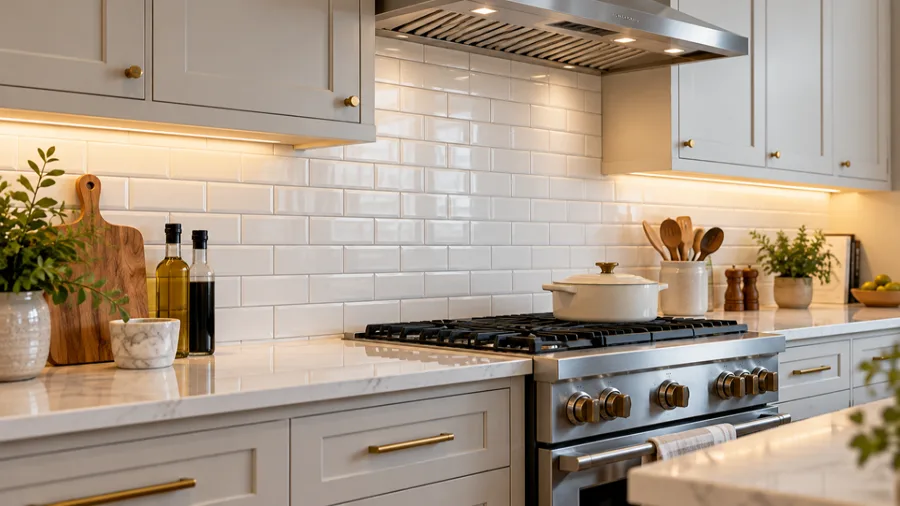
Subway tile has real staying power. It was first made in 1904 for New York City’s new subway walls, and it spread into homes in the 1920s and 1930s. To keep it from looking builder-grade, change one detail. Try a longer 3×12 shape, a handmade edge, a crackle glaze, or a warm white instead of a stark one.
Best for: almost any kitchen, and homes you may sell soon.
Pairs with: white, wood, or painted cabinets and nearly any countertop.
Watch out for: bright white grout on a cooking wall. It stains quickly. A soft gray or warm beige grout hides more.
2. Vertical Stacked Tile
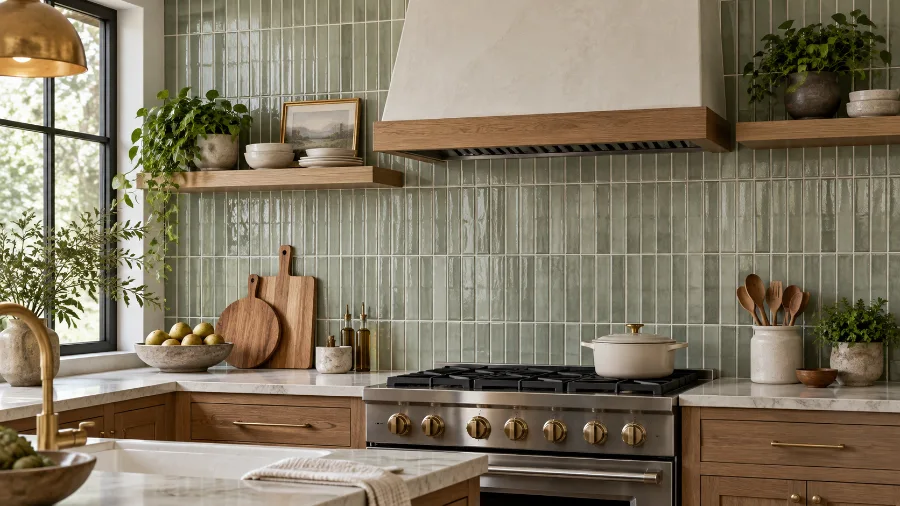
Stack rectangular tiles vertically in straight columns, with no offset. The lines draw the eye up, which helps rooms with low ceilings. The look is clean and modern.
Best for: modern and minimalist kitchens.
Pairs with: flat-panel cabinets, solid quartz, and slim hardware.
Watch out for: layout errors. A stacked grid shows every crooked line and uneven wall. It is less forgiving for DIY than a classic offset pattern.
3. Herringbone on the Range Wall
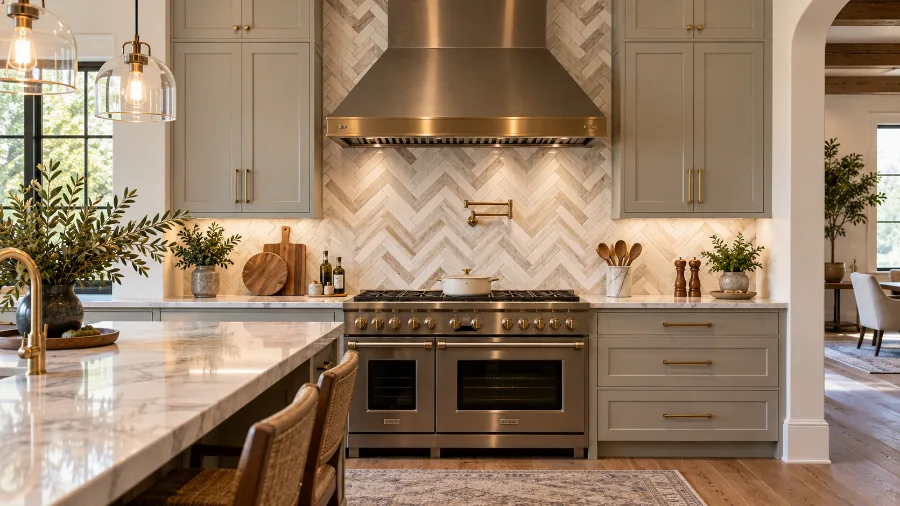
Herringbone adds movement without adding color. Use it on the range wall only to limit visual noise. That keeps the pattern as a focal point while the rest of the kitchen stays calm.
Best for: farmhouse, transitional, and classic kitchens.
Pairs with: shaker cabinets and plain or softly veined counters.
Watch out for: cost and waste. Herringbone needs many angled cuts, so labor rises and you need more spare tile. Ask your installer how much extra to order.
4. Picket Tile
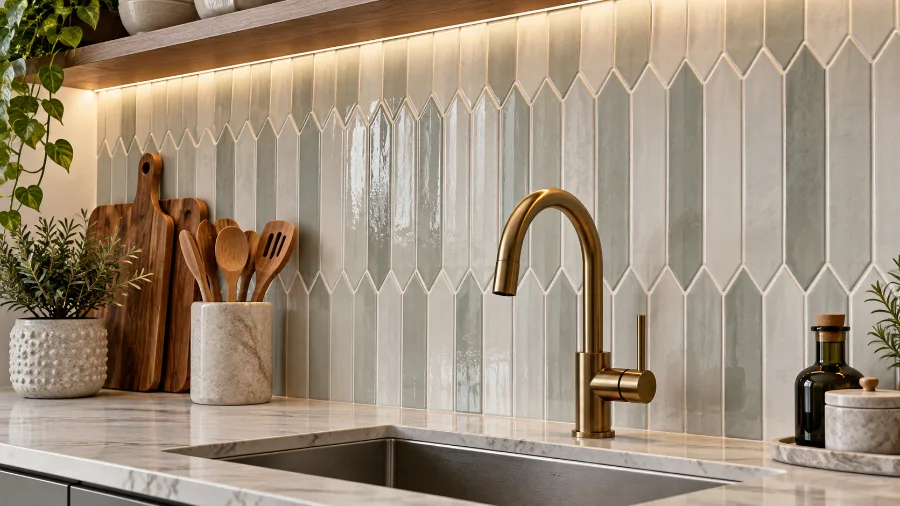
Picket tile is a long tile with pointed ends, like a fence picket. It works as a modern twist on subway tile and keeps a clean, structured look. You get a subtle pattern without a busy effect.
Best for: kitchens that want a little more personality than subway tile.
Pairs with: white or light wood cabinets and white quartz.
Watch out for: edges. The pointed ends leave jagged gaps at the boundaries, so plan finishing trim or careful cuts.
5. Zellige and Handmade-Look Tile
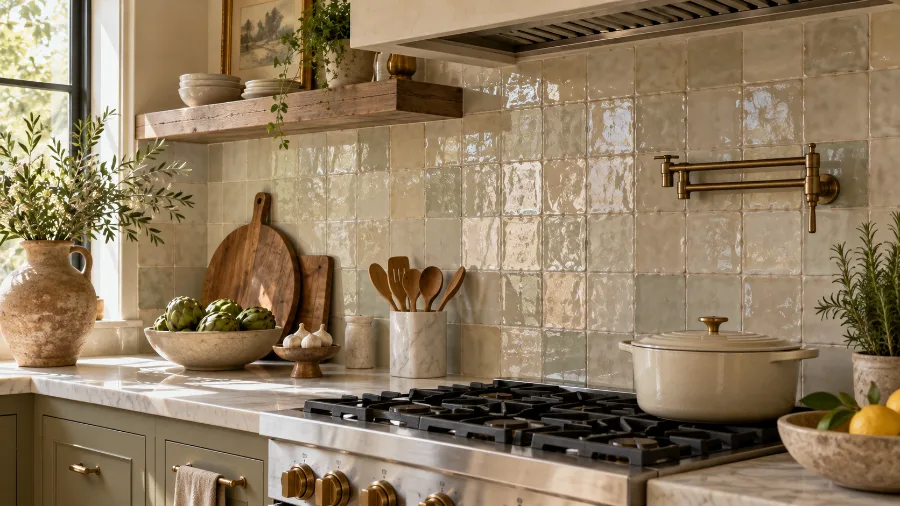
Zellige is glazed clay tile with an uneven surface and color shifts from tile to tile. Light bounces off it in many directions, which adds movement without loud pattern. Warm white grout softens the color shifts. A straight stack layout keeps the wall calm.
Best for: simple kitchens that need warmth and texture.
Pairs with: wood or painted cabinets and quiet, solid counters.
Watch out for: irregularity. Real zellige has chips and uneven edges by design. If you want a cleaner finish, choose a zellige-look porcelain or ceramic.
6. Plain Tile With Contrasting Grout
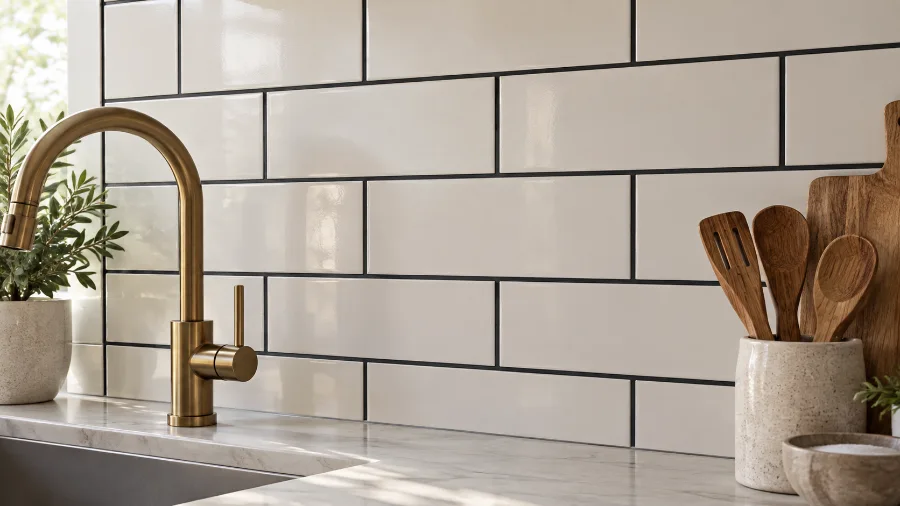
This is one of the cheapest ways to change a look. Pair white tile with charcoal grout, or green tile with cream grout. The grout turns a plain tile into a graphic grid.
Best for: budget remodels and industrial or farmhouse styles.
Pairs with: black hardware, butcher block, or concrete-look counters.
Watch out for: layout flaws. Dark grout highlights every uneven gap. Make a small sample board first to check the effect.
Stone, Slab, and Stone-Look Ideas
7. Full-Height Countertop Slab
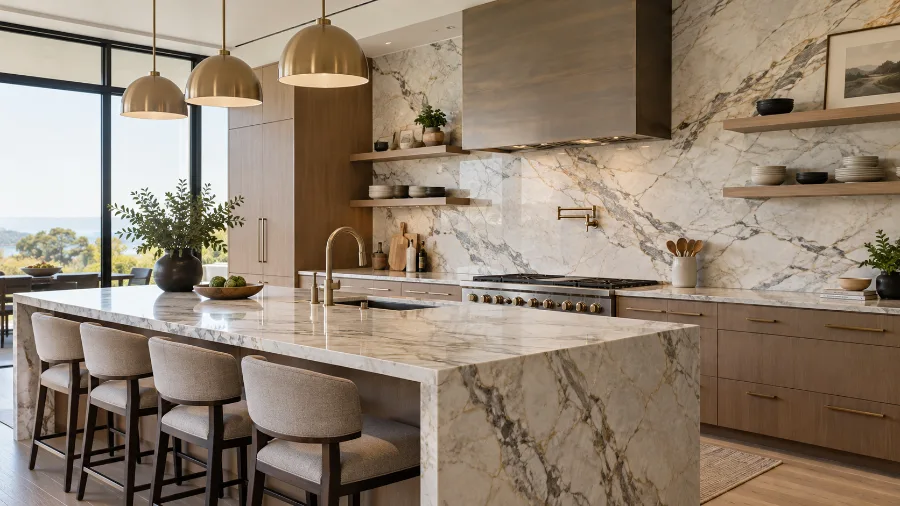
A slab backsplash, often called a “countersplash,” runs the countertop material up the wall. The result has no grout and few seams. Its share grew in the 2026 survey data above.
For a polished result, bookmatch the slabs so the veining mirrors itself. Use a full-height piece behind the cooktop with side returns. Keep seams away from the sink splash zone.
Best for: open-plan and luxury kitchens.
Pairs with: quartz or quartzite counters and wood or flat-panel cabinets.
Watch out for: cost and planning. Outlets, switches, and the range hood all need exact cutouts. Decide on these before fabrication.
8. A Bookmatched Slab Behind the Range Only
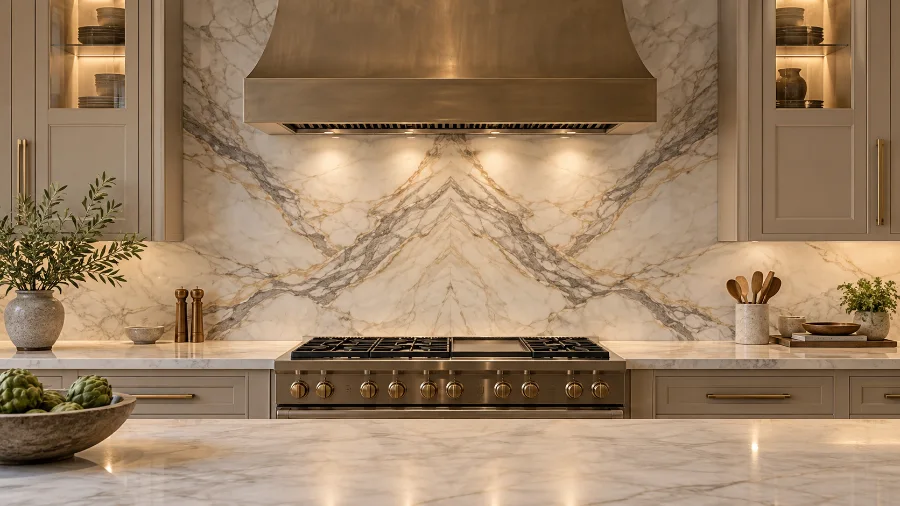
You do not need slab on every wall. Put one dramatic stone panel behind the range, then use simple tile or paint elsewhere. You get the luxury look with a fraction of the material.
Best for: kitchens with a strong range-and-hood focal point.
Pairs with: a matching or quieter countertop and simple cabinet hardware.
Watch out for: hood placement. The hood and panel must line up. Confirm hood dimensions before cutting the stone.
9. Honed Marble Tile
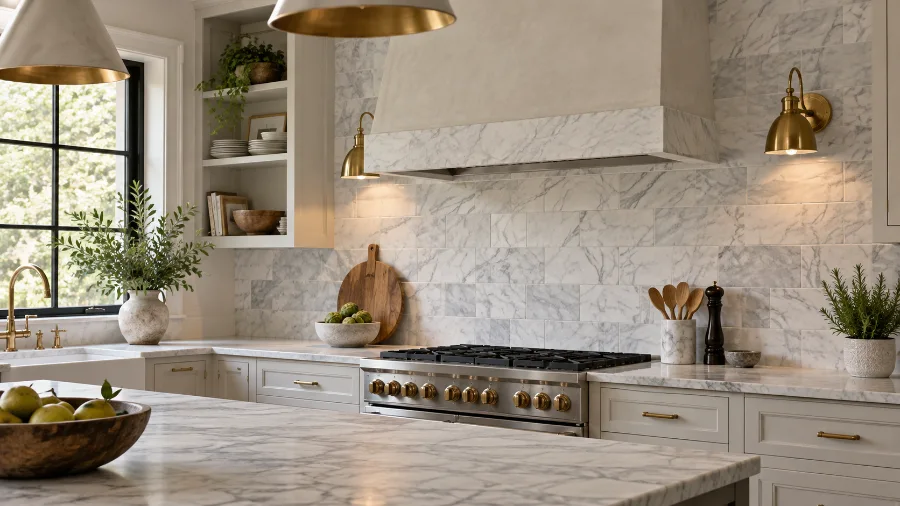
Marble subway, marble mosaics, or marble herringbone add a soft, classic look. A honed finish shows fewer marks than a polished one.
The trade-off is care. A penetrating sealer helps marble resist stains, but it cannot stop acids from etching the surface. Lemon juice, vinegar, and tomato sauce can leave dull spots.
Best for: classic and luxury kitchens where patina is welcome.
Pairs with: white or painted cabinets and marble or white quartz counters.
Watch out for: acidic cleaners and splashes. If you want zero etching, choose marble-look porcelain instead.
10. Marble-Look Large-Format Porcelain
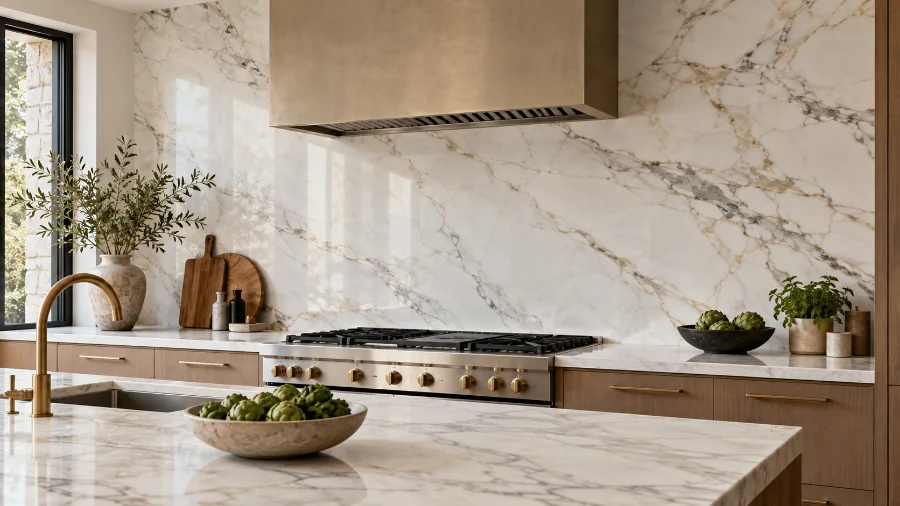
Large porcelain tiles or panels give you a marble look with much less upkeep. Fewer grout lines mean less cleaning, and big surfaces can make a kitchen look larger.
Best for: busy cooks who love marble but not its maintenance.
Pairs with: quartz counters and white, gray, or wood cabinets.
Watch out for: installation. Big panels are heavy and need a flat wall. Most homeowners should hire a pro.
11. Limestone or Travertine
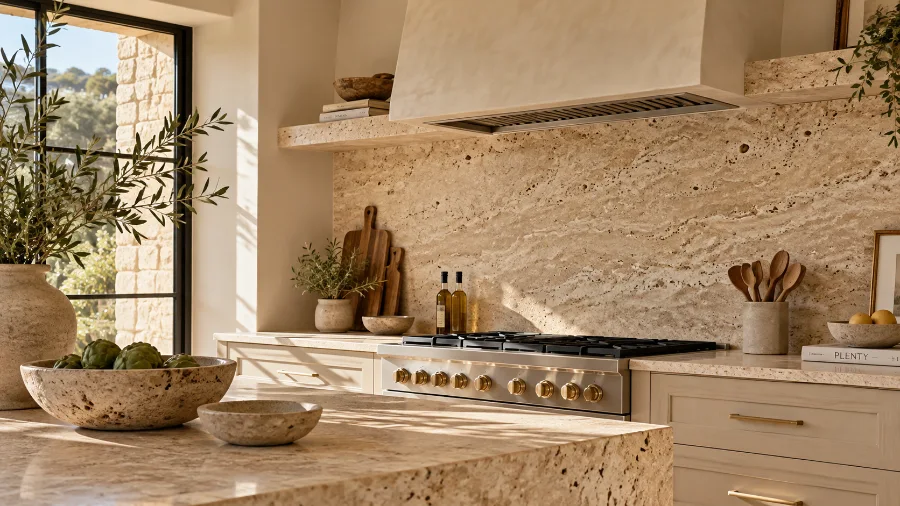
These soft, warm stones suit kitchens with wood, plaster, and natural textures. They look calm and organic, which fits the earthy direction in recent trend reports.
Best for: rustic, Mediterranean, and European-style kitchens.
Pairs with: wood cabinets, butcher block, or honed stone counters.
Watch out for: porosity and acids. Like marble, limestone is calcium-based, so acids etch it even when sealed. Seal it and use a pH-neutral stone cleaner.
12. Concrete-Look Porcelain
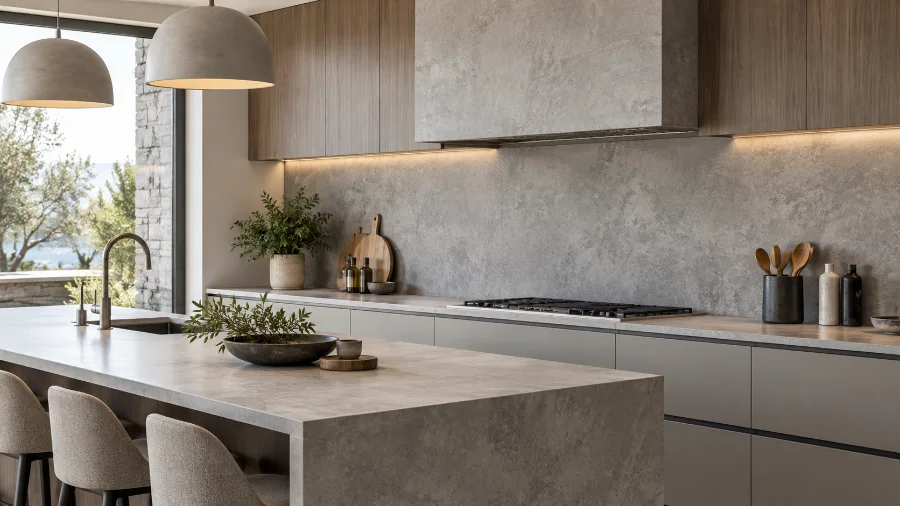
Concrete-look porcelain gives a soft, matte, industrial look without real concrete’s cracking and staining risks. White cement-look surfaces feel minimal but still show subtle texture.
Best for: modern, industrial, and minimalist kitchens.
Pairs with: flat-front cabinets, stainless appliances, and solid quartz.
Watch out for: a cold feel. Add warmth with wood shelves, brass, or warm lighting.
Color-Forward Backsplash Ideas
13. Green Tile With Wood Cabinets
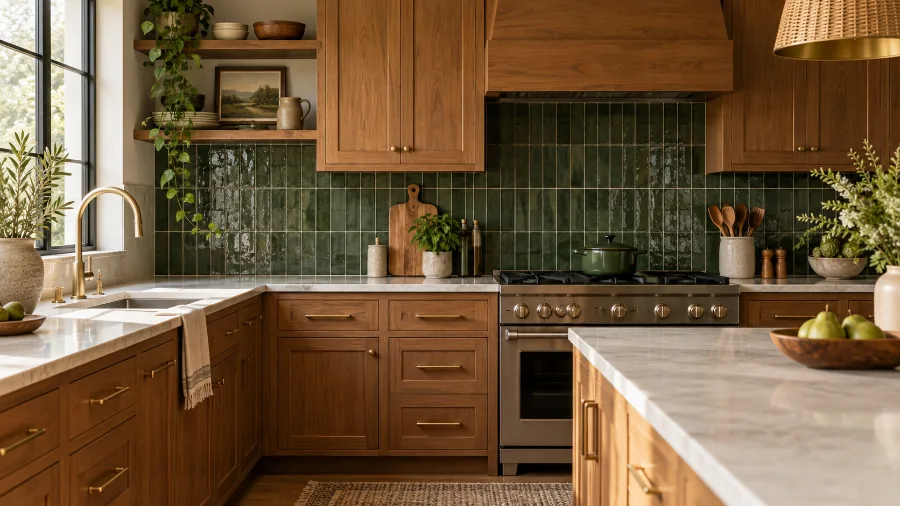
Green and wood make a natural pairing. With wood cabinets now leading in the 2026 survey data, a green backsplash is an easy way to add color. Sage feels soft. Olive feels earthy. Deep forest green feels rich.
Best for: warm modern, cottage, and rustic kitchens.
Pairs with: white oak or walnut cabinets, warm white quartz, and brass hardware.
Watch out for: lighting shifts. Greens can look gray or yellow under some LEDs. Test samples under your actual bulbs.
14. Blue Tile With White Cabinets
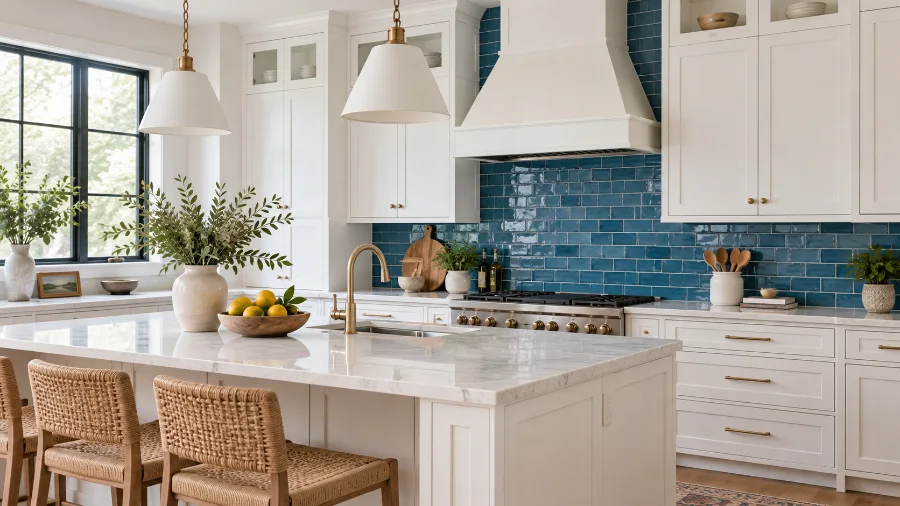
Blue is a classic partner for white cabinets. Handcrafted texture and tonal variation in blue tile add depth while keeping a calm feel. Navy reads formal. Cobalt reads bold. Pale blue reads coastal.
Best for: coastal, transitional, and classic kitchens.
Pairs with: white cabinets, white quartz or marble, and brass or polished nickel.
Watch out for: clashing with busy counters. Saturated blue works best with plain or softly veined surfaces.
15. A Black Backsplash
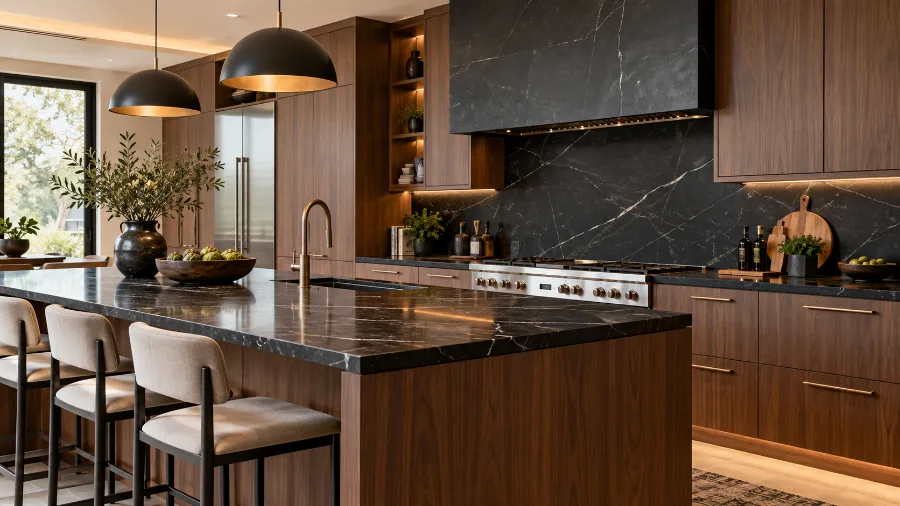
A black backsplash creates instant drama. Matte black tile, honed black stone, or black zellige all work. With white cabinets, the dark wall adds depth while the cabinetry keeps the room bright.
Best for: modern and luxury kitchens with good light.
Pairs with: white or light wood cabinets and white or black counters.
Watch out for: visible residue. Dark surfaces show water spots, flour, and dried grease. Glossy black also shows streaks. Add strong under-cabinet lighting so the wall does not feel like a hole.
16. Warm Gray Tile
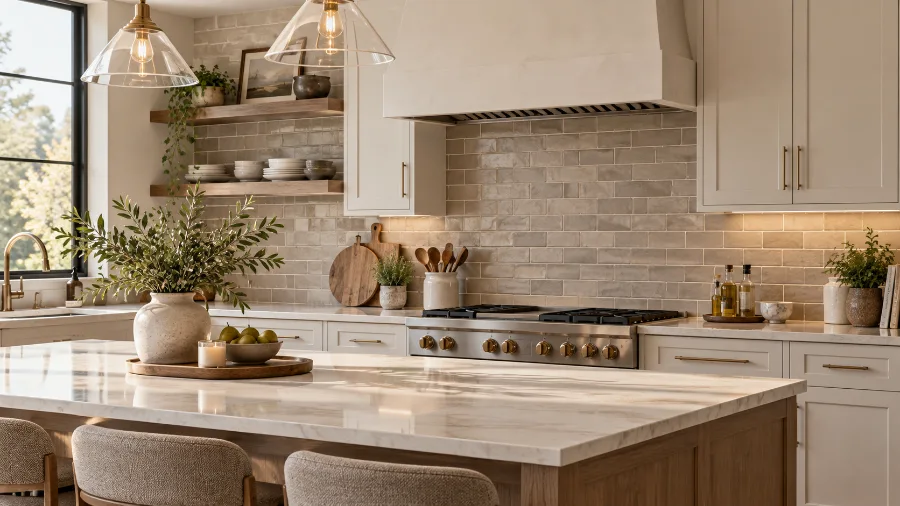
Gray bridges light and dark. Light gray subway tile gives quiet contrast with white cabinets. Gray marble mosaics pair well with stainless steel.
Best for: transitional kitchens and kitchens with stainless appliances.
Pairs with: white or gray cabinets and white or gray-veined counters.
Watch out for: cool grays next to warm wood. They can look flat. Choose a warm gray or greige if your cabinets or floors are wood.
17. Earthy Neutrals and Terracotta Tones
Sand, clay, cream, and terracotta bring a sunny, grounded feel. They suit the shift toward organic, earthy kitchens in recent trend reports.
Best for: Mediterranean, Spanish, farmhouse, and warm modern kitchens.
Pairs with: wood or cream cabinets, butcher block, and warm stone.
Watch out for: real terracotta’s porosity. It needs sealing. Terracotta-look porcelain gives the color with far less upkeep.
18. A Single Band of Color
Love color but fear commitment? Add one narrow stripe of colored tile within a neutral backsplash. It adds interest without overwhelming the kitchen.
Best for: budget remodels and cautious color lovers.
Pairs with: almost any cabinet and counter.
Watch out for: placement. Line the band up with a window sill, shelf, or outlet row so it looks planned, not random.
Pattern and Shape Ideas
19. Soft-Contrast Checkerboard
Checkerboard is back, but softer. Instead of black and white, try cream and sage, or two shades of blue. Small squares feel playful. Larger squares feel calmer.
Best for: cottage, retro, and eclectic kitchens.
Pairs with: simple shaker cabinets and solid counters.
Watch out for: busy small kitchens. High contrast can crowd a small room. Center the pattern carefully so cut tiles at the edges look even.
20. Encaustic and Patterned Tile
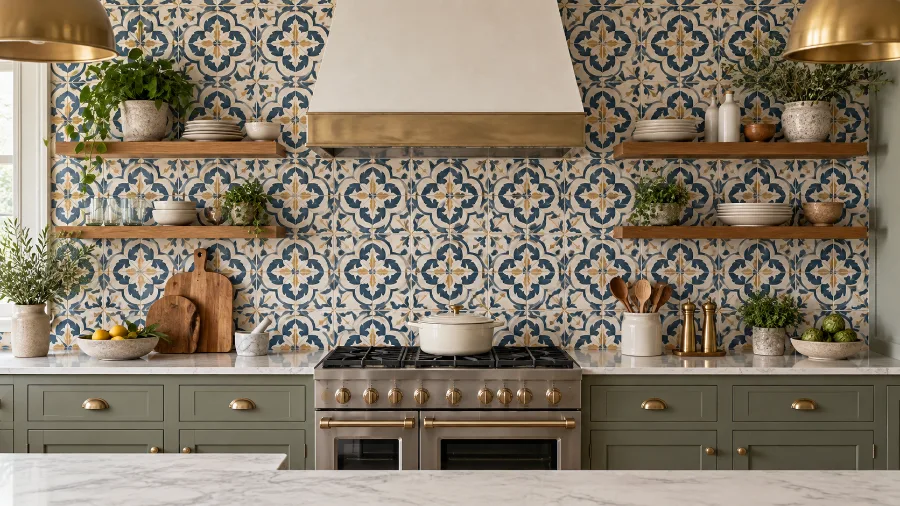
Pattern tile gives a kitchen an old-world or graphic feel. Authentic encaustic tile is handmade from cement. It is not waterproof, so it needs routine sealing. Encaustic-look porcelain gives the same pattern with less maintenance.
Best for: Spanish, Mediterranean, and eclectic kitchens.
Pairs with: solid-color cabinets and plain counters.
Watch out for: competing patterns. Keep the countertop and floor quiet. For a cooking wall, porcelain look-alikes are easier to keep clean.
21. Fish Scale Tile
Fish scale (scallop) tile adds soft curves to a room full of straight lines. A glossy glaze makes the pattern shimmer.
Best for: coastal, cottage, and whimsical kitchens.
Pairs with: white or pastel cabinets and white counters.
Watch out for: edges. The curved shapes are harder to finish neatly at corners and cabinet ends. Plan trim pieces before you start.
22. Hexagon and Penny Round Tile
Small hexagons and penny rounds give a vintage, retro feel. Both usually come on mesh sheets, which speeds installation.
Best for: vintage, farmhouse, and bistro-style kitchens.
Pairs with: white or colored cabinets and simple counters.
Watch out for: grout volume. Tiny tiles mean many grout lines and more scrubbing. Consider stain-resistant grout, especially near the stove.
23. Fluted, Ribbed, and 3D Tile
Textured tile creates depth through light and shadow. Even an all-white kitchen gains architectural interest.
Best for: coffee bars, beverage stations, and low-splash walls.
Pairs with: flat-panel cabinets and solid counters.
Watch out for: grease. Grooves and ridges trap splatter. Avoid placing them directly behind a cooktop.
Beyond Tile
24. Glass Tile or a Back-Painted Glass Panel
Glass reflects light and wipes clean easily. It also resists water and fire, which makes it practical in a kitchen. A single back-painted glass panel removes grout entirely. For budgeting, a glass tile backsplash typically costs about $900 to $1,500 installed for an average-size wall.
Best for: modern kitchens and small, dark kitchens that need brightness.
Pairs with: glossy or flat-panel cabinets and solid quartz.
Watch out for: smudges and chipped edges. Panels need precise templating and outlet cutouts, so hire a pro.
25. Stainless Steel Behind the Stove
Stainless steel gives a professional, restaurant-style look. It does not burn, and it wipes clean. Installed metal backsplashes typically range from about $900 to $3,000.
Best for: serious cooks and industrial or modern kitchens.
Pairs with: stainless appliances, concrete-look counters, and dark or wood cabinets.
Watch out for: scratches and fingerprints. A brushed finish hides marks better than a mirror finish.
26. Thin Brick for Farmhouse and Rustic Kitchens
Thin brick veneer gives the look of an old brick wall without the weight. Brick adds character and contrasts well with modern cabinetry. It is also fairly affordable, at roughly $500 to $700 installed for a typical backsplash.
Best for: farmhouse, rustic, and industrial kitchens.
Pairs with: white or wood cabinets, butcher block, or soapstone-look counters.
Watch out for: the rough, porous surface. It holds grease and stains. Seal it well, and consider a smoother material directly behind the cooktop.
27. Mirror Backsplash in a Small Kitchen
A mirror backsplash bounces light and makes a narrow kitchen feel wider. It typically costs about $480 to $780 installed. Antiqued or smoked mirror hides splashes better than clear mirror.
Best for: small galley kitchens and kitchens with few windows.
Pairs with: dark or wood cabinets and simple counters.
Watch out for: splashes and heat. Every spot shows. Keep the mirror away from the cooktop, and ask your installer whether the product suits areas near heat.
Budget-Friendly and DIY Ideas
28. Peel-and-Stick Tile
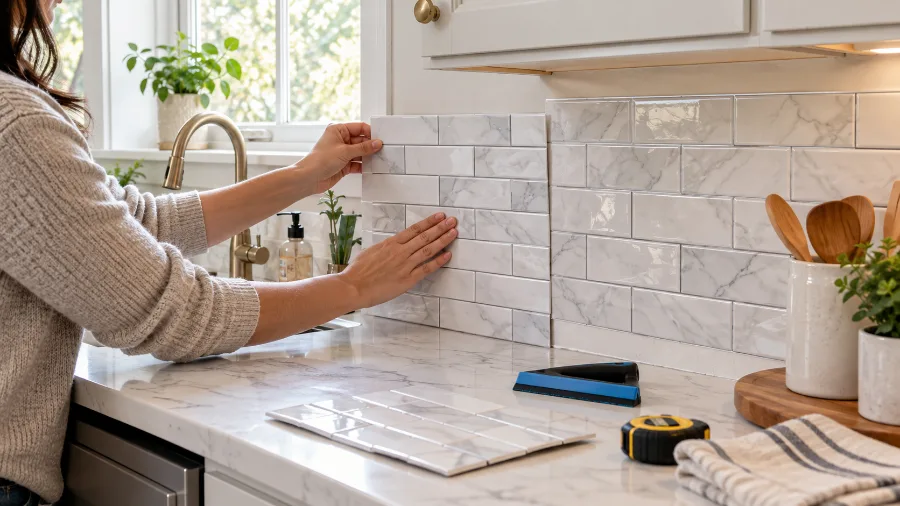
Peel-and-stick tile is the easiest DIY backsplash. It skips the mortar, tile saws, and installer fees. That makes it a strong choice for renters and homeowners on a budget.
Follow the maker’s safety rules near your stove. One popular brand’s instructions say that behind a gas range without a protective rear panel, you should leave 8 inches (20 cm) of clear space above the cooktop. They also call for at least 2 inches of space from side walls next to the range and from countertop appliances like toaster ovens. The same brand says to wait three weeks after painting a wall, and not to install on unprimed drywall. Its warranty also requires that the tiles stay below 120°F (49°C). Other brands may set different limits, so read yours.
Best for: renters, quick refreshes, and first-time DIYers.
Pairs with: any cabinet; choose a design that suits your countertop.
Watch out for: close-up realism and heat. Many products look less convincing up close, and all have heat limits.
29. Scrubbable Paint or Wallpaper on Low-Splash Walls
Paint and wallpaper are the cheapest way to change a wall. Waterproof paint and peel-and-stick wallpaper are both easy, non-tile options.
Best for: walls away from the stove and sink, coffee nooks, and rentals.
Pairs with: any style; wallpaper adds pattern that tile cannot easily match.
Watch out for: splash zones. Paint and paper wear quickly behind a cooktop or sink. Combine them with a tile or glass panel in those spots.
30. Refresh Instead of Replace
If your current tile is sound, you may not need a new backsplash. Deep-clean and regrout, or apply a grout colorant to change the grout color. Some peel-and-stick products can also go over existing tile, as long as the surface is smooth, clean, and dry.
Best for: dated but intact tile and tight budgets.
Pairs with: your existing cabinets and counters.
Watch out for: hidden damage. Loose or cracked tiles, or soft drywall behind them, mean you need a real repair first.
Backsplash Advice by Location and Layout
Behind the Stove
This wall takes the most heat and grease. Choose non-combustible, easy-wipe surfaces: glazed ceramic, porcelain, stainless steel, glass, or a sealed slab. Avoid deep grooves, rough brick, and unsealed stone directly behind the burners. If you love a fragile material, use it elsewhere and keep the range wall practical. Take the backsplash up to the hood if you can, since grease spatters higher than the standard height.
Around the Kitchen Sink
This wall takes the most water. Porcelain, glazed ceramic, quartz, and glass all handle moisture well. Seal natural stone. Caulk, rather than grout, the joint where the backsplash meets the counter, since that joint moves slightly. With a slab, keep seams away from the sink area.
Small Kitchens
In a small kitchen, fewer lines and more light help. Large-format porcelain, a single slab, glass, or a mirror can make the room feel bigger. In a galley kitchen, stacked rows running horizontally along the long wall can make the room feel wider. Keep high-contrast patterns to one wall.
White Cabinets vs. Wood Cabinets
White cabinets work with almost anything. Use the backsplash to add contrast (blue, green, black) or texture (zellige, marble).
Wood cabinets have strong grain and warm color, so the backsplash should calm them down. Warm whites, creams, sage, and honed stone work well. Cool grays and stark whites can clash with warm wood.
Matching Your Backsplash to Your Countertop
| If your countertop is… | Try this backsplash | Avoid |
| Busy granite or heavily veined stone | Solid tile in a color pulled from the stone | Patterned or veined tile |
| Plain white quartz | Pattern, color, zellige, or marble | Nothing major; this is the most flexible |
| Marble or marble-look quartz | Matching slab, white zellige, or simple subway | A different marble with clashing veins |
| Butcher block | White subway, green tile, or thin brick | Orange-toned wood-look tile |
| Black or dark counters | White, light gray, or warm neutral tile | All-black backsplash in a dim room |
| Concrete or concrete-look | Stainless, white stacked tile, or black grout | Ornate patterns |
How Much Does a Kitchen Backsplash Cost?
Typical estimates for an installed kitchen backsplash run from about $600 to $2,100, but the range is wide. Costs vary by material, wall size, layout, and region.
Recent published cost guides report these figures:
- A typical project costs $600 to $1,300, with an average near $1,000 including installation.
- Installed prices commonly run $15 to $45 per square foot for labor and materials.
- Another national estimate puts a new backsplash at $900 to $2,100.
- A mid-2026 estimate for professional tile installation starts at about $28 to $50 per square foot.
Why the spread? Each guide uses different assumptions about wall size, labor rates, and what the price includes. Treat these as rough guides, and get at least three local quotes.
A few factors push costs up: removing old tile, moving outlets, complex patterns like herringbone, and slab fabrication. One way to save is timing. Adding the backsplash to a larger kitchen remodel can lower its price, because installers are already on site.
How to Care for Each Backsplash Material
Ceramic and porcelain: Wipe with warm water and mild dish soap. The grout needs more care than the tile. Seal cement-based grout, or choose stain-resistant grout from the start.
Marble, limestone, and travertine: Use a pH-neutral stone cleaner. Never clean these stones with vinegar, lemon juice, or other acidic products. Reseal on the schedule your installer or sealer maker recommends.
Quartz slab: Wipe with mild soap and water. Avoid harsh abrasive pads.
Glass and mirror: Use a soft cloth and a non-abrasive cleaner. Dry the surface to prevent water spots.
Stainless steel: Wipe in the direction of the grain. Avoid steel wool and chlorine cleaners.
Cement and terracotta: Seal on schedule, and wipe spills quickly.
Peel-and-stick: Follow the maker’s rules. Most call for a mild, non-abrasive cleaner and no strong chemicals.
10 Common Backsplash Mistakes to Avoid
- Choosing the backsplash before the countertop. Pick the larger, costlier surface first.
- Putting busy on busy. A mosaic or patterned backsplash works best when cabinets and countertops are muted.
- Skipping real-light samples. Tile looks different in a showroom than in your kitchen.
- Forgetting outlets. Plan outlet placement, cover plate colors, or under-cabinet power strips before you tile.
- Ending the tile in a random spot. Stop at a cabinet edge, a window, or a wall corner.
- Leaving raw tile edges. Plan bullnose tile or metal edge trim.
- Using bright white grout behind the stove. It stains fast.
- Using peel-and-stick tile too close to a flame. Follow the maker’s clearance rules.
- Cleaning stone with vinegar or citrus. This causes permanent etching on marble and limestone.
- Under-ordering tile. A second order may come from a different batch with a slightly different color. Order enough extra the first time, and keep a few spare tiles for repairs.
Frequently Asked Questions
What is the most timeless kitchen backsplash?
Simple ceramic or porcelain tile in a neutral color and classic shape is the most timeless choice. White or cream subway tile has stayed popular for more than a century and works with almost any cabinet or countertop.
What backsplash styles will be popular in 2027?
No 2027 data exists yet. Based on 2026 surveys, slab backsplashes are growing fast, and professionals expect the backsplash to be a top spot for statement color. Our prediction is that slab, large-format, handmade-look tile, and warm colors that suit wood cabinets will keep growing in 2027.
What is the cheapest kitchen backsplash?
Paint and wallpaper cost the least, but they wear poorly in splash zones. Peel-and-stick tile and DIY ceramic subway tile are the best low-cost options that hold up to daily cooking. Regrouting existing tile can also make an old backsplash look new.
Should a backsplash be lighter or darker than the countertop?
There is no fixed rule. The safer approach is contrast with one surface and harmony with the other. For example, pair a dark countertop with a light backsplash, or match the backsplash to the countertop and let the cabinets provide contrast.
Should a kitchen backsplash go all the way to the ceiling?
Take it to the ceiling on walls without upper cabinets, behind a range hood, or around open shelves. It looks finished and protects more wall. On walls with upper cabinets, stopping at the cabinets is standard.
What is the best backsplash behind a stove?
Glazed ceramic, porcelain, stainless steel, glass, and sealed quartz slabs are practical choices. They resist heat and wipe clean. Avoid textured tile with deep grooves and unsealed porous materials directly behind the burners.
Can I install a kitchen backsplash myself?
Yes, for many projects. Peel-and-stick tile, ceramic subway tile in a simple pattern, and mesh-backed mosaics are realistic DIY jobs. Slabs, glass panels, large-format porcelain, and natural stone usually need a professional.
How much does it cost to install a kitchen backsplash?
A typical installed backsplash costs about $600 to $1,300, with an average near $1,000. Costs rise with premium materials, complex patterns, outlet changes, and old tile removal.
Final Thoughts: Start With Your Countertop and Your Cooking Habits
The best backsplash is not the trendiest one. It is the one that suits your countertop, your cabinets, and the way you cook.
Start with three questions. What does my countertop need: calm or contrast? How much heat, grease, and water hits each wall? How much maintenance will I actually do?
If you cook often, pick tough, easy-wipe materials for the stove and sink walls. Save fragile or textured materials for low-splash areas. If you want a trend, try it on a smaller feature wall first. Then bring home samples, look at them in your own light, and choose the one you still like after a few days.

Noah Williams
Interior Designer & Flooring Expert