Noah Williams is an interior designer and flooring expert at Nova Floor. In Dubai, he helps people pick the right floor, get it installed, and keep it looking good. He also writes simple, practical flooring and home care guides for readers in Dubai and around the world.
Linoleum vs. Vinyl Flooring | Differences, Pros, Cons & Which Is Better?
Noah Williams
Linoleum and vinyl look alike on a showroom floor. They behave very differently once you install them.
Linoleum is a natural material made from linseed oil, wood flour, cork dust, limestone, and pine resin. Vinyl is a synthetic plastic made from polyvinyl chloride (PVC). That single difference drives everything else: how each floor handles water, how long it lasts, how you clean it, and what it costs.
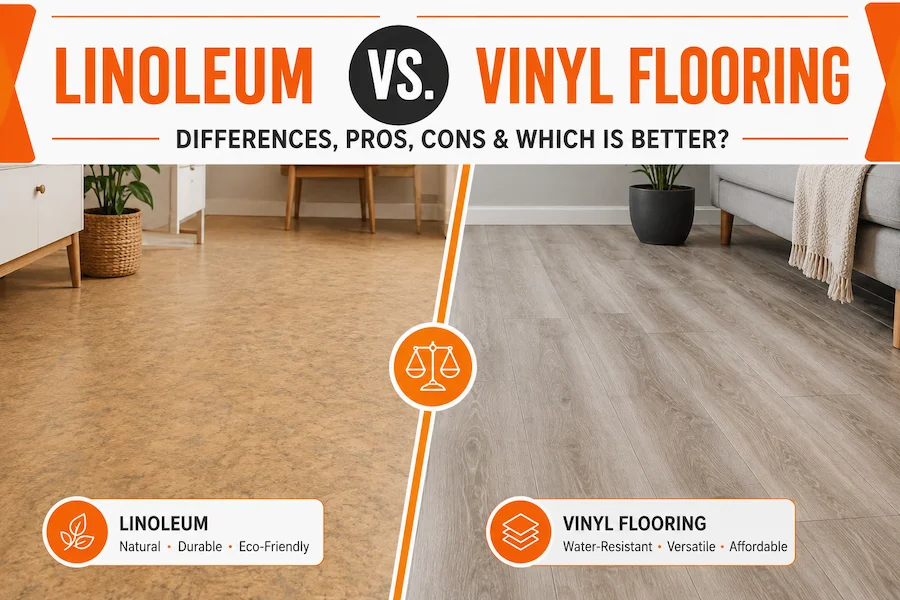
This guide by Nova Floor compares linoleum flooring and vinyl flooring across material, appearance, durability, water resistance, maintenance, installation, comfort, lifespan, cost, and environmental impact. It also answers the questions buyers ask most, including whether linoleum is waterproof and how to tell which floor you already have.
Contents
Linoleum vs Vinyl
Choose vinyl if you need a waterproof floor for a bathroom, basement, laundry room, or kitchen, want to install it yourself, or want the widest choice of wood and stone looks at the lowest price.
Choose linoleum if you want a natural, biodegradable floor with a 25 to 40 year lifespan, low VOC emissions, and color that runs through the full thickness so scratches barely show.
Vinyl wins on water, price, and ease. Linoleum wins on longevity, sustainability, and indoor air quality.
Linoleum vs. Vinyl Flooring: Side by Side Comparison
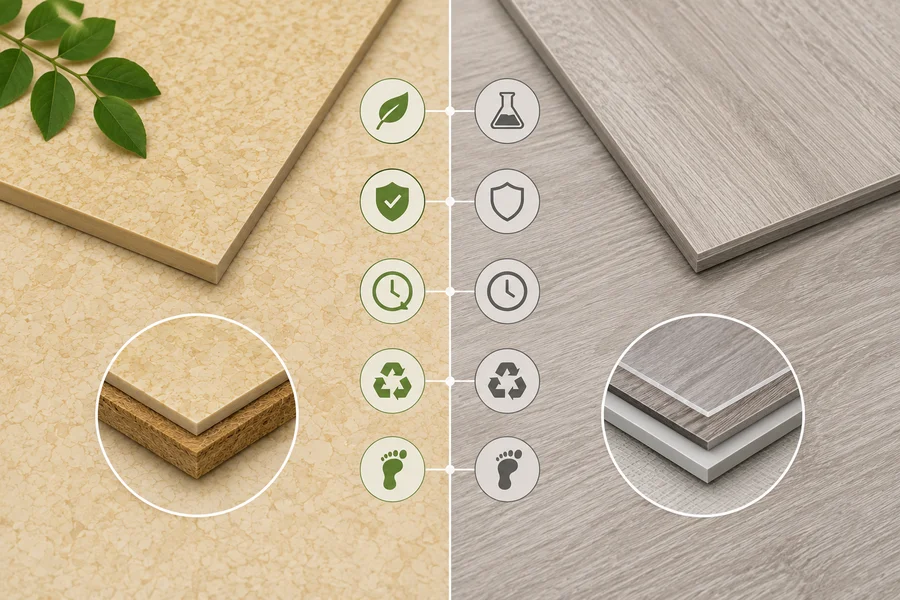
| Factor | Linoleum Flooring | Vinyl Flooring |
| Core material | Linseed oil, wood flour, cork dust, limestone, rosin, jute backing | Polyvinyl chloride (PVC), plasticizers, stabilizers, pigments |
| Origin | Natural and renewable | Petroleum based and synthetic |
| Color depth | Through body, runs full thickness | Printed film layer under a clear wear layer |
| Water resistance | Water resistant, not waterproof | Water resistant to fully waterproof |
| Typical lifespan | 25 to 40 years | 10 to 25 years |
| Material cost | $3 to $7 per sq. ft. ($12+ for premium) | $0.50 to $7 per sq. ft. |
| Installed cost | $6 to $14 per sq. ft. | $3 to $10 per sq. ft. |
| DIY friendly | Click planks yes, sheet no | Yes for planks, tiles, and modern sheet |
| Maintenance | Neutral pH cleaners only, periodic finish renewal | Sweep and damp mop |
| Design range | Marbled, flecked, solid colors | Wood, stone, tile, and concrete looks |
| Underfoot feel | Firm with slight give, warm | Soft with cushion or rigid, depends on type |
| Fire behavior | Resists melting and cigarette burns | Softens and melts under heat |
| End of life | Biodegradable, can be incinerated cleanly | Difficult to recycle, mostly landfilled |
What Is Linoleum Flooring?
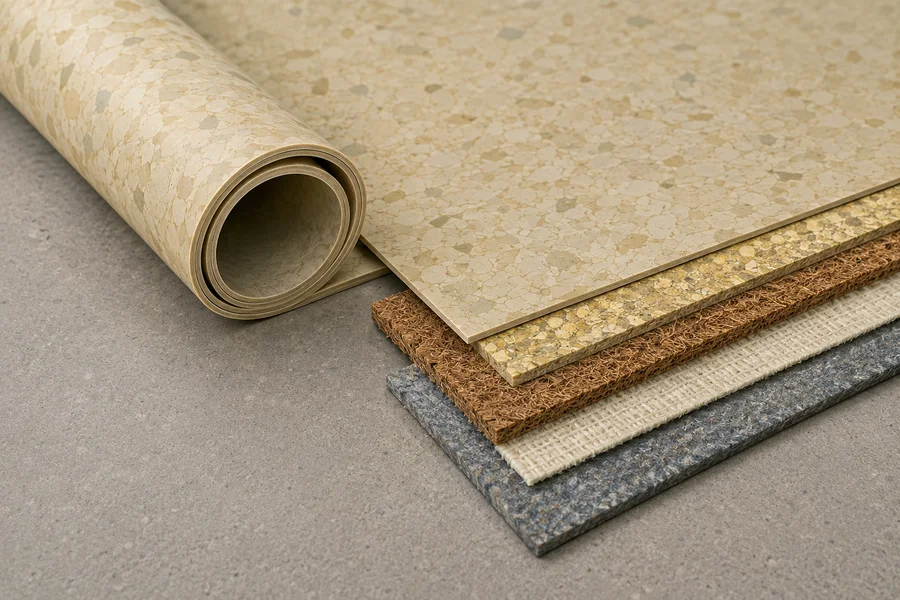
Linoleum is a resilient floor covering invented by Frederick Walton in the 1860s. Manufacturers oxidize linseed oil from flaxseed until it forms a tough binder called linoxyn. They blend that binder with pine rosin, then mill it together with wood flour, cork dust, and ground limestone. Pigments add the color. The mixture gets calendered onto a jute backing under heat and pressure, then cures in drying rooms for weeks.
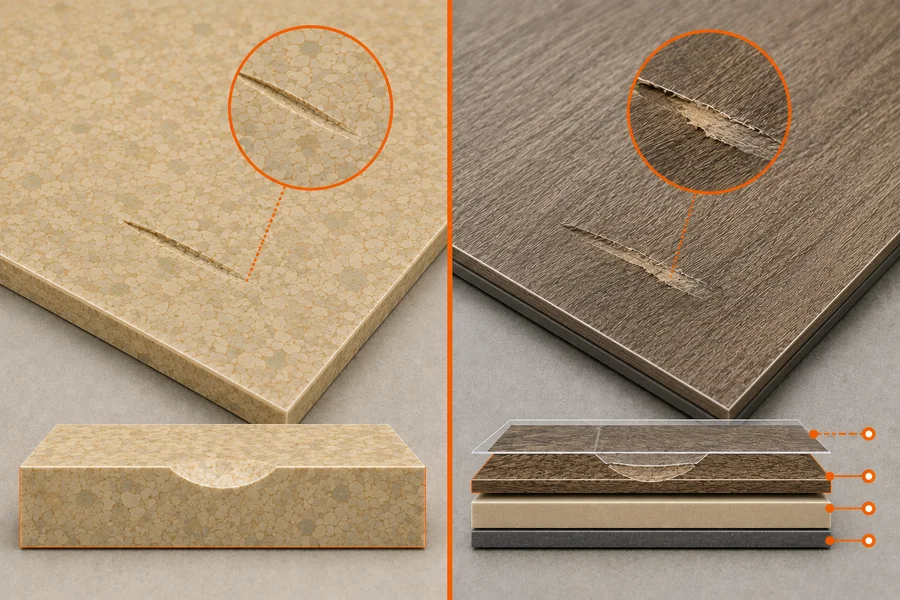
That process explains linoleum’s defining trait. The color and pattern exist throughout the full thickness of the material, not on a printed surface. A deep scratch exposes more of the same color.
Forbo Marmoleum is the best known brand today. Tarkett Veneto and Gerflor DLW are other established lines.
Types of Linoleum Flooring
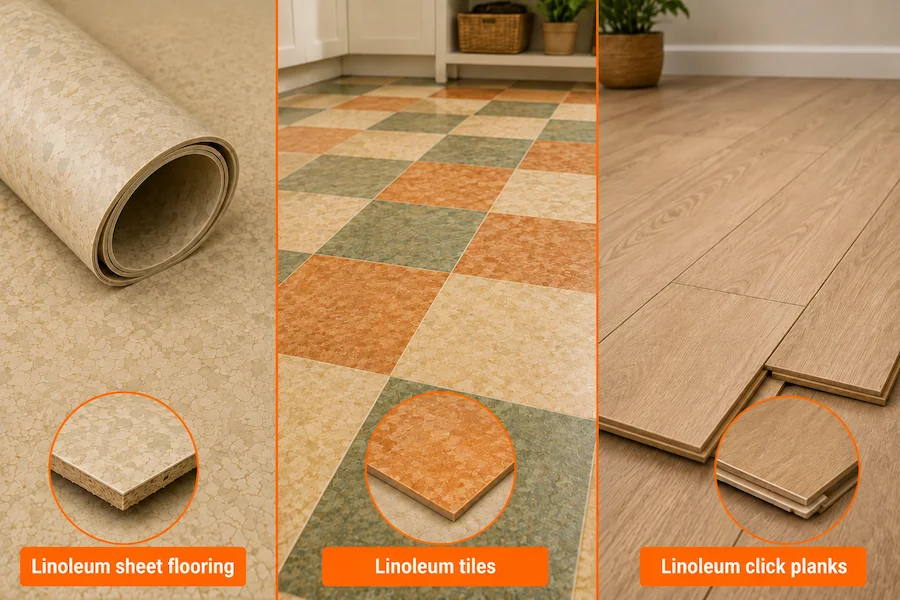
Linoleum sheet flooring comes in rolls roughly 6.5 feet wide. Installers glue it down with full spread adhesive. In commercial work, they heat weld the seams with a colored welding rod to create a continuous, sealed surface. Sheet is the most durable format and the best choice for high traffic.
Linoleum tiles typically measure 12 by 12 or 20 by 20 inches. They glue down individually and let you mix colors into patterns or borders.
Linoleum click planks bond a thin linoleum wear surface to a high density fiberboard (HDF) core with a cork backing. They float over the subfloor with no adhesive. This makes them the DIY option. The HDF core swells if it gets wet, so click linoleum does not belong in bathrooms, basements, or laundry rooms.
Residential linoleum sheet usually measures 2.0 to 2.5 mm thick. Commercial grades run 3.2 mm or more.
What Is Vinyl Flooring?
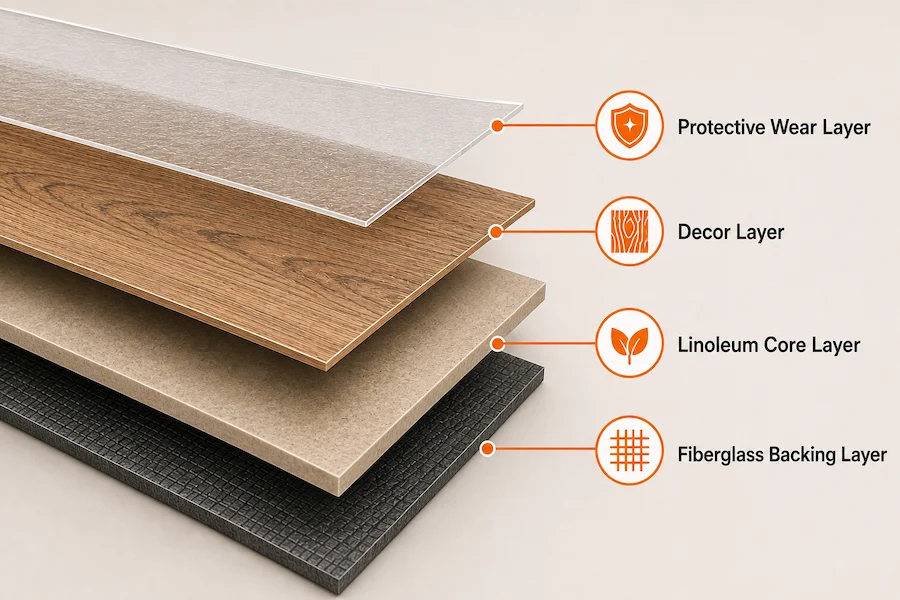
Vinyl flooring is a synthetic product built from PVC resin mixed with plasticizers, stabilizers, and fillers. Most vinyl uses a layered construction:
- A backing layer for dimensional stability, often fiberglass, felt, or a rigid composite core
- A printed design film that reproduces wood grain, stone, or tile
- A clear wear layer that protects the print
- A urethane or ceramic bead topcoat that resists scuffs
Vinyl reached American homes at scale in the 1950s. It undercut linoleum on price and needed less care, which pushed linoleum out of the mainstream for decades.
Types of Vinyl Flooring
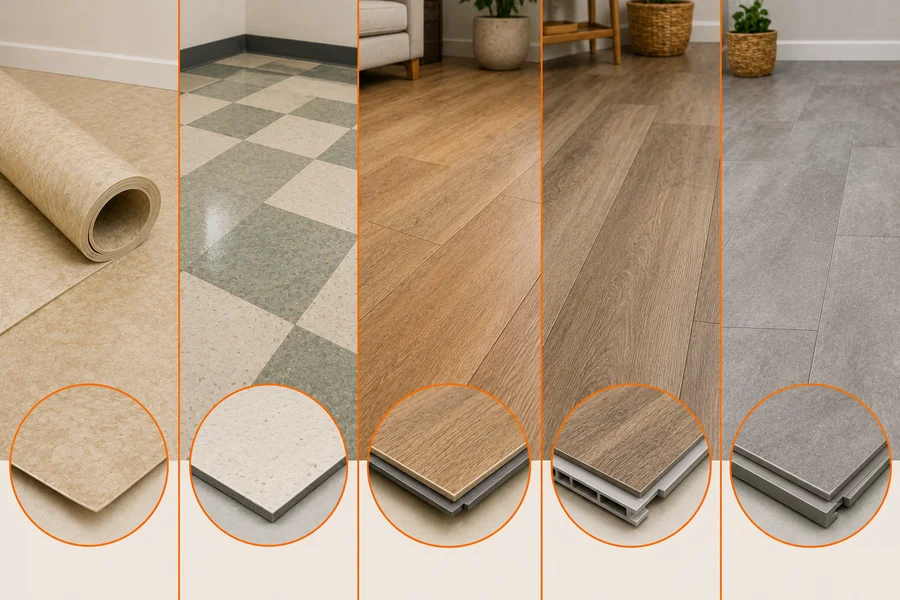
Sheet vinyl rolls out in 6 or 12 foot widths. Modern sheet vinyl with a fiberglass backing lies flat and often installs loose lay or with perimeter adhesive, which makes it far easier to fit than linoleum sheet.
Vinyl composition tile (VCT) is a dense, low cost commercial tile. It needs stripping and waxing on a schedule, so it appears mostly in schools and retail spaces.
Luxury vinyl tile (LVT) and luxury vinyl plank (LVP) are flexible planks and tiles with realistic visuals and beveled edges. They glue down or click together.
WPC (wood plastic composite) rigid core vinyl uses a foamed composite core. It feels softer and warmer underfoot and hides minor subfloor imperfections.
SPC (stone plastic composite) rigid core vinyl uses a limestone filled core. It is denser, more dent resistant, and more dimensionally stable in rooms with temperature swings. SPC flooring is the strongest choice for heavy furniture and direct sunlight.
The wear layer determines how long vinyl survives, and manufacturers measure it in mils. Use this as your buying benchmark:
| Wear layer | Suitable for |
| 6 to 8 mil | Bedrooms, guest rooms, low traffic |
| 12 mil | Kitchens, family homes, light commercial |
| 20 mil | Busy households with pets, retail |
| 28 to 40 mil | Heavy commercial traffic |
Linoleum Flooring vs Vinyl: 10 Key Differences
1. Material and Construction
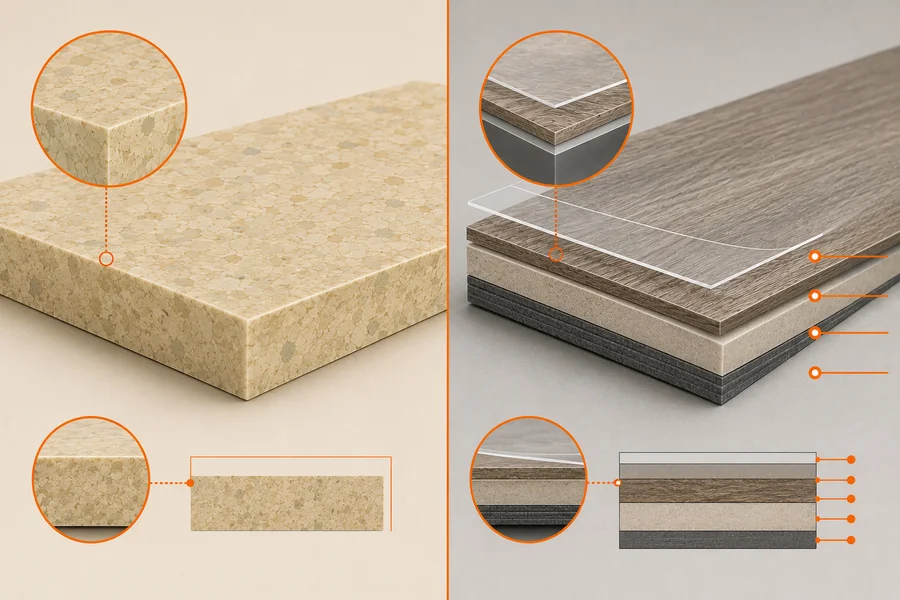
Linoleum is a homogeneous material. Every part of its thickness has the same composition and color. Vinyl is heterogeneous in most forms, with a thin printed image doing the visual work and a wear layer protecting it.
This matters for damage. Grind a heel into linoleum and you see the same color underneath. Wear through a vinyl wear layer and the print disappears, leaving a pale or blurred patch you cannot repair.
2. Appearance and Design Options
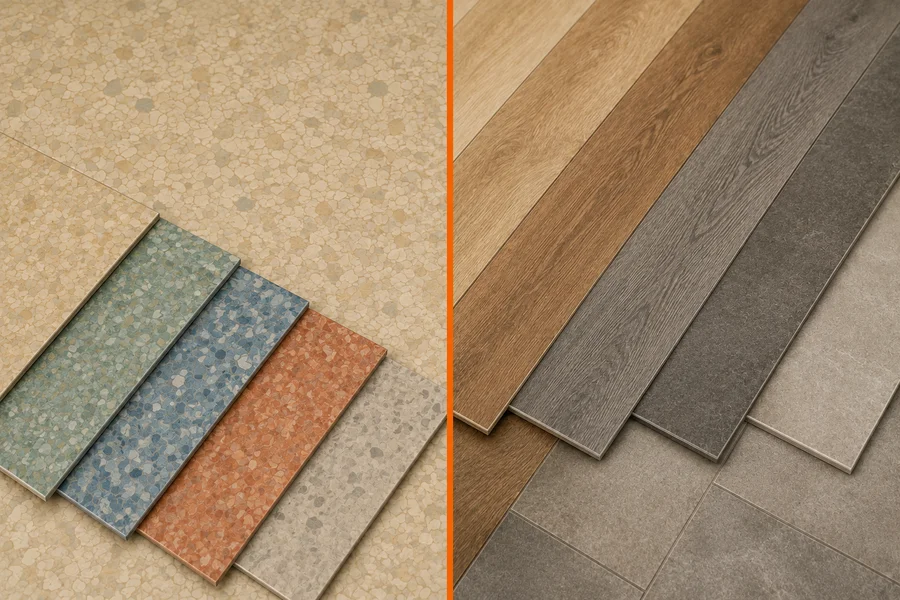
Vinyl offers far more looks. High resolution printing and embossed-in-register texturing produce oak, walnut, marble, slate, and concrete visuals that pass casual inspection. If you want a floor that reads as wood, vinyl is the practical answer.
Linoleum has a distinct visual language of its own. Expect marbled swirls, subtle flecks, and saturated solid colors. Designers use it for its clean, matte, mid century character rather than for imitation. It also allows custom inlay work, where an installer waterjet cuts shapes and logos into the field.
3. Is Linoleum Waterproof?
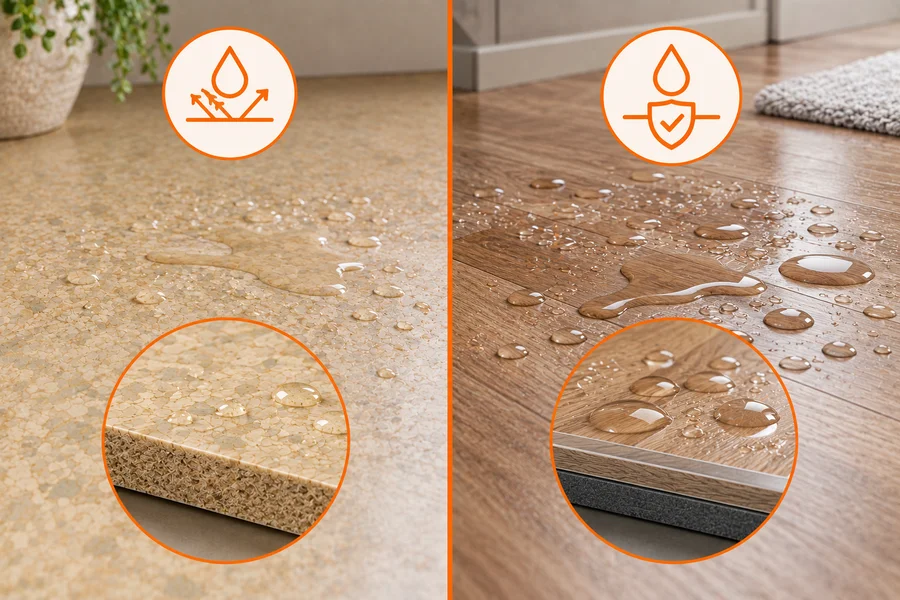
Is Linoleum Waterproof?No. Linoleum is water resistant, not waterproof. Its jute backing and organic binder absorb moisture. Standing water, repeated flooding, or moisture rising through a concrete slab causes swelling, curling edges, and adhesive failure. Prolonged damp also encourages mold under the sheet.
Vinyl performs better here. Because PVC does not absorb water, sheet vinyl, LVT, WPC, and SPC all shrug off spills. Rigid core vinyl products carry full waterproof ratings and survive standing water without damage.
Two practical caveats apply to both floors:
- Water still travels through seams and reaches the subfloor. Waterproof flooring does not mean a waterproof room.
- Click linoleum and some laminate style products use an HDF core that fails when wet, regardless of the surface material.
Test your concrete slab for moisture before installing either floor. ASTM F2170 relative humidity probes and ASTM F1869 calcium chloride tests give you the numbers manufacturers require for warranty coverage. Linoleum is the less forgiving of the two.
4. Durability and Wear
Both are resilient floors, meaning they flex under load and recover.
Linoleum resists abrasion well and holds up to rolling loads and dropped objects. It also resists cigarette burns and does not melt, since it has no thermoplastic content. Its weakness is softness against point loads. Stiletto heels, unprotected furniture legs, and grit dragged across the surface can gouge it. Alkaline chemicals attack the linseed oil binder, so harsh cleaners cause real chemical damage.
Vinyl resists scratches, dents, and stains through its wear layer and topcoat. SPC rigid core handles heavy furniture without denting. Its weaknesses are heat and sunlight. Direct sun through a south facing window can fade or expand vinyl, and hot objects can leave permanent marks.
5. Maintenance and Cleaning
Vinyl needs less work. Sweep or vacuum, then damp mop with a neutral cleaner. No sealing, no waxing, no annual ritual.
Linoleum needs more attention, but less than older guides suggest. Traditional linoleum required an applied sealer once or twice a year plus periodic waxing. Modern products ship with a cured factory finish such as Forbo Topshield, which removes the need for initial sealing and stretches maintenance intervals to several years in residential use.
Three linoleum rules still matter:
- Use only neutral pH cleaners. Alkaline products break down the binder and dull the surface permanently.
- Never wet mop or flood the floor. Use a damp mop and dry it quickly.
- Renew the finish when the surface starts to look dull, typically every three to five years at home and more often in commercial settings.
6. Installation
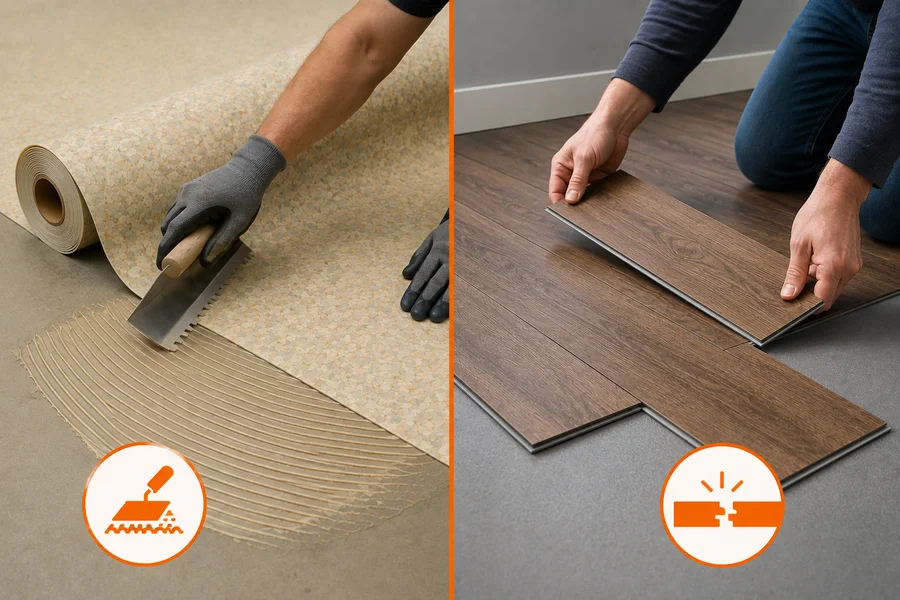
Vinyl is the DIY winner. Click LVP and SPC planks lock together and float over the subfloor. Peel and stick tiles need only a clean, flat base. Fiberglass backed sheet vinyl lies flat with minimal adhesive.
Linoleum sheet is a professional job. The material is stiff, heavy, and unforgiving of a bad cut. It requires full spread adhesive, correct trowel notching, rolling to bed it, and a cure period before use. It also needs acclimation in the room before installation, and installers usually leave a small relaxation allowance because sheet linoleum expands slightly across its width and contracts along its length. Commercial installs add heat welded seams.
Only click linoleum planks give you a realistic DIY path.
Expect these labor differences to show up in your quote. Vinyl installation typically runs $1 to $4 per square foot. Linoleum sheet installation runs $3 to $8 per square foot or more, depending on prep and seam work.
7. Comfort, Warmth, and Sound
Both floors feel warmer and softer than ceramic tile or stone. Both reduce leg fatigue in kitchens and standing work areas.
Linoleum has natural insulating value from its cork and wood content, and it holds a warm surface temperature. It also carries low static, which matters in offices and labs.
Vinyl comfort depends on the product. Cushioned sheet vinyl and WPC rigid core feel soft underfoot. Thin LVT glued directly to concrete feels hard. Adding a compatible acoustic underlayment under floating vinyl improves both feel and sound transmission, which helps in apartments and upper floors.
Both work over radiant floor heating. Keep the surface temperature below roughly 80°F (27°C) and follow the manufacturer’s ramp up schedule.
8. Lifespan
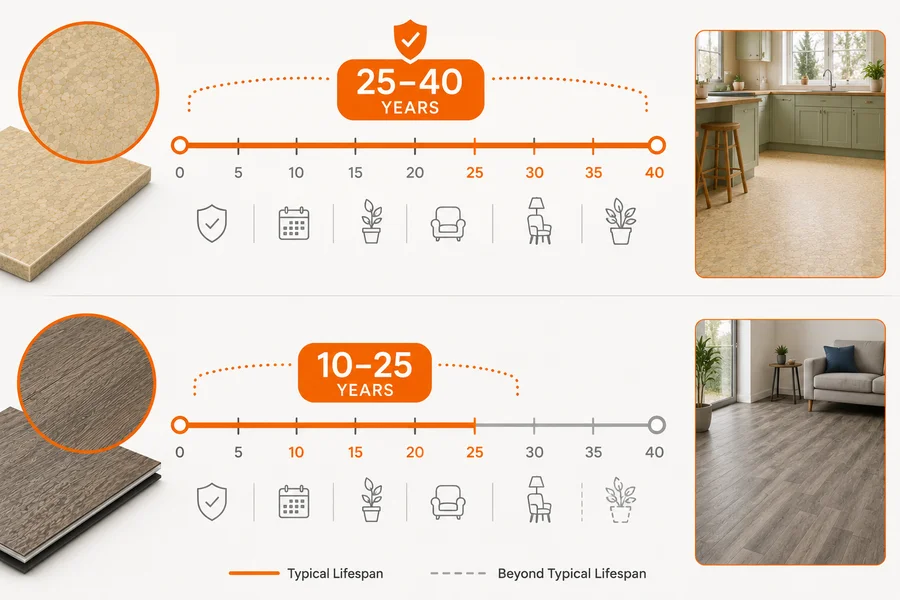
Linoleum lasts 25 to 40 years with proper care. Some institutional installations pass 50 years. Through body color is the reason. The floor thins slowly rather than losing its appearance suddenly.
Vinyl lasts 10 to 25 years. Thin sheet vinyl in a busy kitchen may need replacing in a decade. A 20 mil LVP in a normal household can reach 25 years. Once the wear layer goes, the floor is finished, because you cannot refinish printed vinyl.
Linoleum can be lightly sanded and refinished in commercial settings, which extends its life further. Vinyl cannot.
9. Cost
Vinyl costs less upfront in almost every comparison.
| Product | Material cost per sq. ft. | Installed cost per sq. ft. |
| Sheet vinyl | $0.50 to $3 | $3 to $7 |
| LVT / LVP | $2 to $5 | $4 to $9 |
| SPC / WPC rigid core | $3 to $7 | $5 to $10 |
| Linoleum sheet | $3 to $7 | $6 to $12 |
| Linoleum tile or click | $4 to $9 | $7 to $14 |
| Premium linoleum (Marmoleum) | $5 to $12+ | $8 to $16 |
Prices vary by region, subfloor prep, and removal of the old floor. Get local quotes before budgeting.
Run the math over time and the gap narrows. A linoleum floor at $9 installed that lasts 35 years costs about $0.26 per square foot per year. A vinyl floor at $6 installed that lasts 15 years costs about $0.40 per square foot per year. Linoleum can win on lifetime cost if you stay in the home and maintain it.
10. Environmental Impact and Indoor Air Quality
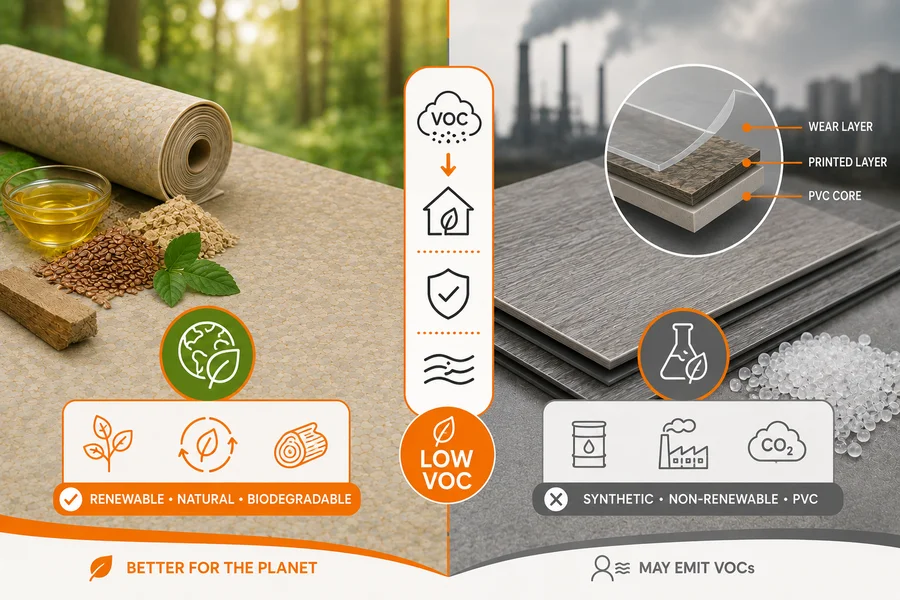
Linoleum holds a clear advantage. Its ingredients are renewable and rapidly replenished. Flax matures in about 100 days, and limestone is abundant. The material is biodegradable and burns cleanly at end of life without producing chlorinated compounds. Many linoleum products carry Environmental Product Declarations and contribute to LEED and BREEAM credits. Linoleum also has naturally antimicrobial properties, since the ongoing oxidation of linseed oil inhibits bacterial growth.
One honest note: fresh linoleum releases a mild, slightly sweet linseed odor for a few weeks after installation. It is harmless and fades.
Vinyl depends on fossil feedstocks and is difficult to recycle because of its mixed additives. Older vinyl used phthalate plasticizers, which drew health scrutiny.
The industry has responded. Many current vinyl floors use phthalate free plasticizers and carry FloorScore or Greenguard Gold certification for low VOC emissions. If indoor air quality concerns you and you still want vinyl, buy only certified products and check the manufacturer’s declaration.
Linoleum Flooring Pros and Cons
Pros
- Made from natural, renewable, biodegradable materials
- Through body color hides scratches and wear
- Lifespan of 25 to 40 years, often double that of vinyl
- Naturally antimicrobial and hypoallergenic
- Low VOC emissions and strong green building credentials
- Antistatic, useful in offices, labs, and healthcare
- Resists burns and does not melt
- Warm and comfortable underfoot
- Can be refinished to extend service life
Cons
- Not waterproof and vulnerable to standing water and slab moisture
- Sheet installation requires a professional
- Higher upfront material and labor cost
- Damaged by alkaline cleaners, so cleaning products must be chosen carefully
- Softer surface can gouge under point loads
- Ambering, a temporary yellow cast from the linseed oil, appears in dark storage or low light rooms
- Fewer realistic wood and stone looks
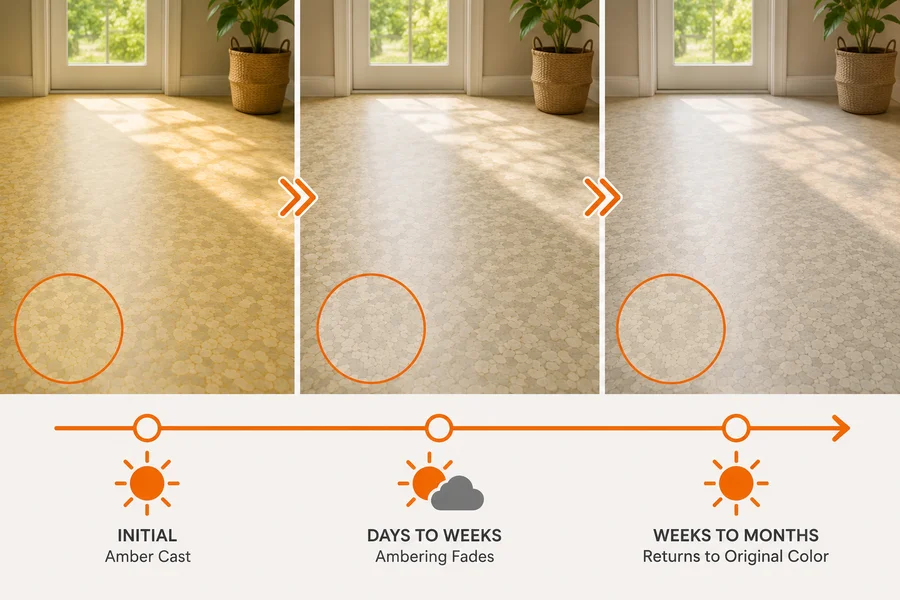
About ambering: linoleum can look slightly yellow when it has been stored in the dark. This is called ambering. It comes from the linseed oil in the material, and it fades on its own once daylight reaches the floor. It is not permanent damage. Let a linoleum sample sit in a bright room for a few days before you judge its true color.
Vinyl Flooring Pros and Cons
Pros
- Waterproof options suitable for bathrooms, basements, and laundry rooms
- Lowest upfront cost of any resilient floor
- DIY friendly click, loose lay, and peel and stick formats
- Huge range of wood, stone, and tile visuals
- Very low maintenance with no sealing or waxing
- Strong wear layers resist scratches, scuffs, and stains
- Rigid core options resist dents from heavy furniture
- Widely available with fast lead times
Cons
- Petroleum based and hard to recycle
- Printed design layer cannot be repaired or refinished
- Shorter lifespan of 10 to 25 years
- Some products emit VOCs, so certification matters
- Fades and can expand under strong direct sunlight
- Damaged by heat and hot objects
- Adds little to resale value
Best Use Areas: Room by Room
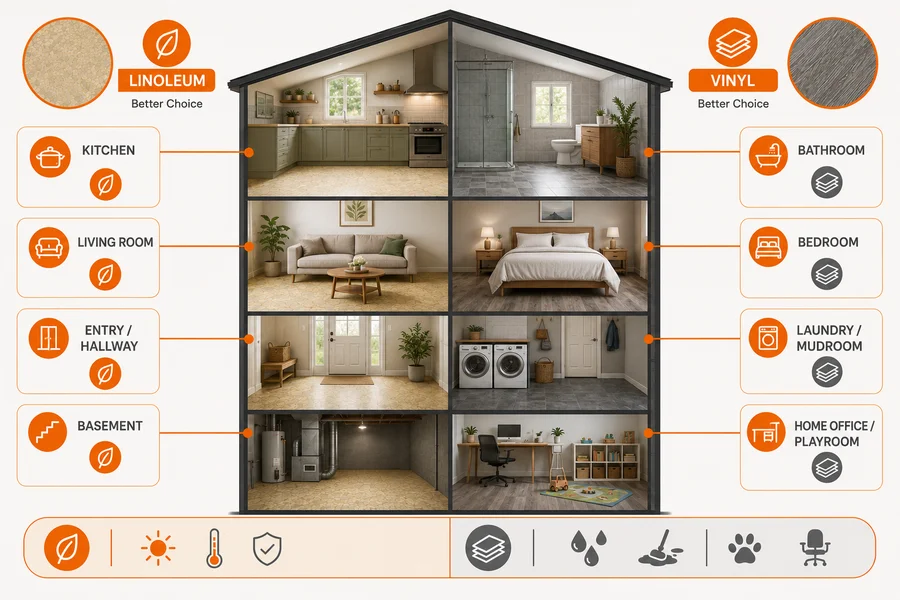
| Room | Better choice | Why |
| Bathroom | Vinyl (sheet or SPC) | Standing water and humidity rule out linoleum |
| Basement | Vinyl (SPC) | Slab moisture and flood risk demand a waterproof, dimensionally stable floor |
| Laundry room | Vinyl | Appliance leaks are common |
| Kitchen | Either | Vinyl for spill tolerance, linoleum for durability and comfort if you clean up promptly |
| Living room | Either | Linoleum offers longer life, vinyl offers wood looks |
| Bedroom | Either | Low traffic and low moisture suit both |
| Hallway and entry | Linoleum | Through body color survives grit and heavy foot traffic |
| Home office | Linoleum | Antistatic and quiet |
| Healthcare and schools | Linoleum sheet | Antimicrobial, heat welded seams, decades of service |
| Retail and commercial kitchens | Vinyl or VCT | Waterproof, cheap to replace in sections |
| Sunrooms | Linoleum | Vinyl can fade and expand in strong direct sun |
How to Tell if Your Existing Floor Is Linoleum or Vinyl
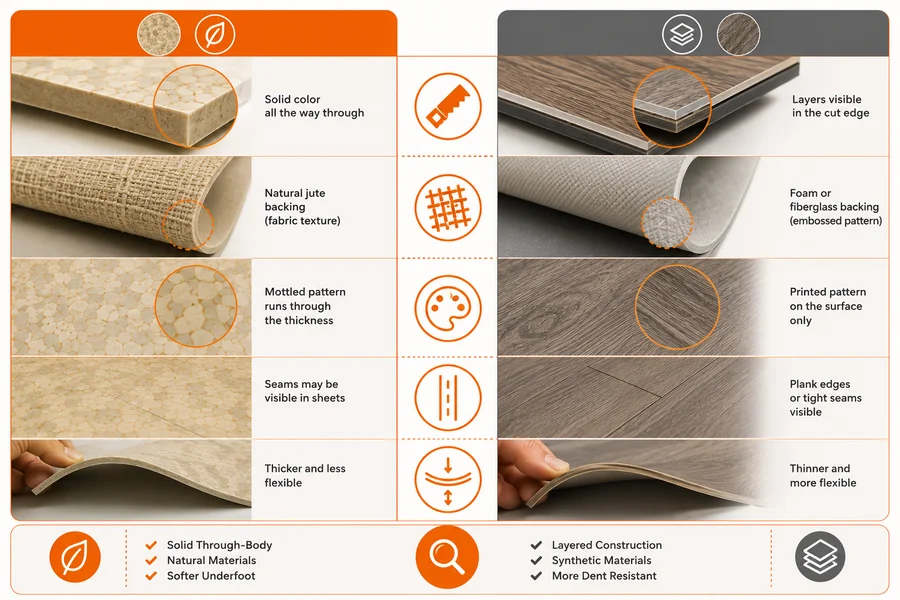
Many homeowners call every resilient floor linoleum. Use these checks:
- Look at a cut edge. Find an exposed edge at a doorway or under an appliance. Linoleum shows the same color through the full thickness. Vinyl shows a distinct layered profile with a print line.
- Check for a jute backing. Linoleum sits on a fibrous, burlap-like backing. Vinyl backings are smooth felt, fiberglass, or a solid composite.
- Smell it. Warm linoleum gives off a faint linseed oil scent. Vinyl smells like plastic or nothing at all.
- Judge the pattern. Realistic wood grain or stone photography means vinyl. Marbled swirls or speckled solids usually mean linoleum.
- Check the age of the home. Floors installed before 1960 are more likely linoleum. Most resilient flooring installed after 1970 is vinyl.
What About Asbestos in Old Floors?
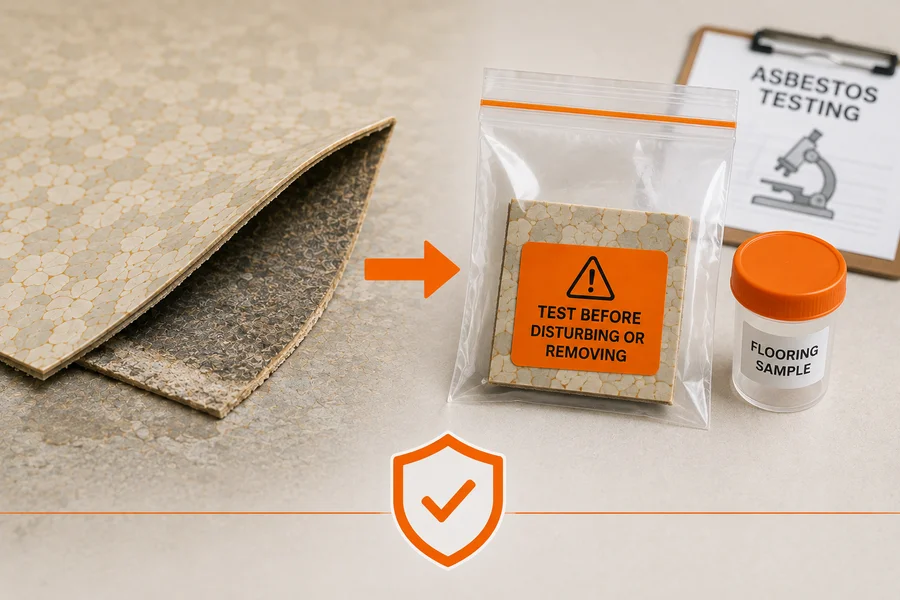
Manufacturers phased asbestos out of flooring products through the late 1970s and 1980s. Current linoleum and vinyl contain none.
The risk in older homes is real but narrow. Asbestos rarely appeared in the linoleum body itself. It appeared in vinyl asbestos tile (VAT), which was common in 9 by 9 inch tiles, and in the asphalt-saturated felt backing used under some sheet flooring.
Intact flooring poses little risk. Do not sand, grind, or dry scrape a suspect floor. If your home predates 1980 and you plan to remove old resilient flooring, have it tested first, or install the new floor over the top where the manufacturer allows it.
Which Is Better, Linoleum or Vinyl?
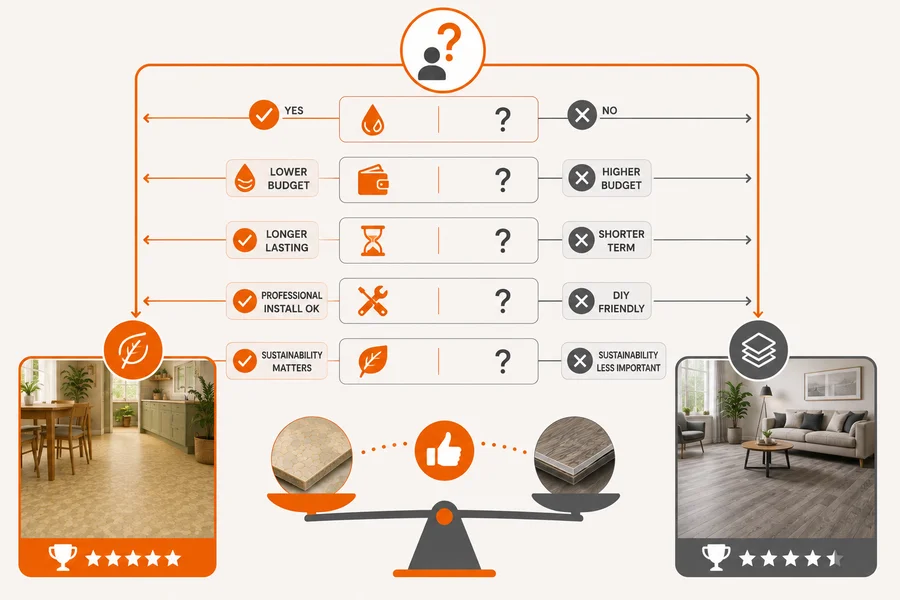
Neither wins outright. The right answer follows your priorities.
Choose linoleum flooring if:
- You want a natural, non petroleum floor
- Indoor air quality and low VOCs matter to you
- You plan to stay in the home for 20 years or more
- Your room stays dry and has no slab moisture problems
- You want color that survives scratches
- You are willing to use the right cleaners and hire a professional installer
Choose vinyl flooring if:
- You need waterproof performance in a bathroom, basement, or laundry
- Your budget is tight
- You want to install it yourself
- You want a convincing hardwood or stone look
- You want maintenance to mean nothing more than a mop
- The floor is for a rental, a flip, or a short term stay
For most American homes with a normal budget and at least one wet room, vinyl is the practical default. For a dry, high traffic space where you value longevity and sustainability over price, linoleum is the better long term investment.
Buying Guide: What to Check Before You Order
- Test the subfloor for moisture if you are installing over concrete. Manufacturers void warranties over failed slabs.
- Match the wear layer to your traffic for vinyl. Do not put a 6 mil floor in a kitchen with dogs.
- Check the linoleum thickness. 2.0 mm suits bedrooms. 2.5 mm or thicker suits kitchens and hallways.
- Confirm the core on click products. HDF cores fail in wet rooms.
- Look for certifications. FloorScore or Greenguard Gold for vinyl, and an EPD or Cradle to Cradle rating for linoleum.
- Order 10 percent extra for cuts and waste, and 15 percent for diagonal or patterned layouts.
- Read the warranty exclusions. Sunlight fading, moisture, and improper cleaners are the common ones.
- Get physical samples and leave them in the room for a week under real light before you commit.
Frequently Asked Questions
Are linoleum and vinyl the same thing? No. Linoleum is a natural material made from linseed oil, wood flour, and limestone. Vinyl is synthetic PVC plastic. They look similar in sheet form, which is where the confusion comes from.
Is linoleum waterproof? No. Linoleum is water resistant. It handles spills you wipe up promptly. It does not survive standing water, flooding, or moisture rising through a slab.
Which lasts longer, linoleum or vinyl? Linoleum. It typically lasts 25 to 40 years compared to 10 to 25 years for vinyl.
Is linoleum cheaper than vinyl? No. Vinyl costs less to buy and less to install. Linoleum can cost less per year of service because it lasts longer.
Can I install linoleum myself? Only click plank linoleum. Linoleum sheet requires professional installation with full spread adhesive.
Does linoleum contain asbestos? Modern linoleum contains none. Some pre 1980 resilient floors had asbestos in the backing or in vinyl asbestos tile. Test before removing an old floor.
Which is better for pets? Vinyl. It handles accidents, water bowls, and muddy paws without absorbing moisture, and its wear layer resists claw scratches.
Does either floor add resale value? Neither adds much. Both are considered practical rather than premium surfaces. Quality LVP in good condition helps a home show better than worn carpet or damaged tile.
Can linoleum go in a bathroom? It is not recommended. Sheet linoleum with heat welded seams can work in a powder room with careful maintenance. For a full bathroom, choose vinyl.
What cleaners should I avoid on linoleum? Avoid anything alkaline, including ammonia, bleach, and most general purpose degreasers. Use a neutral pH cleaner made for linoleum.

Noah Williams
Interior Designer & Flooring Expert
Related Posts