Noah Williams is an interior designer and flooring expert at Nova Floor. In Dubai, he helps people pick the right floor, get it installed, and keep it looking good. He also writes simple, practical flooring and home care guides for readers in Dubai and around the world.
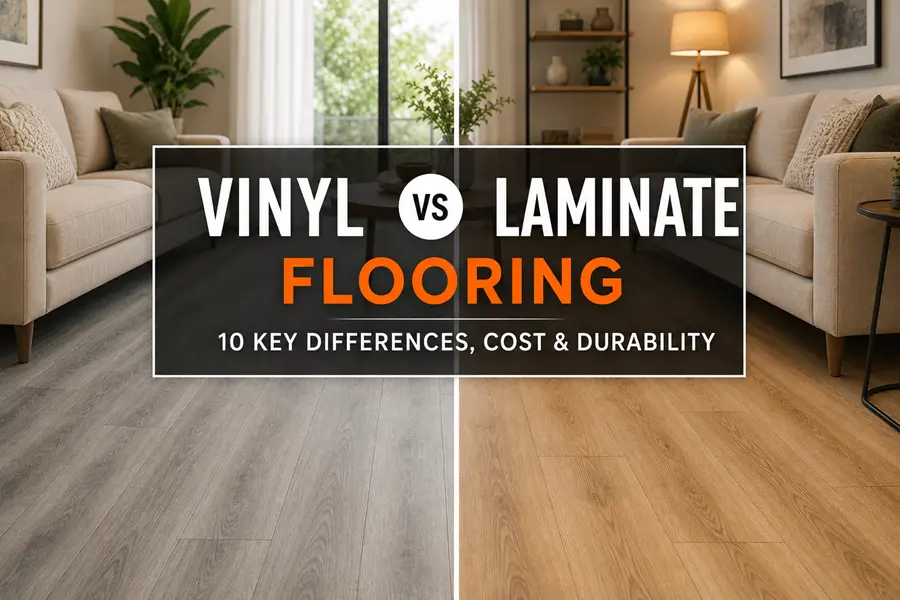
Vinyl vs Laminate Flooring | 10 Key Differences, Cost & Durability
Noah Williams
Vinyl wins on water resistance and works in any room, including bathrooms and basements. Laminate wins on scratch resistance and underfoot realism in dry rooms, and it usually costs less at the budget end. Vinyl runs $3 to $10 per square foot installed. Laminate runs $3 to $8 per square foot installed. Both last 15 to 25 years.
If your room ever gets wet, buy vinyl. If it stays dry and you want the most convincing wood texture for the money, buy laminate.
Contents
Vinyl vs Laminate Flooring | Side by Side
| Factor | Vinyl (LVP / LVT / SPC / WPC) | Laminate |
| Core material | PVC, or PVC mixed with limestone or wood flour | High-density fibreboard (HDF) |
| Installed cost | $3 to $10 per sq ft | $3 to $8 per sq ft |
| Material only | $1 to $7 per sq ft | $1 to $5 per sq ft |
| Waterproof | Yes for rigid core (SPC/WPC) | No, water-resistant only |
| Durability spec | Wear layer in mils (6 to 40) | AC rating (AC1 to AC5) |
| Scratch resistance | Good to very good | Excellent |
| Dent resistance | Excellent | Good |
| Lifespan | 15 to 25 years | 15 to 25 years |
| Typical thickness | 2mm to 8mm | 7mm to 12mm |
| Feel underfoot | Softer, warmer, quieter | Firmer, more solid, louder |
| Best rooms | Kitchen, bathroom, basement, laundry, mudroom | Bedroom, living room, hallway, office |
| Refinishing | Not possible | Not possible |
| Commercial grade | 20 to 40 mil wear layer | AC4 or AC5 |
What Is Vinyl Flooring?
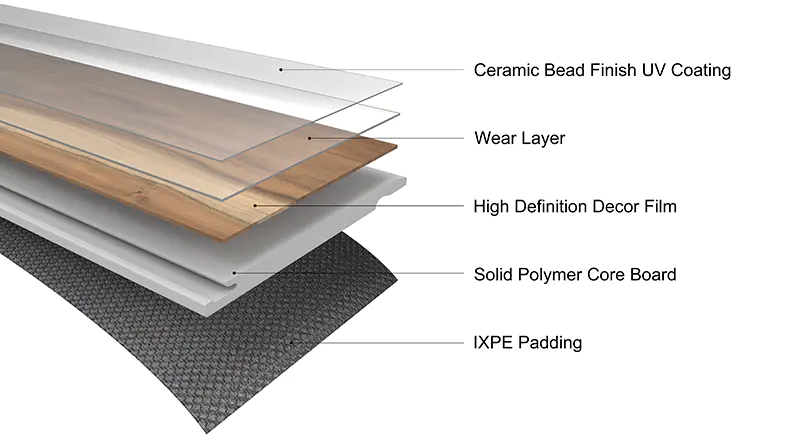
Vinyl flooring is a synthetic floor built around a polyvinyl chloride (PVC) core. Manufacturers press four layers together: a backing layer, a core, a printed design film, and a clear urethane wear layer on top.
The category splits into four products, and the differences matter more than most buyers realise.
Luxury vinyl plank (LVP) copies hardwood in long, narrow boards. Luxury vinyl tile (LVT) copies stone and ceramic in square or rectangular tiles. Both use the same construction. Only the format and print change.
SPC (stone plastic composite) packs limestone powder into the core. The result is dense, around 2000 kg per cubic metre, and it barely moves when temperatures swing. SPC flooring Dubai handles direct sunlight, conservatories and radiant heat better than any other vinyl.
WPC (wood plastic composite) foams wood flour into the PVC core. Density drops to roughly 900 kg per cubic metre. WPC deck flooring feels softer and warmer than SPC, and it absorbs footstep noise better. It dents more easily under heavy furniture.
Sheet vinyl arrives in 6-foot or 12-foot rolls. It creates a near-seamless surface for as little as $0.50 per square foot. Landlords and budget renovators still choose it for laundry rooms and rental bathrooms.
What Is Laminate Flooring?
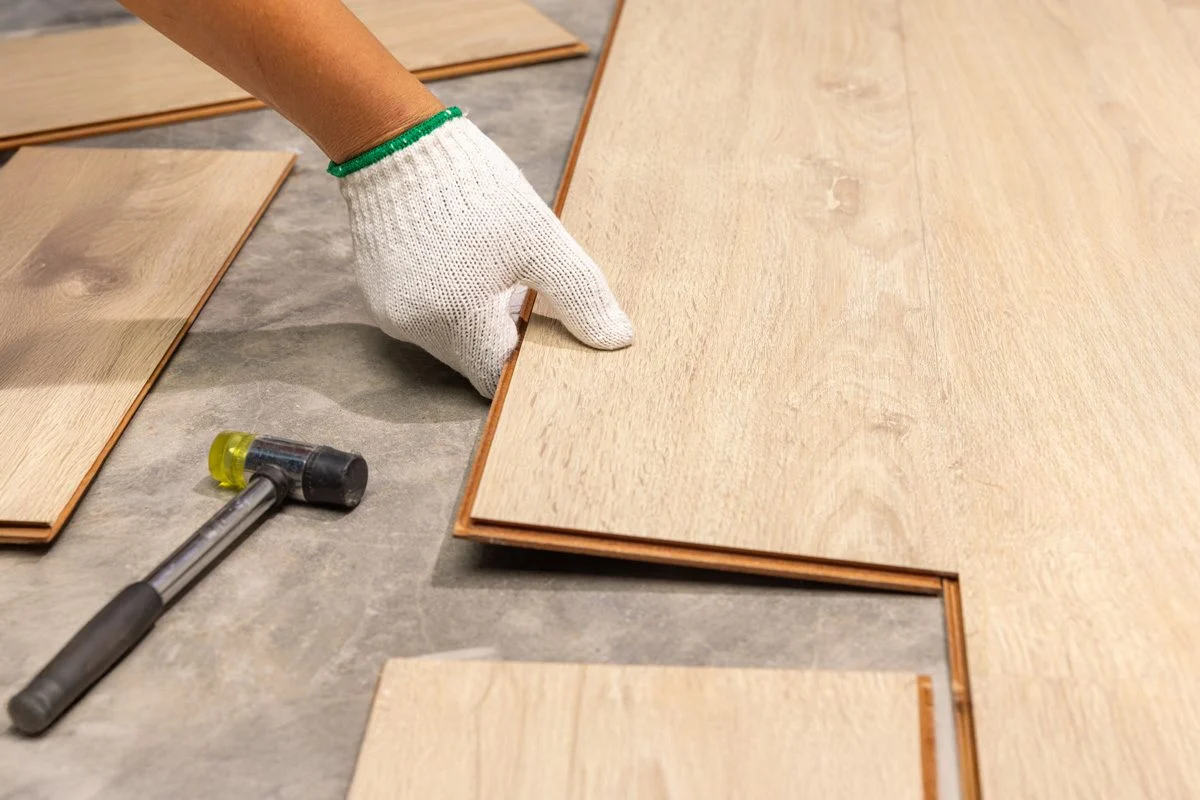
Laminate flooring is a wood-based floor. Its core is high-density fibreboard, made from compressed wood fibre and resin. A photographic decor layer sits on top, then a melamine wear layer sealed under heat and pressure.
That HDF core explains everything about how laminate behaves. It is rigid, it feels solid underfoot, and it resists abrasion extremely well. It also swells if water reaches it.
Modern laminate has narrowed the moisture gap. Premium lines seal the core and coat the edges, then rate the plank for 24 to 72 hours of surface water exposure. Manufacturers call these products water-resistant or waterproof laminate. The warranty language usually covers spills, not standing water, and not flooding.
Laminate planks typically run 7mm to 12mm thick. Thicker boards feel more substantial and forgive minor subfloor dips.
10 Key Differences Between Vinyl and Laminate Flooring
1. Core Construction
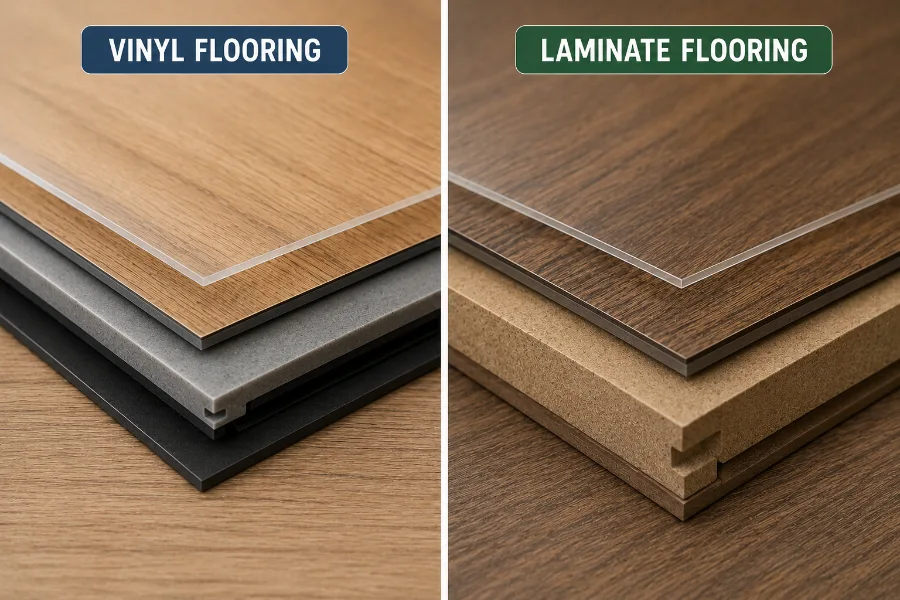
This single difference drives every other difference on the list.
Vinyl has a plastic core. Water cannot swell plastic. Laminate has a wood-fibre core. Water swells wood fibre, and the swelling is permanent.
Everything else follows from that. Vinyl goes in wet rooms. Laminate stays in dry rooms. Vinyl feels softer because plastic flexes. Laminate feels harder because compressed wood does not.
2. Water and Moisture Resistance
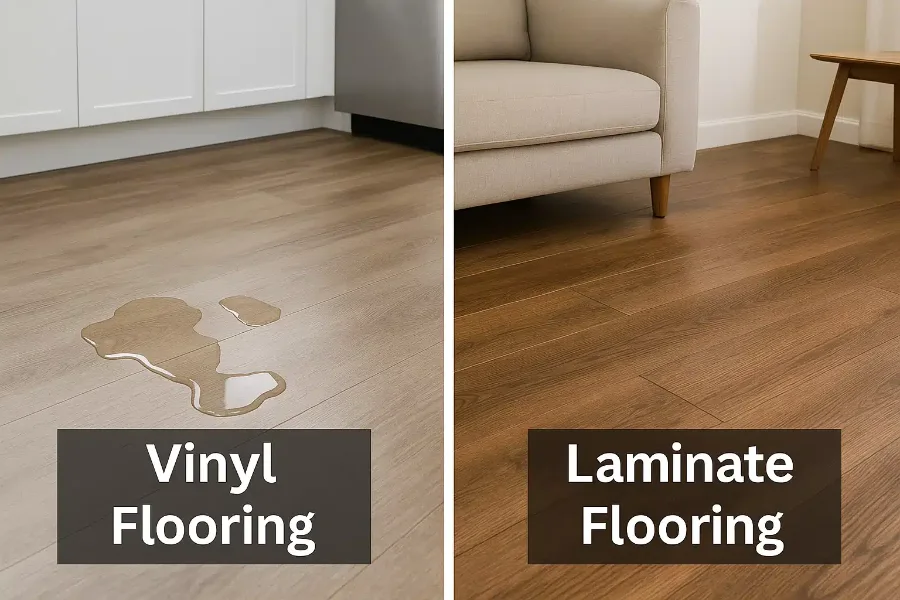
Vinyl wins, and the gap is wide.
Rigid core vinyl with an SPC or WPC construction is waterproof through the plank. Submerge it, dry it, and it returns to shape. Standard flexible LVP and sheet vinyl are highly water-resistant, though water can still travel through seams to the subfloor.
Laminate is water-resistant, never waterproof. Standard laminate absorbs water at the joints. The core expands, the edges lift, and the damage cannot be reversed. Waterproof laminate delays this outcome but does not eliminate it.
One caveat applies to both. Neither floor is a waterproofing system. Water that reaches the subfloor and sits there will still cause mould, regardless of the plank above it. Fix leaks at the source.
Practical guidance: use vinyl in bathrooms, kitchens, basements, laundry rooms and mudrooms. Use laminate everywhere the floor stays dry.
3. Cost
Prices sit close enough that cost rarely decides the question on its own.
Vinyl flooring costs:
- Sheet vinyl: $0.50 to $4.00 per sq ft, materials
- LVT: $2.00 to $7.00 per sq ft, materials
- LVP: $2.50 to $7.00 per sq ft, materials
- Premium rigid core with a thick wear layer: $6.00 to $12.00 per sq ft
- Installed total: $3 to $10 per sq ft
Laminate flooring costs:
- Budget laminate: $1.00 to $2.00 per sq ft, materials
- Mid-range AC3 and AC4: $2.00 to $5.00 per sq ft, materials
- Premium waterproof laminate: $4.00 to $6.00 per sq ft, materials
- Installed total: $3 to $8 per sq ft
Extras most quotes forget:
- Labour: $1.50 to $3.00 per sq ft in most markets, $2.00 to $5.00 in high-cost cities
- Underlayment: $0.25 to $0.75 per sq ft when not pre-attached
- Transitions, T-moulding and stair nosing: $0.15 to $0.50 per sq ft
- Old floor removal and disposal: $1.00 to $2.00 per sq ft
- Subfloor levelling: varies widely, and it is the most common budget surprise
A 500 square foot room lands between $1,500 and $6,000 installed with either material. DIY installation cuts roughly 30% to 40% from that figure.
Laminate is cheaper at the entry level. At mid-range and premium tiers the two converge, and vinyl often delivers better value because you get waterproofing at the same price.
4. Durability Ratings
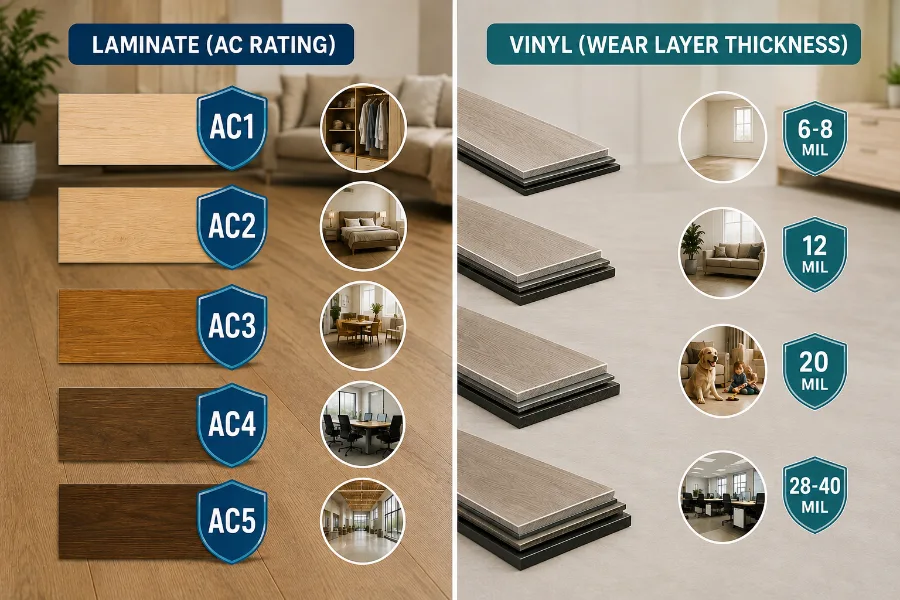
The two materials use different measuring systems, and comparing them incorrectly is the most common shopping mistake.
Laminate uses the AC rating. AC stands for Abrasion Class, tested under EN 13329 using a Taber abrasion wheel. The scale runs AC1 to AC5.
- AC1: light residential, closets and guest rooms
- AC2: general residential, bedrooms and dining rooms
- AC3: heavy residential and light commercial, the practical minimum for any main room
- AC4: general commercial, and the best value for busy family homes
- AC5: heavy commercial, retail floors and public buildings
Vinyl uses wear layer thickness in mils. One mil equals one thousandth of an inch.
- 6 to 8 mil: rentals and low-traffic rooms only
- 12 mil: the minimum for a main living area
- 20 mil: homes with pets, children or heavy traffic
- 28 to 40 mil: commercial installations
These two scales test different things. AC ratings measure surface abrasion, impact, staining and burn resistance together. Mil ratings measure only the thickness of the protective top coat. Never assume that a 20 mil vinyl equals an AC4 laminate, because no conversion exists.
Verify both from the manufacturer spec sheet, not the showroom sign. In North America, laminate AC ratings appear next to the NALFA certification seal on the box.
5. Lifespan
Both floors last 15 to 25 years in normal residential use. Premium products reach 30.
Neither can be sanded or refinished. Once the wear layer wears through, replacement is the only fix. That single fact separates both materials from hardwood.
Three things shorten lifespan more than product quality:
Installation errors. Industry data consistently shows most flooring complaints trace back to installation or site conditions rather than product defects. Skipped acclimation, missing expansion gaps and damp subfloors cause failures within the first two years.
Humidity swings. Keep indoor humidity between 30% and 50%. Laminate suffers most outside that band because its wood core expands and contracts, stressing the locking joints.
Traffic patterns. Hallways and entryways wear two to three times faster than bedrooms. Specify a higher rating for those zones, or accept earlier replacement.
Cheap laminate installed badly can fail inside 8 years. Quality laminate installed correctly in a dry bedroom can still look good at 25.
6. Scratch and Dent Resistance
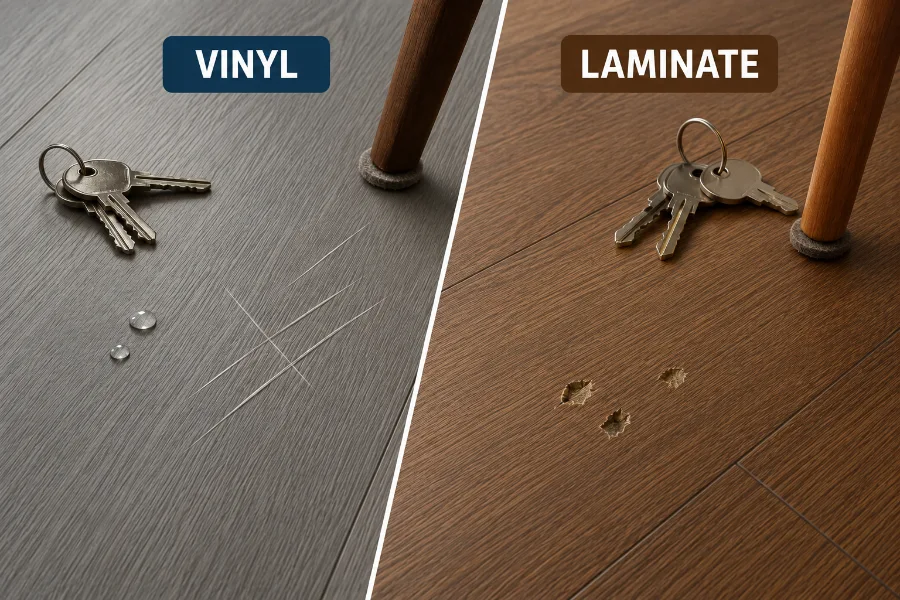
Laminate resists scratches better. Vinyl resists dents better. Both statements are true at the same time, and buyers often hear only one of them.
The melamine wear layer on laminate is harder than the urethane coating on vinyl. Dog claws, grit and dragged chair legs mark vinyl before they mark an AC4 laminate. If scratching is your main worry and the room stays dry, laminate is the stronger pick.
Vinyl absorbs impact without cracking. Drop a cast iron pan on laminate and you can chip the surface. Drop it on vinyl and the plank usually flexes and recovers. Vinyl also handles heavy rolling loads better, which matters for office chairs.
Two exceptions are worth knowing. Thin flexible LVP dents under heavy furniture legs, so use felt pads or wide floor protectors. And direct sunlight fades cheap vinyl faster than it fades laminate, which is why SPC is the better choice for sun-drenched rooms.
7. Appearance and Realism
Both use high-definition printing, so photographs of either look convincing. The difference shows up when you walk on the floor and run a hand across it.
Laminate feels more like wood. Its harder surface holds deeper embossing. Look for embossed in register (EIR), where the surface texture aligns exactly with the printed grain. The effect is convincing enough that guests rarely notice.
Vinyl offers more variety. Big-box retailers typically stock roughly twice as many vinyl products as laminate. Vinyl also covers stone and ceramic looks through LVT, which laminate handles poorly.
Two design details raise realism in either material. Choose wider and longer planks, since 7-inch by 48-inch boards read as more authentic than narrow strips. And open four or five packs at once during installation, mixing boards to break up the repeating pattern. Every printed floor repeats. Random mixing hides it.
8. Comfort, Warmth and Sound
Vinyl feels softer and warmer. The PVC core gives slightly underfoot, and plastic conducts less heat away from bare feet than compressed wood does. WPC is the warmest option because its foamed core traps air.
Laminate feels firmer and more solid. Some people prefer that. Standing on it for long stretches in a kitchen is harder on the joints than standing on vinyl.
Sound is where laminate needs help. A floating laminate floor over a hard subfloor produces a hollow click when you walk on it. Good acoustic underlay fixes this, and skipping it is a mistake homeowners regret daily. Vinyl runs quieter by default, and most rigid core products ship with an attached IXPE or cork pad.
For apartments and upper floors, check the IIC and STC ratings on the underlayment. Many building associations set a minimum.
9. Installation and Underlayment
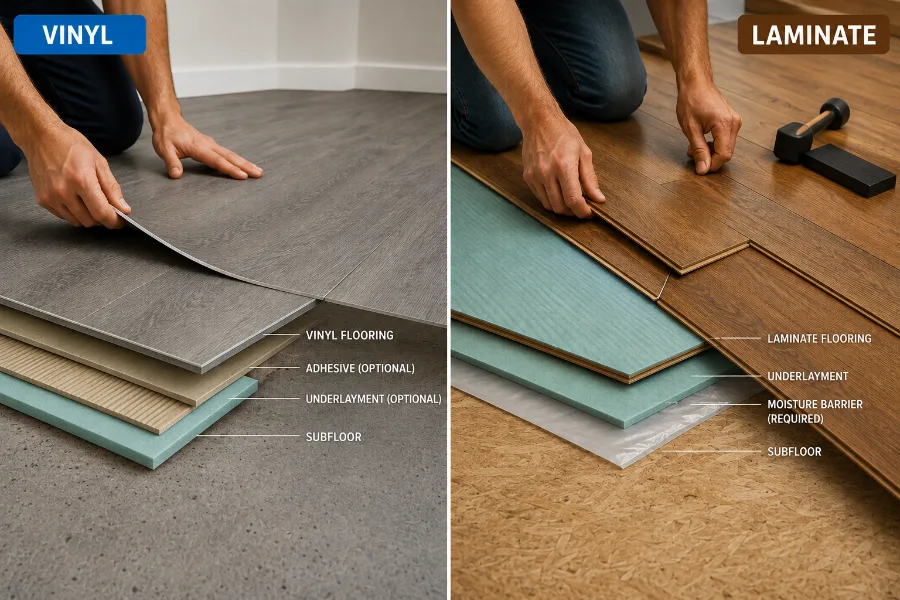
Both install as floating floors using click-lock joints. Neither needs glue or nails in most residential jobs. Both are realistic DIY projects for anyone comfortable with a tape measure and a jigsaw.
Subfloor flatness is the deciding factor. Manufacturers commonly require flatness within 3/16 inch over 10 feet. Rigid core SPC bridges minor dips better than flexible LVP or laminate. Nothing bridges a genuinely uneven floor, so budget for self-levelling compound if the subfloor needs it.
Underlayment rules differ, and this trips people up:
- Laminate almost always needs separate underlay, typically 2mm to 3mm foam. On concrete, add a 6-mil polyethylene moisture barrier underneath.
- Vinyl underlay is thinner, usually 1mm to 1.5mm. Too much cushion under a vinyl plank stresses the locking system and causes joint failure.
- Never install standard laminate foam under SPC vinyl. It compresses under the rigid core and breaks the clicks.
- If your vinyl already has an attached pad, do not add a second layer. Doing so voids most warranties.
Expansion gaps are mandatory. Leave 1/4 to 3/8 inch around every wall, pipe and fixed object. Skirting boards or quarter round cover the gap. Floors that buckle a year after installation almost always lost this gap.
Acclimation matters. Most manufacturers require 48 hours in the installation room before laying planks. SPC often needs less, but the box will say.
Radiant heat compatibility: both work over underfloor heating, with limits. Cap the surface temperature at 80°F to 85°F (27°C to 29°C). SPC handles radiant heat best because its mineral core barely expands. Check the specific product rating before you commit.
Glue-down vinyl is the exception to all of the above. It costs more in labour, needs a clean flat subfloor, and delivers better stability under heavy rolling loads. Commercial jobs usually specify it.
10. Maintenance, Cleaning and Repair
Daily care is nearly identical. Sweep or vacuum with a hard-floor head. Wipe spills quickly. Use felt pads under furniture and a doormat at every entrance, since grit causes most surface wear.
Cleaning vinyl: damp mop with a pH-neutral cleaner. Avoid wax, polish and steam mops. Steam forces moisture into seams and softens adhesives. Most warranties exclude steam damage.
Cleaning laminate: use a barely damp mop, wrung almost dry. Never flood the floor. Standing water finds the joints within minutes. Skip vinegar solutions, which dull the melamine over time.
Repairing either floor: you cannot sand out a scratch, because the wear layer is thin and the pattern beneath it is printed. You replace the damaged plank instead.
On a floating floor, unclick boards back from the nearest wall, swap the damaged plank, and relock the run. It is tedious but achievable. Glue-down vinyl planks come up with a heat gun and a putty knife, then a new plank goes down in fresh adhesive.
Buy 10% extra material and store it. Discontinued patterns are the real reason people replace whole floors over one damaged board.
As a rule of thumb, patch when damage covers less than 10% of the floor. Replace the room beyond that.
Environmental Impact and Indoor Air Quality
Neither material is a green product. Both are manufactured, both consume energy, and neither breaks down usefully at end of life.
Vinyl concerns: PVC production and disposal raise legitimate questions. Some vinyl contains phthalate plasticisers, though the industry has moved steadily toward phthalate-free formulas. Recycling infrastructure for post-consumer vinyl flooring remains limited in most regions.
Laminate concerns: HDF cores use resins that can emit formaldehyde. Laminate does contain wood fibre, often from recycled or by-product sources, which gives it an edge on renewable content.
Certifications to look for on either material:
- FloorScore or GREENGUARD Gold for low VOC emissions
- CARB Phase 2 or TSCA Title VI compliance for formaldehyde limits on laminate
- E1 for European formaldehyde classification
- ASSURE Certified for rigid core WPC and SPC products, covering air quality, heavy metals and ortho-phthalates
- Phthalate-free disclosure on vinyl
Ventilate well for the first week after installation, whichever material you choose. Off-gassing peaks early and drops sharply.
One point in favour of both: durability is itself sustainability. A floor that lasts 25 years beats a floor replaced twice in that period, whatever it is made of.
Residential vs Commercial Use
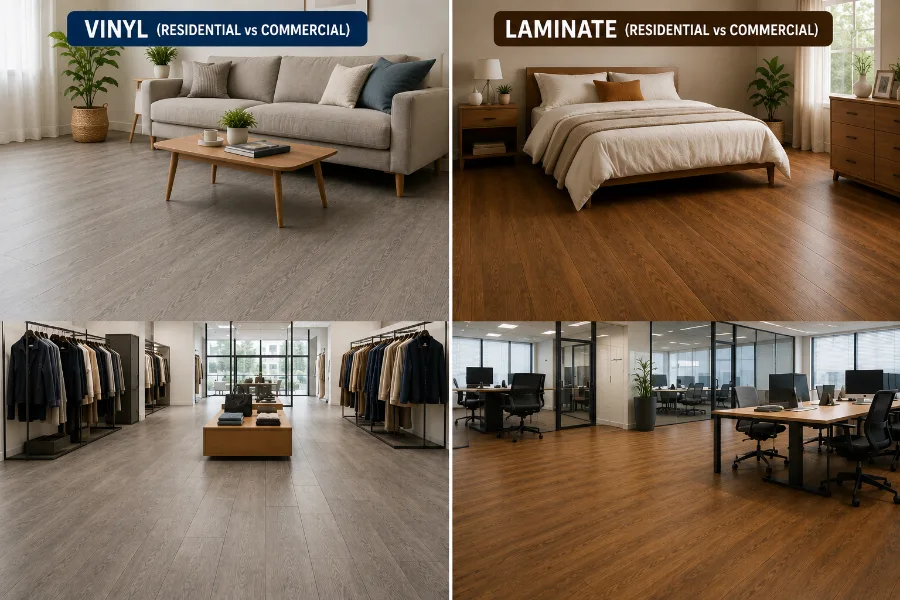
For homes, AC3 laminate covers every room adequately. AC4 costs $1 to $2 more per square foot and is worth it in kitchens, hallways and homes with dogs. For vinyl, 12 mil is the residential minimum, and 20 mil is the sensible upgrade for active households.
For commercial spaces, vinyl dominates for good reason. Healthcare, education and retail specify it because it cleans easily, resists moisture, meets fire standards and costs little to install. Commercial vinyl carries a 28 to 40 mil wear layer, and large floors are usually glued down to prevent movement under rolling loads.
Laminate works commercially at AC4 for offices, boutiques and cafés, and at AC5 for high-footfall public areas. It falls short anywhere with mopping schedules or wash-down cleaning, which rules out most food service and healthcare.
For rentals, vinyl is the pragmatic choice. Tenants spill things. Individual planks swap out between tenancies without redoing the room.
Best Rooms for Vinyl and Laminate
| Room | Best choice | Why |
| Kitchen | Vinyl (LVP or LVT) | Dishwasher leaks, sink splashes, dropped pans |
| Bathroom | Vinyl only | Standing water and constant humidity |
| Basement | Vinyl, rigid core SPC | Concrete slabs release moisture from below |
| Laundry room | Vinyl | Appliance leaks are a matter of when, not if |
| Mudroom and entryway | Vinyl, 20 mil | Wet boots, road salt, grit |
| Living room | Laminate | Dry, high traffic, benefits from scratch resistance |
| Bedroom | Laminate | Dry, low traffic, warm texture underfoot |
| Hallway | Laminate AC4 | Concentrated foot traffic, no moisture |
| Home office | Laminate, or vinyl under a chair mat | Rolling chairs favour vinyl |
| Conservatory or sunroom | SPC vinyl | Temperature swings demand dimensional stability |
| Stairs | Either, with matching nosing | Specify stair nosing at order time |
| Kitchen and living open plan | Vinyl throughout | One material avoids a transition strip mid-room |
Homes with dogs deserve a separate note. Choose vinyl if accidents are your concern, since the waterproof core handles them. Choose laminate if claw scratches are your concern and you control moisture well. Most dog owners end up with 20 mil vinyl because accidents cause the damage that cannot be undone.
Vinyl Flooring | Pros and Cons
Pros
- Waterproof in rigid core form, suitable for every room in the house
- Softer and warmer underfoot than laminate or tile
- Handles impact and rolling loads without cracking
- Quieter, especially with an attached IXPE pad
- Widest style range, covering both wood and stone looks
- Individual planks replace easily
- Thin profile fits under existing door frames
Cons
- Scratches more easily than laminate
- Cheap flexible LVP dents under heavy furniture
- Adds little resale value compared with hardwood
- PVC raises environmental and recycling questions
- Low-cost products fade in direct sunlight
- Thin planks telegraph subfloor imperfections
Laminate Flooring: Pros and Cons
Pros
- Best scratch and abrasion resistance in its price class
- Most convincing wood texture, especially with EIR embossing
- Cheapest option at the entry level
- Firm, solid feel underfoot
- Contains renewable wood fibre
- Clear AC rating system makes comparison easy
- Thicker planks forgive small subfloor dips
Cons
- Not waterproof, and water damage is permanent
- Unsuitable for bathrooms, basements and laundry rooms
- Hollow, clicky sound without proper acoustic underlay
- Chips under sharp impact
- Requires separate underlay in nearly every installation
- Sensitive to humidity swings outside 30% to 50%
Final Recommendation
Choose vinyl if: the room touches water, you have pets or young children, you are flooring a basement or bathroom, you want a stone look, or you need one material to run through an open-plan kitchen and living space. Buy SPC with a 20 mil wear layer.
Choose laminate if: the room stays dry, scratch resistance is your priority, you want the most realistic wood texture, or you are working to a tight budget. Buy AC4 at 10mm or 12mm.
Recommendations by budget, based on a 500 square foot room:
Under $1,500 (under $3 per sq ft): AC3 laminate in a dry bedroom or living room, installed DIY. Or budget sheet vinyl in a laundry room. Skip premium claims at this tier and put the savings into decent underlay.
$1,500 to $3,000 ($3 to $6 per sq ft): the value sweet spot. AC4 laminate for dry rooms, or 12 to 20 mil SPC vinyl for wet ones. Professional installation fits inside this range for straightforward rectangular rooms.
$3,000 to $5,000 ($6 to $10 per sq ft): premium 20 mil rigid core vinyl with an attached acoustic pad, or top-tier waterproof laminate. Professional installation, proper subfloor preparation and quality transitions included. This tier buys the 25-year outcome.
Whole-house strategy: run 20 mil SPC vinyl through the kitchen, bathrooms, laundry and basement. Run AC4 laminate through bedrooms, living rooms and hallways. Match the visual tone across both so transitions read as intentional. This mixed approach costs less than premium vinyl everywhere and performs better than laminate everywhere.
Before you order, verify five specs in writing: the AC rating or wear layer thickness, the core type, the total plank thickness, whether underlayment is attached, and the exact warranty terms for moisture. If a salesperson cannot produce the spec sheet, treat the claims as unverified.
Frequently Asked Questions
What is the main difference between vinyl and laminate flooring? The core. Vinyl has a plastic PVC core that water cannot damage. Laminate has a compressed wood fibre core that swells permanently when wet. Every other difference follows from this.
Is LVP better than laminate? LVP is better in kitchens, bathrooms, basements and laundry rooms because it is waterproof. Laminate is better in dry rooms where scratch resistance and wood texture matter most. Neither wins outright.
Which is cheaper, vinyl or laminate? Laminate is cheaper at the budget end, starting around $1 per square foot for materials. At mid-range and premium levels, prices are nearly identical, and vinyl adds waterproofing at no extra cost.
Which lasts longer? Both last 15 to 25 years, with premium products reaching 30. Installation quality and humidity control affect lifespan more than the material choice.
Can you put laminate in a bathroom? Standard laminate, no. Waterproof laminate can survive a bathroom if you seal the perimeter and wipe spills fast, but vinyl remains the safer choice. Bathroom humidity is constant, not occasional.
Does vinyl or laminate add more home value? Neither adds much. Well-installed LVP is roughly value-neutral to mildly positive with buyers. Appraisers still rank solid hardwood highest. Both beat worn carpet.
Do I need underlayment for vinyl plank? Only if the planks do not have a pad attached, and only 1mm to 1.5mm thick. Thick foam underlay compresses under rigid core vinyl and breaks the click joints.
Can vinyl or laminate go over existing flooring? Both can float over sound, flat, fully bonded existing floors such as tile or sheet vinyl. Remove carpet first. Check total height against door clearances before you start.
Is vinyl or laminate better for dogs? Vinyl for accidents, laminate for claws. Most dog owners choose 20 mil vinyl, because urine damage is permanent while surface scratches are cosmetic.
Which is warmer underfoot? Vinyl, particularly WPC. Its foamed core insulates better than laminate’s dense fibreboard.
Can either be refinished? No. Both use a printed design layer under a thin protective coat. Once that coat wears through, you replace planks rather than sand them.
What thickness should I buy? For laminate, 10mm to 12mm feels solid and forgives small subfloor flaws. For vinyl, 5mm to 8mm rigid core performs best. Below 4mm, vinyl telegraphs every bump in the subfloor.

Noah Williams
Interior Designer & Flooring Expert
Related Posts