
Noah Williams is an interior designer and flooring expert at Nova Floor. In Dubai, he helps people pick the right floor, get it installed, and keep it looking good. He also writes simple, practical flooring and home care guides for readers in Dubai and around the world.
How to Remove Coffee Stains from Carpet | 10 Easy & Effective Methods

Noah Williams
A coffee spill feels like a disaster, but most stains come out. You need to act fast, blot instead of rubbing, and match the cleaner to your carpet fiber.
This guide from Nova Floor shows you how to remove a coffee stain from carpet step by step. It also explains how to clean coffee out of carpet, whether the spill is fresh or old. You will learn 10 methods, from plain cool water to enzyme cleaners and wet extraction. You will also learn which products to avoid on wool, silk, viscose, and sisal.
Contents
The 60-Second Rescue for Spilled Coffee on Carpet
Do these five things before you read anything else:
- Scoop up any pooled liquid or coffee grounds with a spoon.
- Press a clean white cloth or paper towel on the spill. Lift it, move to a clean section, and press again.
- Work from the outside of the stain toward the center.
- Add a small splash of cool water. Blot it up with a fresh cloth.
- Repeat until very little coffee transfers to the cloth.
Do not rub. Do not use hot water. Do not use steam. These three mistakes turn a removable stain into a permanent one.
Why Coffee Stains Carpet So Easily
Coffee is more than brown water. Four things make a coffee stain on carpet hard to remove:
- Tannins. These natural compounds give coffee its color. They bond with carpet fibers, much like dye.
- Heat. Hot coffee soaks deep into the pile and backing fast. Heat also helps the stain bond.
- Oils. Brewed coffee carries small amounts of oil. Oil leaves a dull, greasy film that attracts dust.
- Milk and sugar. Milk adds protein and fat. Sugar leaves a sticky residue. Both make the stain harder to lift and can cause odor.
Dust makes the problem worse. A sticky patch traps fine sand and dirt, so the spot looks darker each week. In the UAE, that dust arrives daily.
Are Coffee Stains Permanent on Carpets?
Not usually. A fresh coffee stain is often fully removable. A dried coffee stain is harder but still treatable. Three factors decide the result:
- Time. Stains treated within minutes lift best. Stains older than a few days may leave a faint shadow.
- Fiber. Synthetic carpets resist staining better than wool, silk, or viscose.
- Treatment. Heat, hard rubbing, and leftover soap can lock a stain in.
A stain becomes permanent when you set it with heat, scrub the dye into the fibers, or bleach the carpet by mistake. Careful cleaning avoids all three.
Before You Start: Tools, Test Spot, and Water Temperature
What you need
- Clean white cloths or white paper towels (colored cloths can transfer dye)
- A spoon or blunt knife
- A spray bottle
- Mild, clear dish soap without bleach or lotion
- White vinegar
- Baking soda
- 3% hydrogen peroxide
- A vacuum cleaner
- A fan
Always test first
Pick a hidden spot, such as inside a wardrobe or under a sofa. Apply a drop of your cleaner and press with a white cloth. Wait five minutes, then blot dry. If you see color on the cloth, fading, or texture change, do not use that cleaner.
Use the right water temperature
| Situation | Water temperature |
| Fresh spill, first dilution | Cool |
| Mixing the soap and vinegar solution | Cool to lukewarm |
| Rinsing any cleaner | Cool |
| Dried or old stain, loosening | Lukewarm (comfortable to the touch) |
| Any stage | Never hot, never steam |
Match the Method to Your Carpet Type
The wrong product on the wrong fiber causes more damage than the coffee. Use this table as a guide.
| Carpet or rug fiber | Safe starting point | Avoid |
| Nylon | Dish soap and vinegar, peroxide on light colors | Strong bleach |
| Polyester | Dish soap and vinegar, spot remover | Heavy scrubbing, oily products |
| Olefin (polypropylene) | Dish soap and vinegar, rinse well | Oily products, which cling to olefin |
| Wool and wool blends | Wool-safe detergent in cold water | Baking soda, peroxide, enzyme cleaners, strong vinegar |
| Silk | Blot only, then call a specialist | Almost every home product |
| Viscose or art silk | Blot only, then call a specialist | Water, which can cause yellowing and shrinkage |
| Sisal, jute, seagrass | Dry blotting, very little moisture | Soaking, which leaves water rings |
| Hand-knotted and Turkish rugs | Dry blot, minimal mild detergent | Soaking, hot water, harsh chemicals |
Wool and silk are protein fibers. Enzyme cleaners digest protein, so they can damage these fibers. Baking soda and peroxide are also too harsh for them.
Match the Method to Your Coffee
| Type of coffee | What it adds | Best approach |
| Black coffee | Tannins | Methods 1 and 2 |
| Arabic coffee (gahwa) | Tannins plus spice and saffron color | Methods 1 and 2, repeat as needed |
| Turkish coffee | Fine grounds plus tannins | Scoop and vacuum grounds first, then Methods 1 and 2 |
| Espresso | Strong tannins and oil | Methods 1, 2, then 5 |
| Latte or cappuccino | Milk protein and fat | Methods 1, 2, then 7 |
| Sweet or flavored coffee | Sugar and dyes | Methods 1, 2, then rinse twice |
| Instant 3-in-1 coffee | Sugar and creamer | Methods 1, 2, then 7 |
| Iced coffee or cold brew | Large volume, melting ice | Blot, then Method 10 if it soaked deep |
The same approach works for tea and karak. They also carry tannins.
10 Easy and Effective Methods for Coffee Stain Removal on Carpet
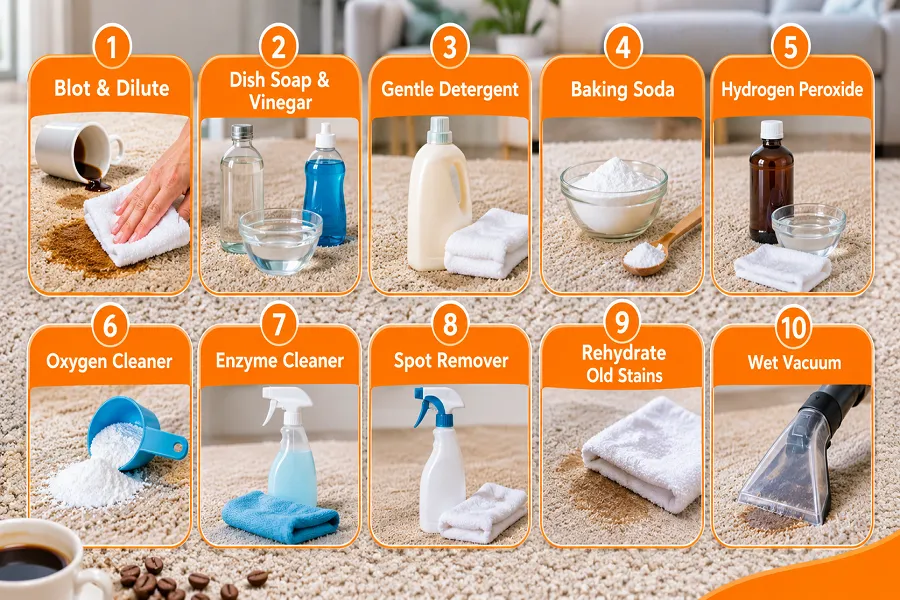
Method 1: Blot and Dilute with Cool Water First
This is the first step for every carpet. It removes most of the coffee before the stain sets.
- Scoop any liquid or grounds off the surface.
- Press a white cloth over the spill. Lift and repeat with clean sections.
- Pour a small amount of cool water on the stain.
- Blot it up right away.
- Repeat until the cloth stays almost clean.
Use just enough water to dilute the coffee. A soaked carpet spreads the stain and wets the pad underneath.
Best for: fresh spills on any carpet.
Method 2: Dish Soap and White Vinegar Solution
This is the most reliable home method for getting coffee stains out of carpet. Soap cuts oils and sugar. Vinegar helps loosen the tannin color.
Mix: 1 tablespoon of clear dish soap, 1 tablespoon of white vinegar, and 2 cups of cool to lukewarm water.
- Blot the stain first (Method 1).
- Dip a white cloth in the solution. Wring it out until damp.
- Blot the stain from the edges toward the center.
- Rewet the cloth and continue until the color stops lifting.
- Rinse by blotting with a cloth dipped in plain cool water.
- Blot dry with a clean dry cloth.
- Let the spot air dry, then vacuum to lift the pile.
The rinse matters. Leftover soap attracts dirt and leaves a dark patch weeks later.
Best for: nylon, polyester, and olefin carpets. Test first on wool.
Method 3: Mild Detergent for Wool and Delicate Carpets
Wool needs a gentle, neutral approach.
Mix: 3 to 5 drops of a wool-safe detergent, or a mild, pH-neutral dish soap, in 1 cup of cold water.
- Blot up the spill.
- Dab the solution onto the stain with a white cloth.
- Alternate between a damp cloth with plain cold water and a dry cloth.
- Stop when the color stops transferring.
- Dry with a fan on a cool setting, then vacuum lightly.
Keep the area as dry as possible. If the stain does not lift after two rounds, stop and call a specialist.
Best for: wool, wool blends, and valuable rugs.
Method 4: Baking Soda for Moisture, Odor, and Leftover Shadows
Baking soda works best as a finishing step. It absorbs moisture and odor. Use it on synthetic carpets only.
Dry method:
- After Method 2, leave the spot slightly damp.
- Sprinkle a thin, even layer of baking soda.
- Let it dry completely. This takes several hours.
- Vacuum thoroughly.
Paste method for a faint shadow:
- Mix 1 part baking soda with about 3 parts water until it forms a spreadable paste.
- Spread it over the stain with a spoon.
- Let it dry fully.
- Vacuum the dry residue in slow passes.
Do not rub the paste into the carpet. Let it dry first. Wet paste is hard to vacuum and can leave white residue.
Best for: synthetic carpets, mild odor, and leftover shadows.
Method 5: Hydrogen Peroxide and Dish Soap for Light Carpets
Peroxide breaks down coffee pigment. It also bleaches. Use it only on light, colorfast synthetic carpets.
Mix: 1 cup of 3% hydrogen peroxide with ½ teaspoon of dish soap.
- Do a test spot first. Wait five minutes.
- Blot the stain to remove loose coffee.
- Dab the solution on with a white cloth.
- Let it sit for up to 10 minutes. Check every few minutes for color loss in the carpet.
- Blot with a dry cloth.
- Rinse with cool water and blot dry.
Do not use peroxide on dark, red, or patterned carpets. It can leave pale patches. Never use it on wool or silk.
Best for: old or stubborn stains on white, cream, or beige synthetic carpet.
Method 6: Oxygen-Based Stain Remover
Oxygen-based cleaners, such as OxiClean-type products, release oxygen to lift stains. They are gentler than chlorine bleach.
- Mix the powder or spray exactly as the label says.
- Test a hidden spot.
- Apply a small amount to the stain with a cloth.
- Wait 5 to 10 minutes. Do not let it dry out.
- Blot, rinse with cool water, and blot dry.
Skip this on wool, silk, and brightly dyed carpets unless the label says it is safe.
Best for: set-in stains on colorfast synthetic carpets.
Method 7: Enzyme Cleaner for Milk, Cream, and Sweet Coffee
Enzyme cleaners break down protein and fat. They also remove the sour smell that milk can leave behind.
- Blot the stain and treat it with Method 2 first.
- Lightly spray or dab the enzyme cleaner. Do not soak the carpet.
- Keep the spot damp for the time on the label, usually 10 to 15 minutes.
- Blot with a clean cloth.
- Rinse with cool water. Blot dry.
Enzyme cleaners can damage wool and silk. Check the label before you use one.
Best for: lattes, cappuccinos, 3-in-1 sachets, and sour milk odor.
Method 8: Carpet Spot Remover
A store-bought spot remover saves time. Choose one marked safe for your carpet fiber.
- Read the label and test a hidden spot.
- Spray lightly on the stain.
- Wait for the time on the label.
- Blot with a clean white cloth. Do not rub.
- Rinse if the label asks you to.
Some products leave a residue that attracts dirt. If the label does not say “no rinse,” rinse with cool water.
Best for: stubborn stains when you have no time to mix a solution.
Method 9: Rehydrate and Treat Old or Dried Coffee Stains
Dried coffee needs patience. The goal is to soften the stain before you clean it.
- Vacuum dried grounds and crusty residue first.
- Lay a cloth dampened with lukewarm water over the stain. Leave it for 5 to 10 minutes.
- Blot to lift the softened coffee.
- Treat with Method 2.
- If a shadow stays, try Method 5 on a light carpet.
- Finish with dry baking soda (Method 4) while the carpet dries.
- Repeat the full cycle up to three times.
If the stain does not change after three rounds, stop. More scrubbing risks fraying the fibers. Call a professional.
Best for: stains that are hours, days, or weeks old.
Method 10: Wet Vacuum or Carpet Extractor for Large Coffee Spills on Carpet
A wet-dry vacuum or carpet cleaning machine pulls liquid out of the carpet and pad. Use it when coffee has soaked in or covers a large area.
- Blot the surface first.
- Treat the stain with Method 2.
- Fill the machine with cool water and a small amount of carpet-safe cleaner.
- Make slow passes over the spot.
- Do a final pass with clean water.
- Use dry passes to extract moisture.
- Run a fan until the carpet is fully dry.
Keep steam and hot water away until the stain is gone. Heat can set leftover tannin. Check your carpet’s care label before you use any machine on handmade or natural-fiber rugs.
Best for: wall-to-wall carpet, iced coffee spills, and soaked areas.
Home Remedies to Skip or Use with Caution
You will find many hacks online. Some help a little. Others cause damage.
| Remedy | Verdict |
| Club soda | Safe but weak. It can help with a fresh spill. Blot right away. |
| Lemon juice | Mildly acidic and can lighten carpet dye. Skip it on colored carpets. |
| Salt | Can absorb a fresh wet spill, but leaves residue. Vacuum well. |
| Toothpaste | Often contains abrasives, whiteners, and dyes. Skip it. |
| Beer | Leaves sugar and a sticky film. Skip it. |
| WD-40 | Leaves oily residue that attracts dirt. Skip it. |
| Chlorine bleach | Destroys carpet color and fibers. Never use it. |
What to Do by Stain Age
| Stain age | What to do |
| Under 5 minutes | Methods 1 and 2 |
| Under 24 hours | Methods 1, 2, and 4 |
| 1 to 7 days | Method 9, then Method 5 or 6 on suitable carpets |
| Weeks or months | Method 9, then a professional if the stain stays |
How to Dry Carpet After Cleaning (and Avoid Brown Rings)
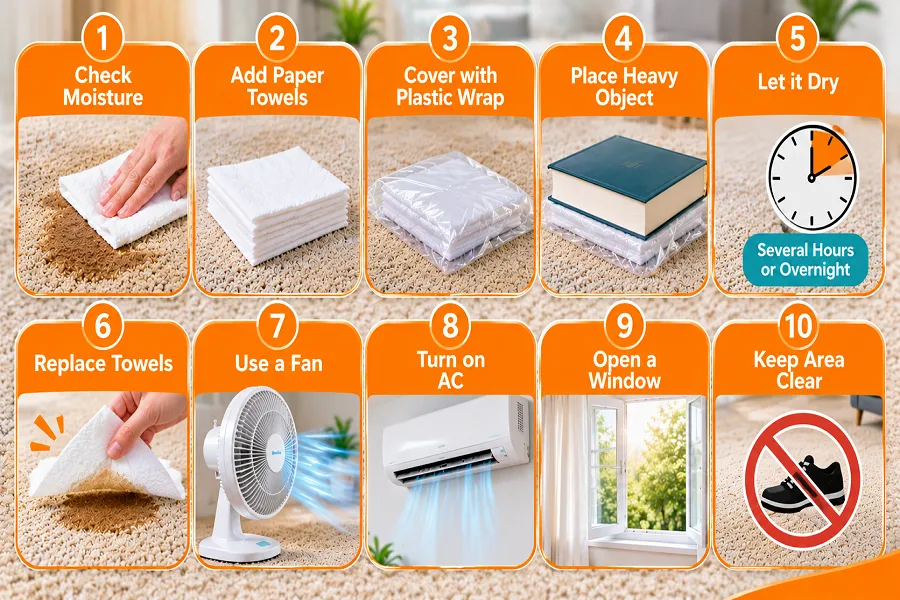
Poor drying causes many “failed” stain removals. Water carries stain from the pad back up to the surface. That creates a brown ring around the spot.
Check if coffee reached the pad
Press a dry white paper towel on the spot. If brown color transfers, coffee soaked down to the pad or backing.
Pull moisture out
- Lay a stack of white paper towels, about a centimeter thick, over the spot.
- Cover it with a sheet of plastic wrap.
- Place a heavy book or jar on top.
- Leave it for several hours or overnight.
- Replace the towels if they turn brown.
Speed up drying
- Run a fan across the spot.
- Turn on the air conditioner.
- Open a window if the air is not humid.
- Use a dehumidifier in humid coastal weather.
- Keep people and furniture off the area until dry.
Carpet should feel dry within a few hours. Dampness that lasts more than 24 to 48 hours can cause mildew and a musty smell. For more drying tips, read our guide on how to clean a carpet.
Troubleshooting: When the Stain Still Shows
Removing coffee stains from carpet sometimes takes more than one round. Use this table when the spot still looks wrong.
| Problem | Likely cause | Fix |
| Stain disappears, then returns | Wicking from the pad | Use the weighted paper towel method. Dry fully. |
| Brown ring around the spot | Over-wetting | Lightly dampen the whole ring, blot, and dry with a fan. |
| Yellow halo | Acid or over-wetting on delicate fibers | Stop. Call a professional. |
| Sticky or crunchy patch | Sugar or soap residue | Rinse with cool water and blot dry twice. |
| Sour smell | Milk protein | Use Method 7 on suitable fibers. Finish with baking soda. |
| Pale patch | Bleaching from peroxide or lemon | Not fixable at home. Ask a professional about re-dyeing. |
| Fuzzy, frayed pile | Hard scrubbing | Trim loose fibers gently with scissors. Avoid further rubbing. |
Common Mistakes That Make Coffee Stains Permanent
- Rubbing or scrubbing. This pushes coffee deeper and frays fibers.
- Using hot water or steam too soon. Heat can set tannin and milk protein.
- Soaking the carpet. Water spreads the stain and wets the pad.
- Skipping the rinse. Leftover soap attracts new dirt.
- Using colored cloths. Dye can transfer onto the carpet.
- Mixing cleaners. Never mix peroxide with vinegar in one bottle. The mix can create an irritating acid.
- Skipping the test spot. A hidden test takes five minutes. A faded patch lasts for years.
- Waiting. Every hour makes the stain harder.
Special Situations For Coffee Stains

Coffee on rugs
Learn the rug’s construction before you clean. Hand-knotted rugs can bleed dye if soaked. Tufted rugs have a glue-based backing that weakens with too much water. Use dry blotting and minimal moisture for these. Many Turkish carpets use hand-knotted wool or silk, so they need gentle care. Rugs of any shape follow the same rules, including round rugs and runners. To get coffee out of a rug, blot first. Then use Method 3 or Method 2, depending on the fiber.
Coffee on natural fiber carpet
Sisal carpets absorb water fast and can show rings. Blot with dry cloths only. Use a very small amount of mild soap on a barely damp cloth. Dry quickly with a fan.
Coffee on stairs and hallways
Stairs and corridors see constant traffic, so spills spread quickly. Blot, treat, and dry the spot before people walk on it. Stairs dry slowly at the edges of each step. Run a fan along the staircase and keep people off it until it feels dry. Our stair carpets follow the same cleaning rules as any fitted carpet.
Coffee on outdoor carpet
Outdoor carpets use water-resistant synthetic fibers. Blot the spill, scrub gently with soapy water, and rinse with a hose. Let it dry in the sun.
Coffee on fitted carpet
Large wall-to-wall areas hold more liquid and pad. For big spills on wall-to-wall carpet, use Method 10 and dry the pad.
Coffee in bedrooms and living rooms
Morning coffee often ends up on bedroom carpets and living room carpets. Light-colored carpets show stains fastest. Bold shades such as red carpets hide a faint shadow but can fade with peroxide, so test first.
Coffee in offices, mosques, and event spaces
Busy commercial floors need fast, repeatable cleaning. Keep a spill kit near the coffee station. Office carpets,mosque carpets, and exhibition carpets take heavy foot traffic. A stain left overnight gets walked into the pile. Treat these areas right away. Schedule professional extraction for large or repeat stains.
Coffee on sofas and car seats
Use the same steps with less water. Upholstery foam soaks up liquid fast, so blot more and spray less.
When to Call a Professional Carpet Cleaner
Home methods have limits. Call an expert when:
- The spill covers a large area or soaked the pad.
- The stain stays after three full rounds.
- Your carpet is silk, viscose, antique, or hand-knotted.
- A brown ring keeps coming back.
- A sour smell remains.
- The stain turned yellow after cleaning.
- Your carpet warranty requires approved cleaning methods.
Professionals use controlled extraction, fiber-safe cleaners, and strong drying equipment. Early help costs less than repairing a damaged carpet.
How to Prevent Coffee Stains on Carpet
- Use lidded travel mugs in carpeted rooms.
- Drink coffee at a table, not on the sofa or in bed.
- Place trays under cups when serving guests in the majlis or living room.
- Put a washable rug under coffee stations.
- Apply a stain-guard treatment on new carpet. Check your warranty first.
- Keep a spill kit with white cloths, a spray bottle, dish soap, and baking soda.
- Vacuum often so dust does not turn a spill into mud.
- Deal with sticky residue quickly. It attracts dust and can draw pests such as carpet beetles.
- Choose stain-resistant fibers if you drink coffee near the carpet often. Our guide to flooring types compares carpet with other options. You can also browse our full carpet collection.
Frequently Asked Questions
How do you get coffee stains out of carpet?
Blot the spill with a white cloth and dilute it with cool water. Then apply a solution of 1 tablespoon of dish soap, 1 tablespoon of white vinegar, and 2 cups of water. Blot, rinse with plain water, and dry the spot with a fan.
What is the best way to get coffee stains out of carpet?
The best way is fast blotting, then the dish soap and vinegar solution. For light carpets with stubborn stains, add a peroxide step. For milk-based coffee, add an enzyme cleaner.
What gets coffee stains out of carpet?
Dish soap, white vinegar, and cool water remove most fresh stains. Baking soda absorbs odor and leftover moisture. Hydrogen peroxide and oxygen-based cleaners help on old stains on light synthetic carpet.
What coffee stain remover works on light carpets?
On light or cream synthetic carpets, use 3% hydrogen peroxide mixed with a few drops of dish soap, or an oxygen-based stain remover. Both lift coffee pigment without chlorine bleach. Test a hidden spot first, because peroxide can lighten some dyes. On wool or silk, skip both and use a wool-safe detergent instead.
How do I clean a coffee spill on carpet?
Scoop up the liquid, blot with a white cloth, and dilute with cool water. Treat with a soap and vinegar solution, rinse, and dry with a fan. Work quickly, because fresh spills lift best.
How do I get coffee out of a carpet that has dried?
Vacuum off any dried residue. Cover the stain with a cloth dampened in lukewarm water for 5 to 10 minutes. Then clean with soap and vinegar, and repeat up to three times.
How do I get coffee out of a rug?
Blot the spill and use a very small amount of mild soap in cold water. Dab, rinse, and blot dry. Keep the rug as dry as possible. Handmade rugs, silk, and viscose may need a specialist.
Are coffee stains permanent on carpet?
Not usually. Fresh stains often come out completely. Old stains may leave a faint shadow, especially on light or delicate carpets. Heat and scrubbing raise the risk of a permanent mark.
Can I use hot water on coffee stains?
No. Hot water and steam can set tannin and milk protein. Use cool water first. Use lukewarm water only to loosen a dried stain.
Does vinegar remove coffee stains from carpet?
Yes, on most synthetic carpets. Mix it with dish soap and water, and rinse well. Test it first on wool, and skip it on silk.
Does baking soda work on coffee stains?
It helps absorb moisture, odor, and faint residue. It works best after you treat the stain with soap and vinegar. Do not use it on wool.
How do I remove old coffee stains from carpet?
Vacuum any dried residue. Cover the stain with a damp cloth for 5 to 10 minutes to soften it. Then clean with soap and vinegar. Try peroxide on light synthetic carpets. Repeat up to three times, and then call a professional.
How long should carpet take to dry after cleaning?
A few hours with a fan and air conditioning. If the carpet stays damp for more than 24 to 48 hours, mildew can start. Use a dehumidifier or call a professional.
Can I use a steam cleaner on a coffee stain?
Not at first. Treat and remove the stain, and then steam clean the whole area if needed. Check the care label first.
Final Thoughts
Coffee does not have to ruin your carpet. Blot first, dilute with cool water, and treat the stain with a method that suits your fiber. Rinse well, dry thoroughly, and stop before you damage the pile. If a stain refuses to move, a professional can often save a carpet that home methods cannot.

Noah Williams
Interior Designer & Flooring Expert