Noah Williams is an interior designer and flooring expert at Nova Floor. In Dubai, he helps people pick the right floor, get it installed, and keep it looking good. He also writes simple, practical flooring and home care guides for readers in Dubai and around the world.
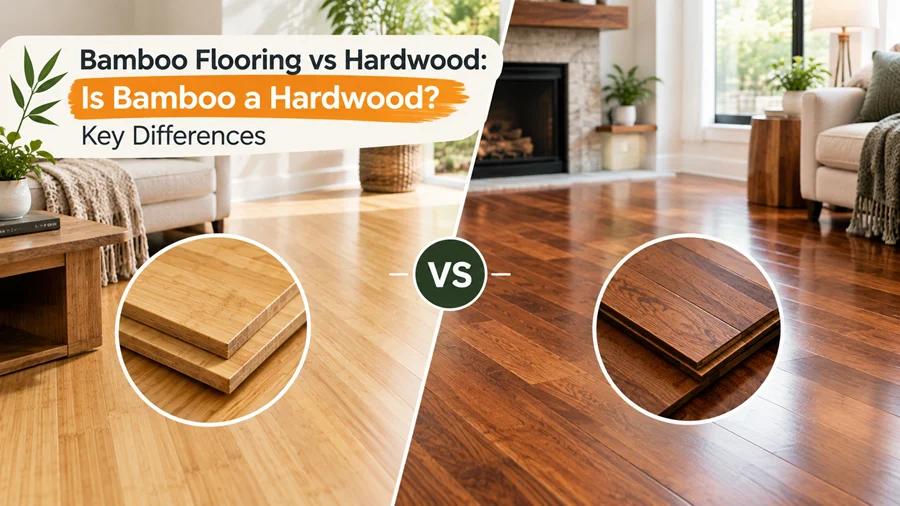
Bamboo Flooring vs Hardwood | Is Bamboo a Hardwood? Key Differences
Noah Williams
Bamboo is not a hardwood. It is a giant grass. Bamboo flooring is often sold next to hardwood because it looks, installs, and wears a lot like wood. Strand woven bamboo is usually harder and cheaper than oak, and the plant grows back in about five years. Solid hardwood lasts much longer, can be sanded and refinished many more times, comes in far more styles, and has stronger resale appeal. Standard bamboo and hardwood floors are not waterproof.
Whether you’re weighing hardwood vs bamboo for one room or a whole house, the right pick depends on your budget, your climate, how long you plan to stay in your home, and the look you want. This guide by Nova Floor experts compares both floors point by point, with real numbers, so you can decide with confidence.
Contents
Is Bamboo Wood?
Not in the scientific sense. Bamboo flooring belongs to the grass family (Poaceae), the same plant family as wheat, corn, and lawn grass. Trees make wood by adding a new layer of growth every year, which forms growth rings. This flooring never does this. A bamboo stalk comes out of the ground at its full width and reaches full height in one growing season. After that, it spends a few years getting harder and denser.
Still, bamboo is “woody.” Its fibers contain the same building blocks as wood: cellulose, hemicellulose, and lignin. That is why it can be cut, glued, pressed, and milled into planks that look and feel like wood flooring. So in everyday talk, people call it “bamboo wood” and shop for “bamboo wood flooring,” and that is fine.
Is Bamboo a Hardwood?
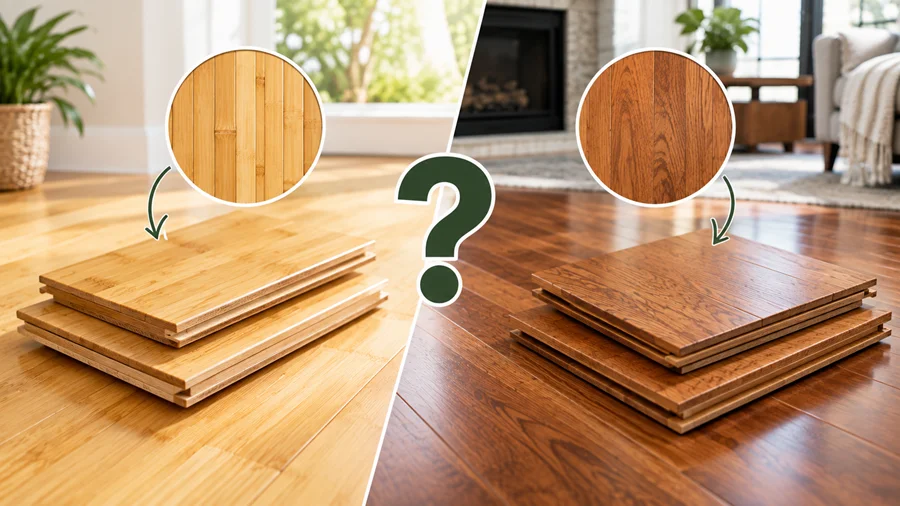
No. In botany, “hardwood” means wood from flowering, broad-leaf trees such as oak, maple, hickory, cherry, and walnut. Bamboo is not a tree, so it cannot be a hardwood.
So why is it is considered hardwood by so many stores? Three reasons:
- It does the same job. Bamboo planks install, look, and wear much like hardwood planks.
- It is often harder than many true hardwoods. Good strand woven beats oak on dent tests.
- Stores group products by use, not by botany. You will often find bamboo in the “hardwood” aisle or website category.
Fun fact: “hardwood” does not always mean hard. Balsa, used in model airplanes, is a hardwood but softer than most softwoods.
Bamboo vs Hardwood Flooring at a Glance
Strand woven bamboo wins on price and dent resistance; solid hardwood wins on lifespan, refinishing, style range, and resale.
| Factor | Bamboo flooring | Hardwood flooring |
| What it is | Grass strips or fibers glued and pressed into planks | Lumber from broad-leaf trees (solid or engineered) |
| Hardness (Janka, lbf) | About 1,100–1,400 for horizontal/vertical; most strand woven lots test about 3,000–4,000 | About 950–1,820 for common U.S. species; 2,350+ for some exotics |
| Material cost | About $2–$10 per sq. ft. | About $6–$15 per sq. ft. |
| Installed cost | About $7–$17 per sq. ft. | About $9–$25 per sq. ft. |
| Typical lifespan | About 20–25 years on average; up to 50 with good care | Decades; solid hardwood can last 100+ years |
| Full sand-and-refinish | Usually 1–3 times, depending on type and thickness | Solid: about 6–8 times; engineered: depends on wear layer |
| Moisture | Slightly more tolerant, not waterproof (except rigid-core products) | Sensitive to water and humidity |
| Style range | Limited: natural, carbonized, stained, a few grain looks | Very wide: dozens of species, grades, cuts, widths |
| Regrowth time | About 5–6 years for Moso bamboo | Decades for most hardwood species |
| Resale appeal | Positive, but less recognized by buyers | Strong; one of the top-returning interior projects |
Prices are typical 2026 U.S. national ranges. Your local price depends on region, product, and job conditions.
Bamboo Flooring Types (and Why They Matter)
The type of bamboo you buy changes its hardness, price, lifespan, and look more than any other factor. Most confusion in the bamboo vs hardwood debate comes from treating all bamboo as one product.
| Bamboo type | How it is made | Material cost (per sq. ft.) | Best for |
| Horizontal | Flat strips glued side by side; bamboo “knuckles” show | $2–$5 | Classic bamboo look, low-traffic rooms |
| Vertical | Narrow strips turned on edge; clean, striped look | $2–$7 | Modern style, low-traffic rooms |
| Strand woven | Shredded fibers mixed with resin, pressed under heat and pressure | $3–$10 | Busy homes, kids, pets |
| Engineered | Bamboo top layer (often strand woven) on a plywood or HDF core | $2–$10 | Concrete slabs, humidity swings, click-lock DIY |
| Rigid-core (“waterproof”) | Bamboo surface bonded to a waterproof core | Varies by brand | Spill-prone areas like kitchens |
Strand woven is the most popular type today. It is the hardest and often looks more like real wood grain than traditional bamboo.
Natural vs carbonized color. Natural bamboo is light blond to honey. Carbonized bamboo is heated until its sugars caramelize, turning it brown. That heat weakens the fibers. Carbonized bamboo is on average about 20% softer than natural bamboo, and it absorbs water more easily. Many brands publish Janka numbers for the natural color only, so check the rating for the exact color you want.
Harvest age matters too. Most Moso bamboo for flooring is cut in its 5th or 6th year. Younger stalks are softer. Stalks much older than six years can turn brittle.
Hardwood Flooring Types
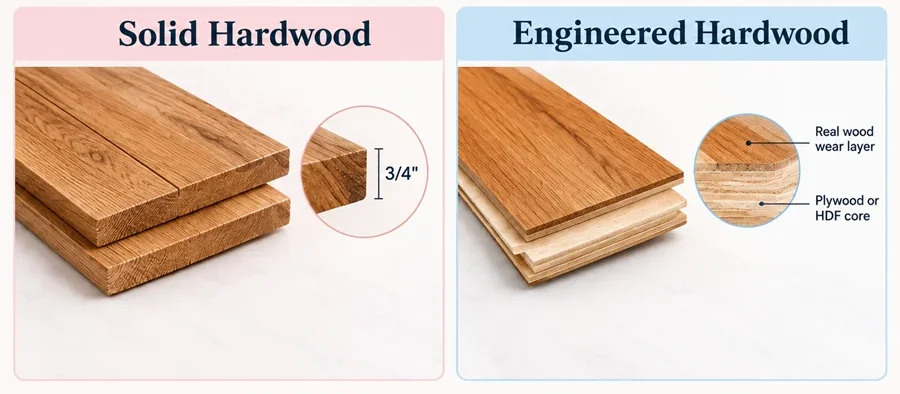
Solid hardwood is one piece of wood, usually 3/4 inch thick, and lasts the longest because you can sand it many times. Engineered hardwood has a real wood top layer (the “wear layer”) on a plywood or HDF core, so it handles humidity better and can go over concrete. Common species include red oak, white oak, hickory, maple, walnut, and cherry.
Bamboo vs Hardwood Hardness
Good strand woven bamboo is about two to three times harder than red oak, the industry benchmark at 1,290 lbf. Traditional bamboo is only about as hard as oak. The Janka test measures the force needed to press a steel ball halfway into a board, so higher numbers mean better dent resistance.
| Flooring | Approx. Janka rating (lbf) |
| Strand woven bamboo | 3,000–4,000 for most lots (some claims exceed 5,000) |
| Ipe (Brazilian walnut) | 3,500–3,680 |
| Brazilian cherry (jatoba) | 2,350 |
| Hickory | 1,820 |
| Hard maple | 1,450 |
| Natural horizontal/vertical bamboo | About 1,380 |
| White oak | 1,360 |
| Red oak (benchmark) | 1,290 |
| Carbonized horizontal/vertical bamboo | About 1,180 |
| Black walnut | 1,010 |
| Black cherry | 950 |
Why bamboo numbers vary so much: Bamboo has no national grading standard. Hardness changes with harvest age, growing region, density, glue, compression, and even where on the plank the test is taken. One strand woven manufacturer notes that ratings can vary from lot to lot, even from the same factory. Treat claims above 4,000 with care unless the brand shares independent lab results.
Bamboo vs Hardwood Durability
Strand woven bamboo is tougher day to day, but hardwood flooring durability wins over a lifetime because solid wood can be restored more times.
Dents: Janka predicts dent resistance, and this is where bamboo flooring durability shines. Strand woven bamboo shrugs off dropped pans, chair legs, and high heels better than oak or maple.
Gouges: Most comparisons miss this. Bamboo’s strength sits in its long fibers, but the tissue between them is weak. A sharp object, like a small rock in a shoe, can cut through those fibers and gouge traditional bamboo deeper than oak with the same Janka rating.
Scratches: The factory finish matters more than the plank. Both floors usually use tough aluminum oxide finishes, and fine scratches show most on dark, glossy floors. For pets and kids, pick strand woven bamboo or hickory in a matte, mid-tone finish.
Bamboo vs Hardwood Moisture Resistance
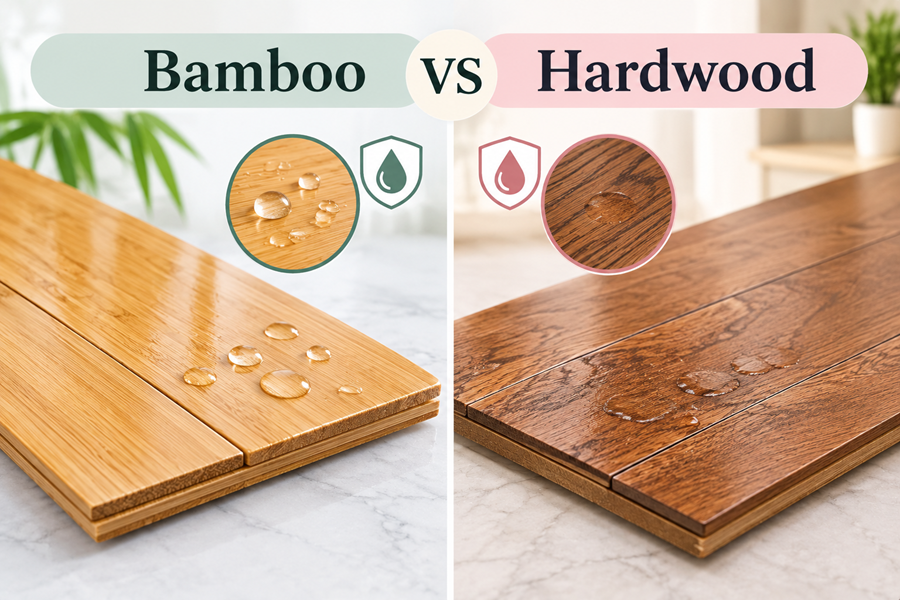
Neither floor is waterproof. Bamboo handles moisture slightly better than most hardwoods, but standing water and humidity swings can damage both.
Bamboo flooring water resistance. Most bamboo is water-resistant, so spills wiped up quickly are fine. Leaks and long-standing water can cause swelling, cupping, and warping. The exception is rigid-core bamboo: several brands now sell a bamboo surface on a waterproof core for spill-prone rooms.
Hardwood flooring water resistance. Solid hardwood swells when it takes on water and shrinks as it dries. That leads to gaps, cupping, and crowning. Engineered hardwood holds its shape better but still should not sit in water.
Two bamboo quirks few guides mention:
- It moves along its length. Wood barely changes length with humidity, but bamboo does. Installers must leave expansion space at the ends of boards, not just the sides. In dry seasons, bamboo ends can also pull apart.
- Strand woven bamboo on concrete can cup. Its dense, glue-filled planks act like a vapor barrier. Moisture rising from a slab can get trapped underneath and slowly build up. On concrete, test the slab and use a top-quality vapor retarder.
Climate matters. Keep rooms at 60–80°F and 30–50% relative humidity (some makers allow 35–55%). Use a humidifier in dry winters and a dehumidifier in humid summers.
Where to skip both: full bathrooms, laundry rooms, and mudrooms. For basements, use engineered bamboo or engineered hardwood only, never solid. If you need true waterproofing, look at rigid-core bamboo, luxury vinyl tile.
Bamboo vs Hardwood Cost
Bamboo usually costs about 25–35% less installed than solid hardwood. Most of the gap comes from materials, since labor rates are similar.
| Cost item (per sq. ft., 2026 U.S.) | Bamboo | Hardwood |
| Materials | $3–$8 typical ($2–$10 full range) | $6–$15 |
| Professional labor | $4–$9 | $3–$10 |
| Total installed | $7–$17 | $11–$25 solid; $9–$20 engineered |
| Sand and refinish | $2–$6 | $2–$8 |
| Old floor removal | About $1.50–$3.50 | About $1.50–$3.50 |
What raises the price: For bamboo, strand woven construction, thicker or wider planks, trusted brands, and certifications. For hardwood, exotic species, select grades, wide planks, special cuts, and patterns like herringbone. Be wary of rock-bottom bamboo: most looks alike in the box, but cheap product often uses young stalks or weak glue.
Lifetime Cost: A Worked Example
Upfront price is only part of the story. Here is a simple 50-year comparison for a 1,000-square-foot area, using mid-range 2026 prices and ignoring inflation.
| 50-year item | Strand woven bamboo | Solid oak |
| First install | $12,000 ($12/sq. ft.) | $18,000 ($18/sq. ft.) |
| Upkeep | 2 recoats: $3,000 | 4 full refinishes (about every 10 years): $20,000 |
| Replacement | Remove and reinstall once at year 25: $14,500 | None |
| Approx. 50-year total | $29,500 | $38,000 |
In pure dollars, quality bamboo often stays cheaper even over decades. Hardwood’s case rests on a floor that can outlast the house, more design choice, and stronger resale value.
Bamboo vs Hardwood Lifespan
Hardwood flooring lifespan is the longest: solid hardwood can last 100 years or more, and engineered hardwood lasts decades. Bamboo flooring lifespan is about 20–25 years on average and up to 50 with good care, but it wears out sooner in humid homes. Warranties run about 10 to 50 years. For both, the biggest factor is how many times you can restore the surface.
Bamboo vs Hardwood Refinishing
Solid hardwood can usually be sanded six to eight times over its life. Most bamboo allows one to three full sandings.
Hardwood Flooring Refinishing
Each sanding removes about 1/32 to 1/16 inch of wood. Solid hardwood has roughly 1/4 inch to work with, and it takes stain well, so you can change its color each time. Engineered hardwood depends on its wear layer:
| Engineered wear layer | Full sanding? |
| Under 2.5 mm (3/32 inch) | Not recommended; screen-and-recoat only |
| About 3 mm | Usually one or two |
| 4–6 mm | Several; can behave close to solid |
Bamboo Flooring Refinishing
- Solid horizontal and vertical bamboo can usually be sanded one or two times, depending on thickness.
- Strand woven bamboo takes a new clear coat well, but staining it on site is hard. Its density and resin wear down sandpaper fast, so hire a pro who has sanded strand bamboo before.
- Engineered bamboo often has a thin top layer that can be refinished rarely, if at all.
- Carbonized or stained bamboo can come out uneven when sanded.
Pro tip: A “screen and recoat” adds a fresh topcoat without removing wood. Doing it every few years greatly delays full sanding on both floors. Always check the maker’s guide first, since wrong sanding can void a warranty.
Bamboo vs Hardwood Maintenance
Daily care is almost the same for both: sweep or vacuum often (grit acts like sandpaper), clean with a barely damp mop and a pH-neutral wood cleaner, wipe spills right away, and use felt pads, entry mats, and trimmed pet nails.
Avoid on both: steam mops, soaking-wet mops, harsh or abrasive cleaners, vinegar or ammonia mixes, and wax on factory-finished floors.
Bamboo flooring maintenance needs closer attention to humidity, especially in very dry winters, when bamboo can shrink or crack. Hardwood flooring maintenance means planning for a refinish every 7–10 years in busy areas. That extra cost is also what gives hardwood its long life.
Sunlight changes both. Natural bamboo turns amber and carbonized bamboo can lighten; cherry and walnut change most. Use blinds in sunny rooms and move rugs now and then.
Bamboo vs Hardwood Installation
Both floors can be nailed, glued, or floated, and both are DIY-friendly in click-lock form. Strand woven bamboo and solid nail-down hardwood are the two hardest to install well.
| Method | Bamboo | Hardwood |
| Nail or staple down | Yes | Yes; the classic method for solid |
| Glue down | Yes; common over concrete | Yes; common for engineered |
| Floating (click-lock) | Yes; very common | Yes; engineered only |
| Over concrete / below grade | Engineered or rigid-core only | Engineered only |
Bamboo installation tips:
- Acclimate longer than you think. Strand woven bamboo is so dense that it can take weeks, not days, to settle to your home’s moisture level. Follow the maker’s guide and check with a moisture meter.
- Use the right fasteners. Strand woven makers typically call for 18-gauge cleats. Thicker cleats can push up bumps, and hitting the nailer too hard can crack plank edges.
- Leave end gaps. Because bamboo expands along its length, leave expansion space at the board ends as well as the sides.
- Use carbide blades. Bamboo contains silica and strand woven contains resin, so both dull regular saw blades fast.
Hardwood installation tips: Solid nail-down needs a flat wood subfloor, special tools, and skill, so most people hire a pro. Engineered click-lock hardwood is one of the easiest real-wood floors to DIY.
Steps that matter for both:
- Get the room ready. Run the heat or AC so the space sits at living conditions (the temperature and humidity range above) for at least five days before the flooring arrives.
- Test moisture. For a wood subfloor, planks and subfloor should be within about 2 percentage points for wide plank, or 4 for narrow strip. Test concrete slabs and use a vapor retarder.
- Leave expansion gaps at every wall and fixed object.
- Radiant heat: Choose engineered products approved for it. Many guidelines cap the floor surface at about 80–85°F and call for slow temperature changes.
- Follow the manufacturer’s instructions to keep your warranty valid.
Bamboo vs Hardwood Appearance
Hardwood offers far more looks. Bamboo offers a clean, modern style in a narrower range.
Bamboo appearance:
- Horizontal: visible knuckles; the classic “bamboo” look.
- Vertical: tight, uniform stripes; very modern.
- Strand woven: a varied, wood-like grain that many people mistake for hardwood.
- Colors: natural blond, caramel carbonized, and a growing range of stained, gray, white-washed, and hand-scraped finishes.
- Best fit: modern, minimalist, Scandinavian, and coastal rooms.
Hardwood appearance:
- Dozens of species, each with its own grain and color.
- Grades from clean and uniform (select) to rustic and knotty (No. 2 common and cabin grade).
- Plain-sawn, rift-sawn, and quarter-sawn cuts create different grain patterns.
- Can be stained almost any color, and restained later when you refinish.
- Wide planks and patterns like herringbone and chevron are easy to find.
- Best fit: any style, from traditional to farmhouse to modern.
Bamboo vs Hardwood Sustainability
Bamboo regrows far faster, but glue, factory energy, and overseas shipping cut into its lead. Responsibly sourced domestic hardwood can be just as green a choice.
Bamboo Flooring Sustainability
Strengths:
- Moso bamboo is ready to harvest in about 5–6 years.
- It regrows from its underground roots, so farmers don’t need to replant.
- Those roots help hold soil in place and prevent erosion.
- Moso bamboo generally needs little or no pesticide to grow.
Concerns:
- Most bamboo flooring is made in China and shipped long distances.
- Manufacturing uses heat, pressure, and adhesives. Strand woven products contain the most glue.
- Glue-heavy planks are hard to recycle at the end of their life.
What the research says: A 2015 life-cycle study published by the International Bamboo and Rattan Organisation (INBAR) with Delft University of Technology found that industrial bamboo flooring and panels can be carbon-neutral or even carbon-negative over their full life. That count included shipping from China to Europe. The study was co-produced with a bamboo manufacturer, and its authors note that each product needs its own analysis.
Hardwood Sustainability
Strengths:
- U.S. Forest Service data cited by the hardwood industry shows 131% more hardwood trees in 2017 than in 1953, with growth outpacing harvest by more than two to one.
- Wood stores carbon for as long as the floor lasts, and a 100-year floor keeps it locked away a long time.
- Solid wood uses little or no glue, can be sourced regionally, and can be reclaimed and reused.
Concerns:
- Hardwood trees take decades to mature.
- Some exotic hardwoods come from poorly regulated or illegal logging.
How to Make the Greenest Choice
- Look for FSC certification on either bamboo or hardwood.
- Choose domestic species if you live in North America.
- Consider reclaimed hardwood for the lowest impact.
- For bamboo, pick brands that name the species and harvest age and publish third-party certifications.
Indoor Air Quality: Glue and Formaldehyde
Because bamboo relies on glue, low-quality products can release formaldehyde. Engineered hardwood can too, through its core and adhesives.
- TSCA Title VI is the U.S. EPA’s formaldehyde standard for plywood, MDF, and particleboard. Since March 22, 2024, it also covers floors made by gluing a wood or bamboo veneer onto one of those cores, unless they use certain exempt resins. So engineered bamboo and engineered hardwood should carry a TSCA Title VI label.
- Solid and strand woven bamboo planks are not one of the three regulated panel types. For these, ask for FloorScore or Greenguard certification, or a no-added-formaldehyde (NAF) resin.
- Air out rooms well for the first few days after installation.
Resale Value
Hardwood has the stronger, better-documented resale edge. In the National Association of Realtors’ Remodeling Impact Report, new wood flooring recovered an estimated 118% of its cost at resale, and refinishing existing hardwood recovered 147%, the top interior project in the report.
Quality bamboo can also raise value, especially when it replaces carpet. But fewer buyers know how to judge it, so hardwood is the safer bet if you plan to sell soon.
Bamboo vs Hardwood Pros and Cons
| Bamboo flooring | Hardwood flooring | |
| Pros | Lower installed cost; strand woven resists dents better than most hardwoods; slightly better moisture tolerance; regrows in about 5–6 years; clean modern look; easy click-lock options | Can last 100+ years; 6–8 full refinishes for solid; huge style range; strong resale value; clear grading standards; easy to find repair pros and matching boards |
| Cons | Quality varies widely and has no grading standard; fewer refinishes; carbonized is softer; traditional types gouge easily; limited styles; can cup, gap, or crack with humidity swings; glue concerns in cheap products | Higher upfront cost; common species dent more than strand woven; sensitive to water; slow-growing resource; solid nail-down is hard to DIY |
Which Should You Choose?
Choose bamboo if:
- You want a hard, dent-resistant floor on a mid-range budget.
- You have kids, pets, or heavy foot traffic and will choose strand woven.
- You like a light, modern, or minimalist look.
- You plan to stay 10–20 years and don’t mind replacing the floor someday.
Choose hardwood if:
- You want a floor that can last for generations.
- You want more design choices now and the option to change color later.
- Resale value is a top priority.
- You live in a very dry climate, where bamboo is more prone to cracking and gaps at board ends.
- You want a material with clear, established grading.
Room-by-room guide:
| Room | Best picks |
| Living and dining rooms | Either works well |
| Bedrooms | Either; traditional bamboo or softer species are fine with light traffic |
| Kitchens | Strand woven, engineered, or rigid-core bamboo; engineered hardwood; use mats at the sink |
| Basements | Engineered bamboo or engineered hardwood only |
| Bathrooms and laundry rooms | Skip both; choose tile or vinyl flooring |
How to Spot Quality Bamboo Flooring
There is no official grading system for bamboo, and most bamboo looks similar out of the box. Ask these questions before you buy:
- Is it Moso bamboo harvested at 5–6 years? Check the spec sheet.
- Which type and color is it? Ask for the Janka rating of the exact type and color you want.
- Is there independent Janka test data? Ask to see the lab report.
- Which safety labels does it carry? Check for the air-quality labels listed above.
- Is it FSC certified?
- What does the warranty cover, and what voids it? Read the humidity and installation rules.
- How thick is the plank or wear layer? Thicker means more refinishing options.
- Is the brand established, with years of real reviews? Be wary of a price that seems too good.
- Can you get a sample? Press a fingernail into it, check the finish, and view it in your home’s light.
Frequently Asked Questions
Is bamboo a hardwood?
No. Bamboo is a grass, not a tree, so botanically it cannot be a hardwood. Stores often sell it alongside hardwood because it looks, installs, and performs like wood flooring.
Is bamboo considered hardwood flooring?
In stores and product listings, yes, bamboo is often grouped with hardwood flooring. In botany and wood science, no. Check the product details so you know exactly what you are buying.
Is bamboo wood?
Not technically. Bamboo has no growth rings or true bark, but its fibers contain cellulose and lignin like wood. That’s why it can be milled into planks and is often called “bamboo wood.”
Is bamboo flooring harder than hardwood?
Strand woven bamboo is harder than almost all common hardwoods, with most lots testing about 3,000–4,000 on the Janka scale versus 1,290 for red oak. Traditional bamboo is about as hard as oak. Carbonized bamboo is roughly 20% softer.
Is bamboo flooring cheaper than hardwood?
Usually. Bamboo typically costs about $7–$17 per square foot installed, compared with about $11–$25 for solid hardwood.
How long does bamboo flooring last compared to hardwood?
Bamboo lasts about 20–25 years on average and up to 50 with good care. Solid hardwood can last 100 years or more because it can be refinished six to eight times.
Is bamboo flooring waterproof?
No. It resists moisture slightly better than hardwood, but standing water and high humidity can still cause damage. Only rigid-core bamboo with a waterproof core is truly waterproof.
Can you refinish bamboo flooring?
Yes, usually one to three times depending on type and thickness. Strand woven bamboo takes a new clear coat well but is hard to sand and stain, so hire an experienced pro.
Does bamboo flooring scratch easily?
The finish matters more than the bamboo. Quality strand woven bamboo with an aluminum oxide finish resists scratches well. Traditional and carbonized bamboo scratch and gouge more easily.
Is bamboo flooring good for dogs?
Strand woven bamboo is a strong choice for dogs because it resists dents. Pick a matte finish in a mid-tone color, keep nails trimmed, and use rugs in play areas.
Is bamboo more eco-friendly than hardwood?
It depends on the product. Bamboo regrows in about five years, but glue and overseas shipping reduce its advantage. FSC-certified bamboo and domestic or reclaimed hardwood are all strong green choices.
Does bamboo flooring increase home value?
It can, especially when it replaces carpet or worn flooring. Hardwood usually adds more, because buyers and appraisers recognize it more easily.
The Bottom Line
Bamboo is not a hardwood, but that doesn’t make it a lesser floor. Quality strand woven bamboo gives you excellent dent resistance and a modern look for about a third less than solid hardwood. Solid hardwood gives you unmatched lifespan, far more style choice, and stronger resale value.
For the most floor for your money over 10–20 years, choose a certified, natural-color strand woven bamboo. For a floor that could outlast your mortgage, choose solid hardwood or thick-wear-layer engineered hardwood. Either way, good installation and steady indoor humidity matter as much as the material.

Noah Williams
Interior Designer & Flooring Expert
Related Posts