Noah Williams is an interior designer and flooring expert at Nova Floor. In Dubai, he helps people pick the right floor, get it installed, and keep it looking good. He also writes simple, practical flooring and home care guides for readers in Dubai and around the world.
How to Clean Bamboo Flooring | 10 Easy Steps & Maintenance Guide
Noah Williams
Bamboo flooring looks like hardwood, wears like hardwood, and fails like hardwood when you clean it wrong. The wrong mop dulls the finish. The wrong cleaner leaves a film you cannot buff out. Too much water swells the planks from underneath, and no amount of polish fixes that.
The good news is that the correct routine takes about fifteen minutes a week.
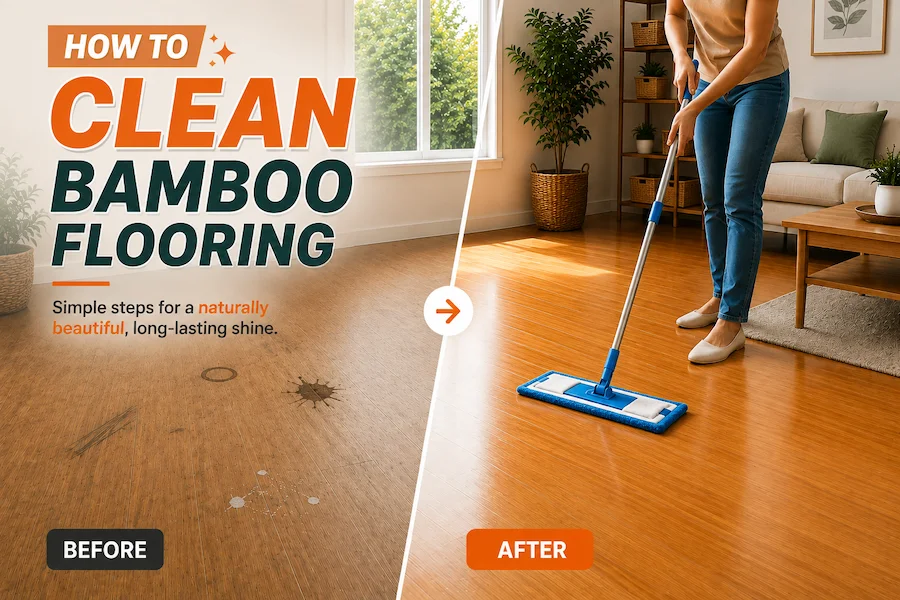
This guide by Nova Floor Experts covers how to clean bamboo flooring properly: the ten step method, the products that are safe, the products that void warranties, stain by stain fixes, drying technique, and a maintenance schedule that keeps the floor looking new for decades.
Contents
Quick answer: how do you clean bamboo floors?
Sweep or vacuum daily with a soft head. Damp mop weekly with a microfiber pad and a pH neutral wood floor cleaner. Wring the pad until it feels barely moist. Never use vinegar, bleach, ammonia, wax, oil soap, or a steam mop. Let the floor air dry on its own.
That is the short version. The details below are what actually protect your investment.
Know your bamboo before you clean it
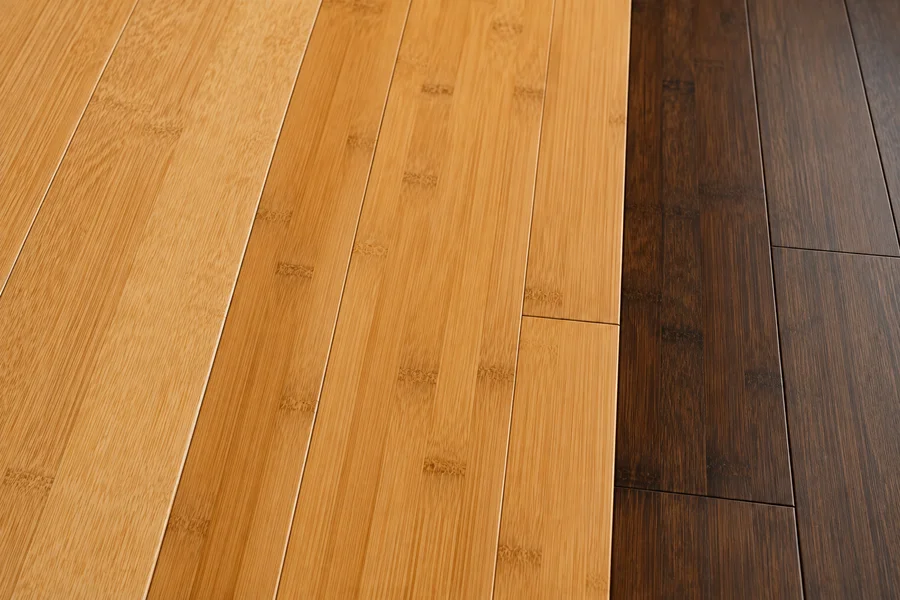
Not all bamboo behaves the same way. Two floors that look identical can react very differently to moisture and cleaning products. Check your paperwork or your supplier before you start.
Strand woven bamboo is shredded, mixed with resin, and compressed under extreme pressure. It is the hardest bamboo you can buy, and it shrugs off scuffs that would mark oak. It is also the most difficult to sand back, so protecting the factory finish matters more here than anywhere else.
Horizontal and vertical bamboo are made from flattened strips glued into planks. You can see the classic knuckle pattern in horizontal boards. These are softer than strand woven and dent more easily under furniture legs and heels.
Carbonized bamboo is heat treated to produce that warm amber or coffee color. That process softens the fibers. Carbonized planks can be noticeably weaker than natural bamboo and less forgiving about standing water. If your floor is dark and you did not choose a stain, it may well be carbonized. Use less moisture and wipe spills faster.
Solid vs engineered. Solid bamboo is bamboo all the way through. Engineered bamboo has a bamboo wear layer over a plywood or HDF core, usually with a click lock joint. Engineered boards handle humidity swings well, but the seams between planks are the weak point. Water sitting in a seam swells the core, and a swollen core lifts the edge permanently.
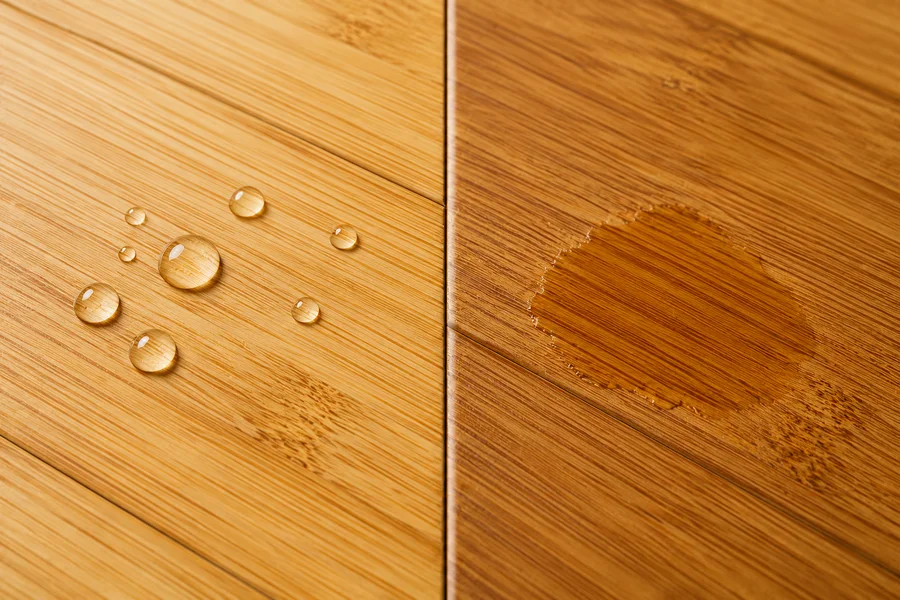
Lacquered vs oiled finish. Most bamboo sold today is prefinished with a UV cured polyurethane or aluminum oxide lacquer. That coating is what you are really cleaning. A small number of floors are hardwax oiled instead. Oiled floors need a dedicated soap made for oiled wood, not a standard cleaner, and they need reoiling every year or two. Place a drop of water on a hidden spot. If it beads and sits there, you probably have a lacquer. If it soaks in and darkens the wood, you likely have an oil finish. Your original paperwork settles it for certain.
What you need
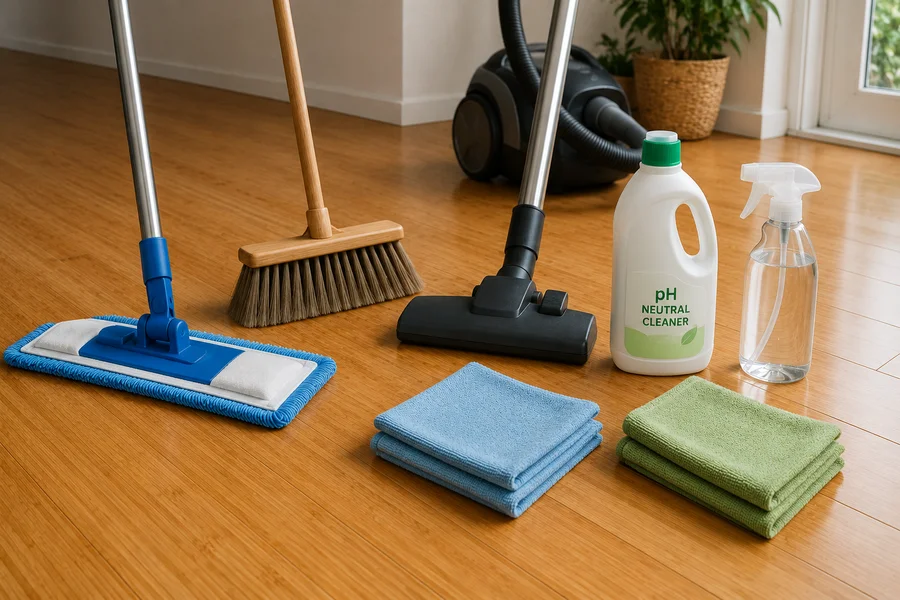
Gather everything before you start. Stopping halfway to hunt for a bucket means water sits on the floor longer than it should.
- Vacuum with a hard floor setting, or a soft bristle broom
- Microfiber dust mop for the dry pass
- Flat microfiber mop with two washable pads
- pH neutral hardwood or bamboo floor cleaner
- Spray bottle, or a bucket for diluting concentrate
- Two clean microfiber cloths for spot work
- Old towel for accidental spills
- Plastic putty knife or an old credit card for stuck residue
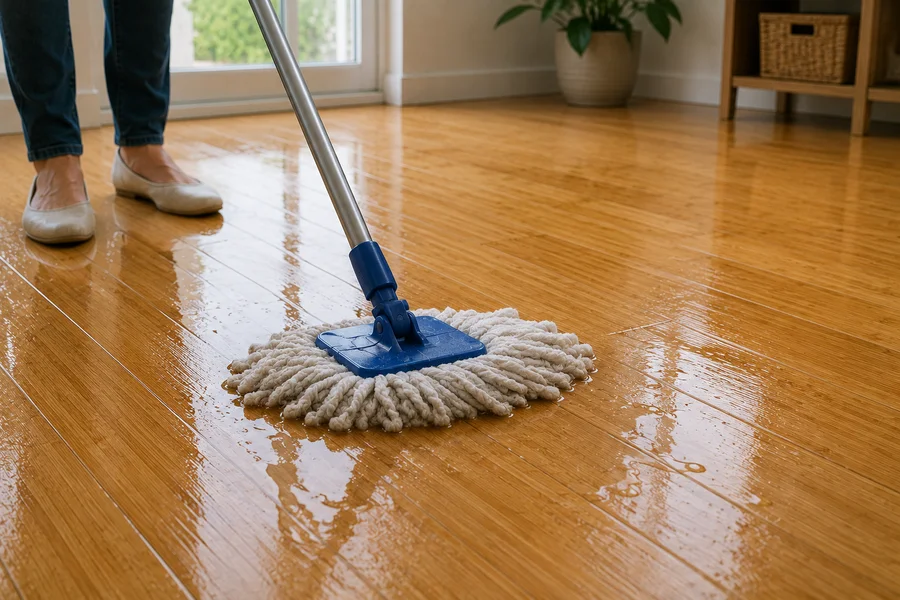
Skip the string mop, the sponge mop, and the cotton yarn mop. All three hold far more water than bamboo tolerates, and they push dirty water into the seams instead of lifting it off.
How to clean bamboo floors in 10 steps
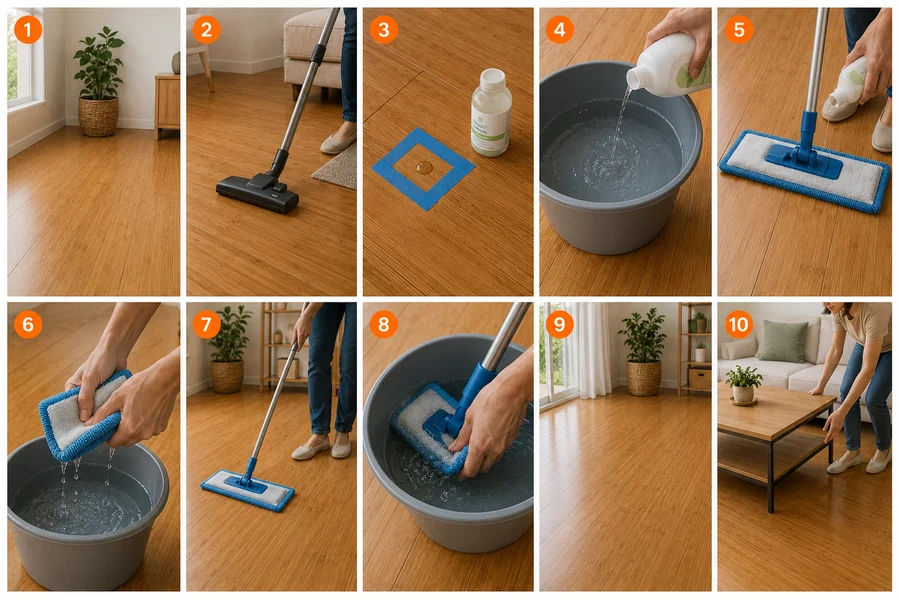
Step 1: Clear the floor and check the room
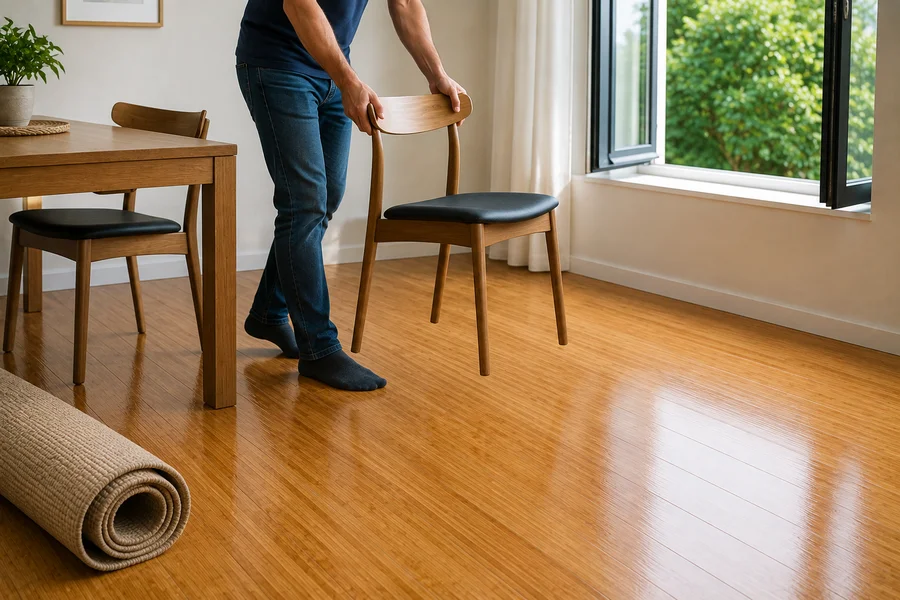
Move chairs, rugs, pet bowls, and light furniture out of the room. Lift anything that traps moisture underneath. Open a window or run a fan, because airflow is what dries the floor later.
Look at the floor in raking light before you touch it. Crouch down and look across the surface toward a window. This reveals fine scratches, cloudy patches, and old residue that flat overhead light hides completely. You now know which areas need attention and which are already fine.
Step 2: Dry clean first, and do it thoroughly
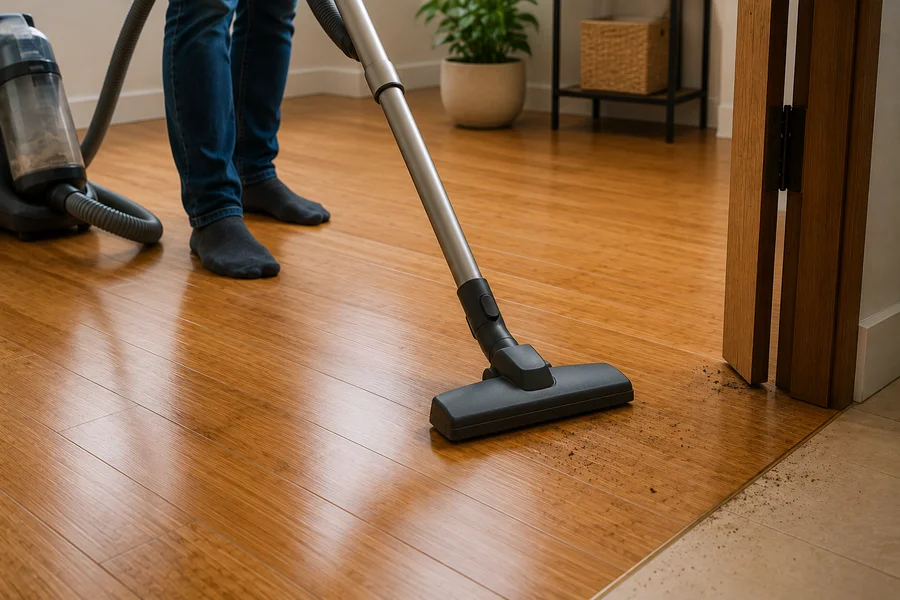
This step prevents more damage than any other step in this guide. Loose grit is abrasive. Walk on it and you grind it into the lacquer like sandpaper. Mop over it and you drag it across the whole room.
Vacuum with the beater bar switched off. Stiff rotating bristles scuff the finish and can chip the edges of engineered boards. Use a hard floor attachment or a felt head. If you prefer to sweep, use a soft bristle broom and work with the grain direction of the planks.
Pay attention to the places grit collects: along baseboards, in doorways, under radiators, and in the gaps between planks. A vacuum crevice tool clears seams far better than a broom.
Step 3: Spot test your cleaner
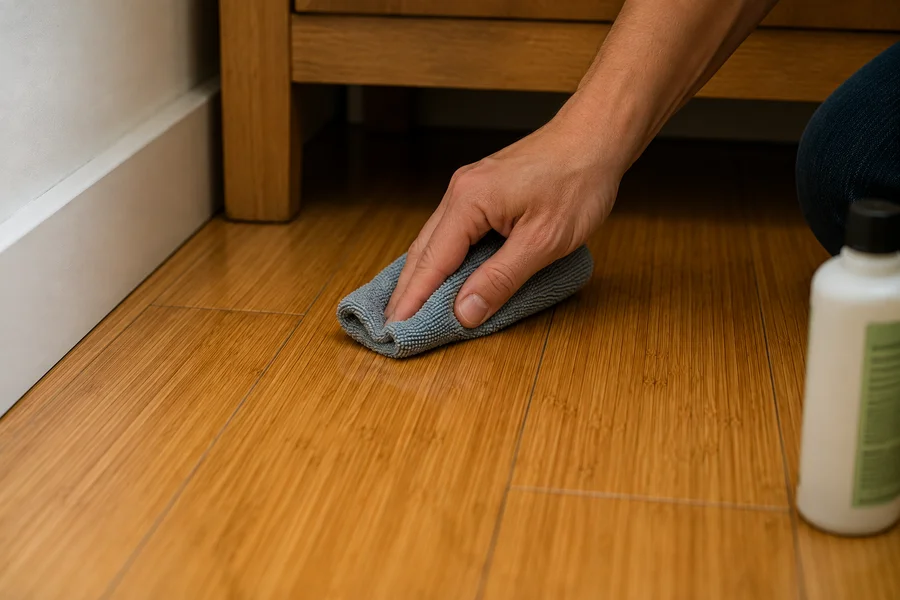
Do this once, the first time you use any new product, and never skip it on an unfamiliar floor.
Choose a hidden square of floor. Inside a closet, behind a door, or under a sofa all work. Apply a small amount of cleaner, wipe it, and let it dry fully. Check for dulling, whitening, stickiness, or a color change. If the finish looks the same after an hour, you are clear to proceed.
This matters most on older floors, floors treated with polish by a previous owner, and any floor with an unknown finish.
Step 4: Mix or load your cleaner correctly
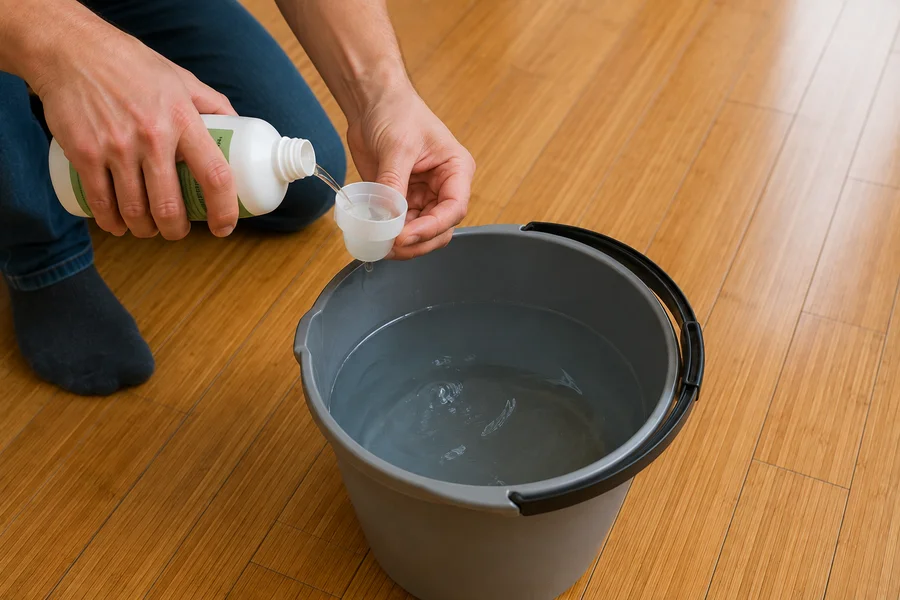
Dilution is where most people go wrong. Too much concentrate leaves a residue that attracts dirt and dulls the sheen within weeks.
Follow the label ratio exactly. If your product calls for a capful per bucket, measure the capful. Do not eyeball it, and do not add extra for a dirty floor. A stronger solution does not clean better on a sealed surface. It just leaves more behind.
Ready to use sprays need no mixing, which is one reason they suit bamboo so well.
Use warm water, not hot. Hot water accelerates evaporation and can leave streaks before you finish the pass.
Step 5: Apply cleaner to the pad, not the floor
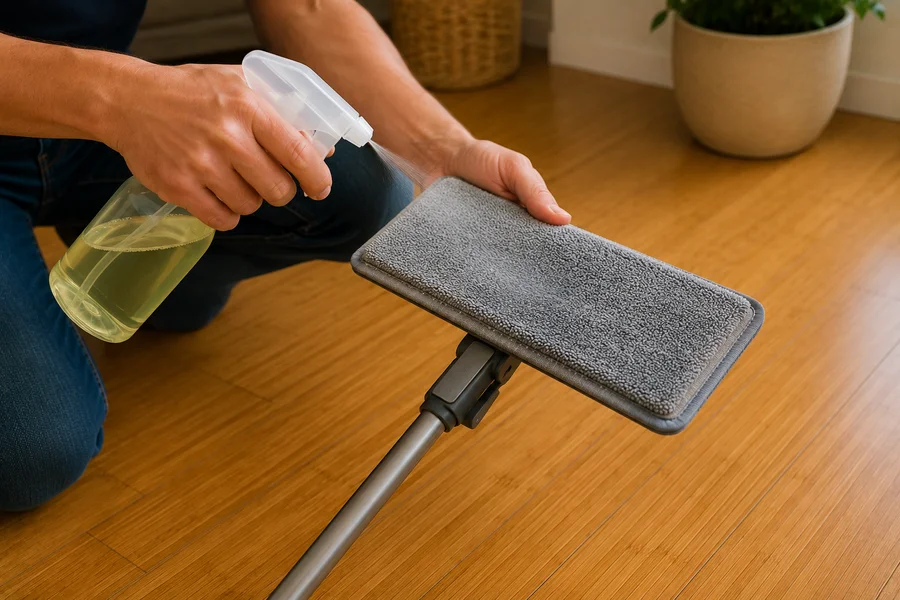
Spray the cleaner onto your microfiber pad, or dip the pad and wring it hard. This gives you control over exactly how much liquid touches the bamboo.
Some manufacturers tell you to spray a light mist directly onto the floor and mop immediately. That works if you spray a small section at a time and never let it sit. It fails the moment you spray ahead of yourself and get distracted.
The pad method is safer for beginners, for engineered floors with visible seams, and for carbonized bamboo. Whichever you choose, the rule underneath is the same: no puddles, no shine of standing liquid, ever.
Step 6: Wring until the pad is barely damp
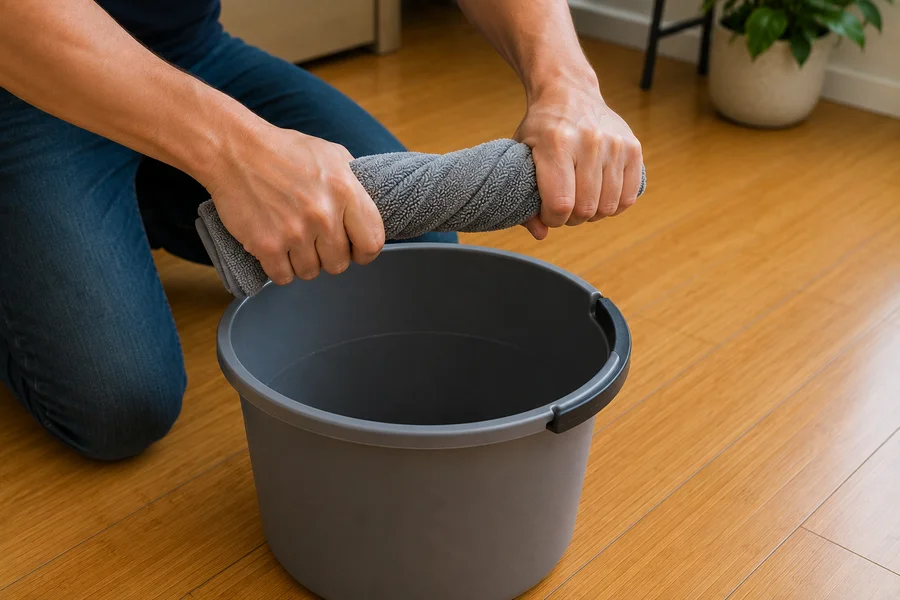
Squeeze the pad until you cannot force out another drop. Then squeeze again.
Here is the test. Press the pad against a dry patch of floor and lift it. If you can see a wet outline that takes more than ten seconds to disappear, the pad is too wet. Correctly wrung, the floor should look faintly matte for a few seconds and then look dry.
Bamboo is a grass, and its fibers absorb water quickly through any gap in the finish. Excess moisture causes cupping, where board edges rise higher than the centre, and crowning, where the centre rises instead. Neither reverses on its own.
Step 7: Mop with the grain in small sections
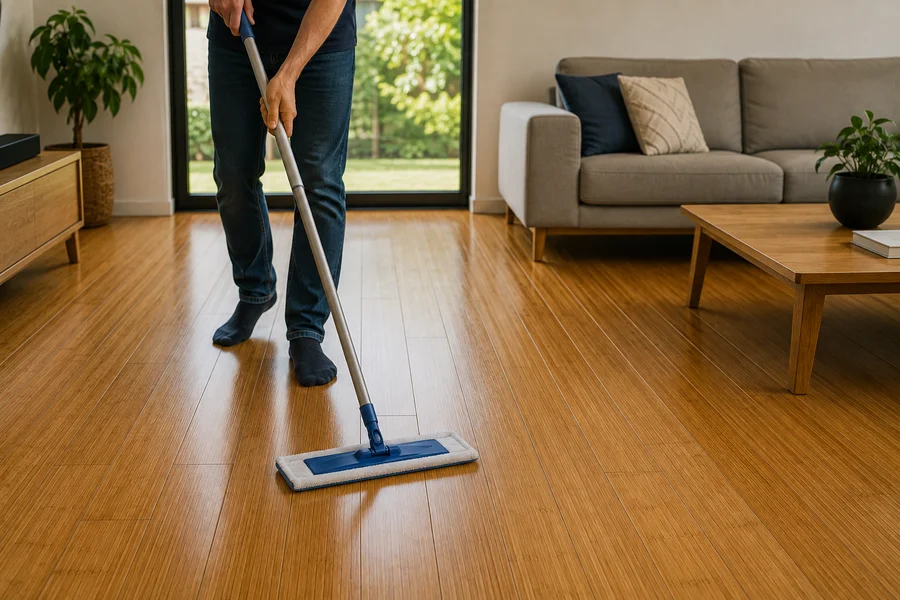
Work in sections of roughly three feet by three feet. Start at the corner furthest from the door and mop your way out. This keeps you off the damp floor.
Move the mop with the grain of the planks, not across it. Bamboo grain runs the length of the board. Following it pulls dirt out of the surface texture rather than pushing it sideways into the seams.
Use light pressure and long straight passes. Overlap each pass by a few inches. Avoid scrubbing in circles, which is how swirl marks appear on glossy finishes.
Flip or rinse the pad the moment it looks gray. A dirty pad redeposits soil and leaves a haze.
Step 8: Rinse if your cleaner needs it
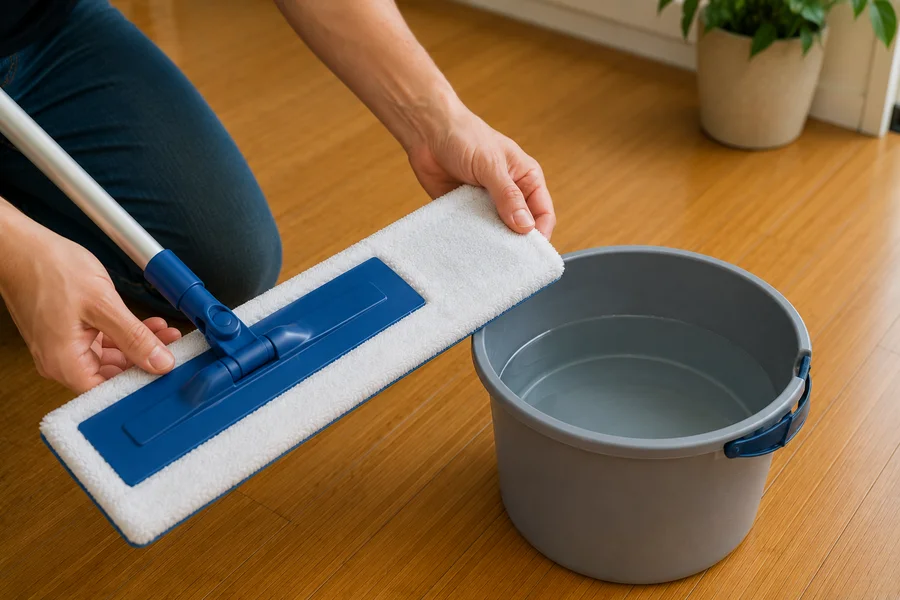
Most modern pH neutral floor cleaners are residue free and need no rinse. Check your label.
If you used a concentrate, an unfamiliar product, or slightly too much solution, follow with a second pass using a clean pad and plain water. Wring it just as hard. This lifts any film before it dries and dulls the sheen.
On high gloss bamboo, a plain water pass is worth doing every time. It is the single easiest way to keep the reflection sharp.
Step 9: Air dry, and keep everyone off
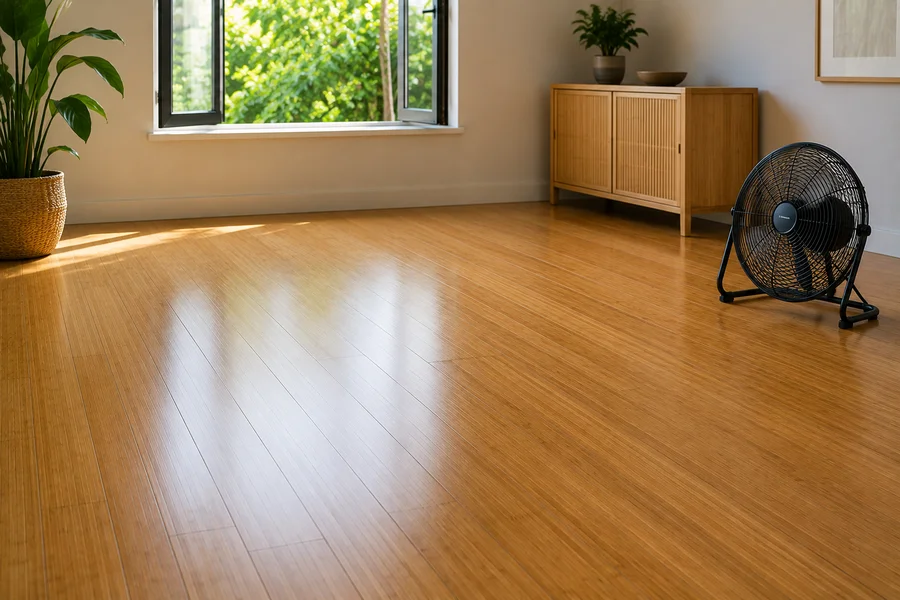
Let the floor dry by itself. This is the step people rush, and rushing it causes visible damage.
Do not towel dry or hand buff a damp bamboo floor. Wiping a semi dry surface drags residue in arcs and creates swirl marks in the lacquer that catch the light forever afterwards.
Speed the process with airflow instead. The window or fan you set up in Step 1 is already doing most of this work. A floor fan on a low setting, aimed across the room rather than at one spot, finishes the job faster. A correctly damp mopped floor dries in five to fifteen minutes depending on humidity.
Keep pets and children off until it is fully dry. Paw prints in a drying cleaner film are surprisingly stubborn.
Step 10: Inspect the floor, then move furniture back
Do the raking light check again. Streaks and haze show up now, while they are still easy to remove with a plain water pass.
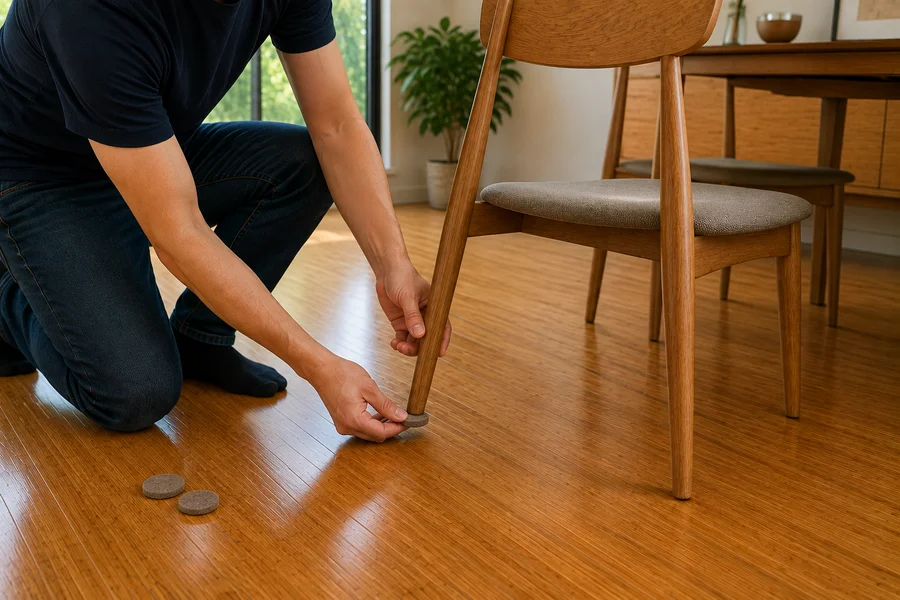
Before you move furniture back, check every foot for a felt pad. Replace any pad that is compressed, torn, or has grit embedded in it. Embedded grit turns a protector into a scouring pad.
Lift furniture rather than sliding it. Two people and ten seconds beat a permanent gouge.
If your hardwood floor needs more than routine cleaning, learn how to refinish hardwood floors and restore its original appearance.
Choosing the best cleaner for bamboo floors
The best cleaner for bamboo floors is a pH neutral, wax free, water based formula made for prefinished wood or polyurethane finishes. That is the whole specification. Everything else is branding.
Neutral pH sits around 7. It cleans without chemically attacking the urethane coating. Alkaline cleaners break down that coating over time. Acidic cleaners etch it and dull the sheen.
What to look for on the label:
- pH neutral or pH balanced
- Safe for polyurethane, urethane, or prefinished wood floors
- Residue free, no rinse
- Wax free and polish free
- Water based, no petroleum distillates
Manufacturer approved products come first. Many bamboo flooring warranties name specific cleaners. Using something else can invalidate your coverage, even if the product itself is harmless. Check your warranty document before you buy anything. If your manufacturer names a brand, use that brand.
Established wood floor cleaners work well when your manufacturer names nothing. Products designed for prefinished hardwood target the same type of lacquer that sits on your bamboo.
Oiled bamboo needs different chemistry. Use a soap made for oiled wood floors. Standard cleaners strip the oil and leave dry patches.
What to avoid, and why it matters
Each of these causes a specific, documented problem.
Vinegar. You will find vinegar recommended all over the internet for cleaning bamboo floors. Ignore it. Vinegar is acetic acid. Repeated use etches polyurethane, softens the sheen, and can lighten carbonized bamboo unevenly. It looks fine the first time, which is exactly why the advice spreads. The damage is cumulative.
Steam mops. Steam forces hot vapour into the seams under pressure. Bamboo is dense but not sealed on its edges or underside. Steam causes swelling, delamination of engineered wear layers, and adhesive failure in glued installations. Most bamboo warranties explicitly exclude steam damage.
Wax and polish. Modern bamboo arrives with a factory cured finish that needs no wax. Wax builds a soft layer that yellows, traps dirt, and prevents any future recoating from bonding. Removing it usually means sanding.
Oil soaps. These leave a film by design. On a sealed floor, that film goes cloudy, gets slippery, and refuses to come off with normal cleaning.
Ammonia and bleach. Both are strongly alkaline and both attack urethane. Bleach also lightens the bamboo itself if it reaches bare fiber through a scratch.
Citrus and solvent based cleaners. Some leave a sticky film that only professional sanding removes. Not worth the risk.
Abrasives. Scouring powder, steel wool, and rough scrub pads scratch the finish immediately. Even a green kitchen sponge is too aggressive.
Standing water. Not a product, but the most common cause of damage. Never pour water onto bamboo. Never leave a wet towel or bath mat lying on it.
Stain removal on bamboo flooring
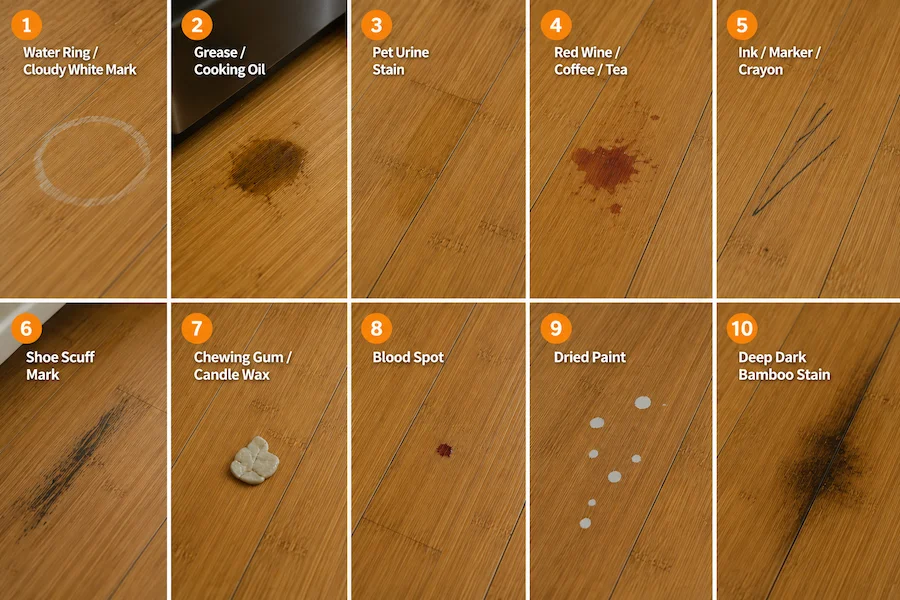
Work from gentlest to strongest, and always test in a hidden spot first. Blot rather than rub. Rubbing spreads the stain and abrades the finish.
Water rings and cloudy white marks. These sit in the finish, not the wood. Rub gently with a cloth barely dampened with cleaner, then dry. If the mark persists, a pea sized dab of plain white toothpaste on a soft cloth can burnish it out. Toothpaste is a very mild abrasive, so use the smallest amount possible, stay on the mark itself, and wipe the area clean straight after. Dark rings mean water reached the bamboo, and those need professional attention.
Grease and cooking oil. Absorb first. Cover with baking soda or cornstarch and leave it for twenty minutes. Vacuum it up. Then wipe with a cloth dampened in a mild solution of pH neutral cleaner. Repeat rather than scrubbing harder.
Pet urine. Speed decides the outcome. Blot every drop immediately with paper towel. Clean with an enzymatic pet cleaner rated as safe for sealed wood floors, because enzymes break down the uric acid that causes lingering odor. Wipe with a barely damp cloth and dry at once. Urine that soaked through a seam and reached the subfloor causes a dark stain that only sanding or board replacement will fix.
Red wine, coffee, tea, and fruit juice. Blot immediately. Clean with your pH neutral cleaner on a damp cloth. Fresh spills come up completely. Dried spills need a second application left in place for two to three minutes before wiping.
Ink, marker, and crayon. Try the pH neutral cleaner first. If the mark stays, dab isopropyl alcohol onto a cotton pad, touch it to the mark only, and wipe with a damp cloth straight afterwards. Alcohol can dull lacquer, so keep contact brief and never flood the area.
Scuff marks from shoes. These are rubber deposits, not stains. A clean tennis ball or a pencil eraser rubbed lightly lifts most of them with no chemicals at all.
Chewing gum, candle wax, and tar. Harden the deposit with an ice pack in a plastic bag for ten minutes. Once brittle, lift it with a plastic putty knife or a credit card. Never use a metal scraper.
Blood. Cold water only, applied to a cloth. Warm water sets the protein and makes the stain permanent.
Paint. Water based paint softens with warm water and a plastic scraper. Solvent based paint is a genuine risk to the finish. Test any solvent in a hidden area, or accept a small touch up rather than a large dull patch.
Dark stains reaching the bamboo itself. Once discoloration is in the fiber rather than the coating, surface cleaning cannot reach it. Call a wood floor professional. Strand woven bamboo in particular is dense and hard to sand, so it needs someone experienced.
Drying bamboo floors the right way
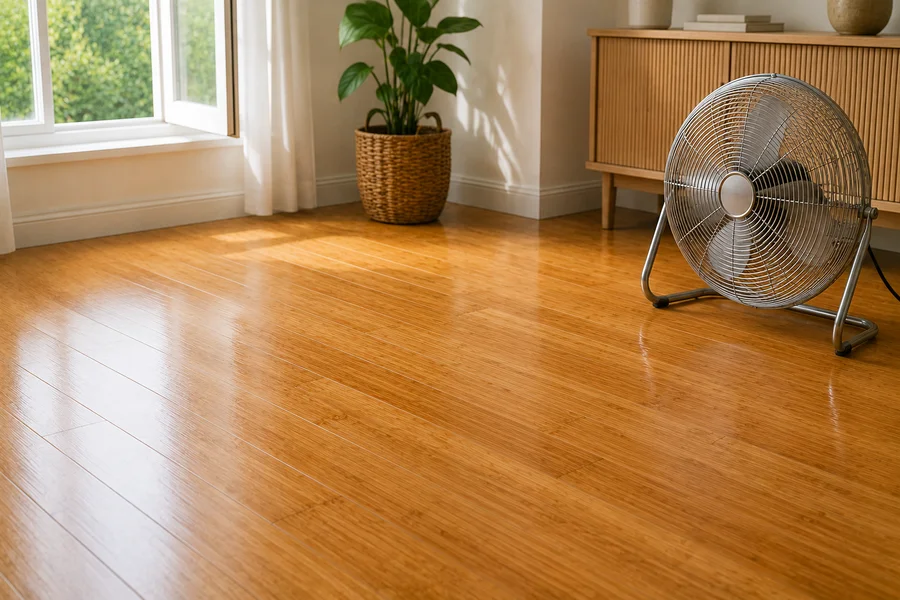
Drying is not the absence of a step. It is a step.
Air dry every time. Airflow and time do the work. A fan across the room cuts drying time roughly in half.
Avoid direct heat. Do not aim a hairdryer or a heat gun at a damp patch. Rapid uneven drying shrinks the surface faster than the core, and that stresses the board.
Watch the seams. If liquid pooled anywhere, dry it with a corner of a dry cloth pressed gently into the joint, then leave a fan running for an hour.
Reduce humidity after cleaning in damp weather. A dehumidifier or an exhaust fan helps the floor return to its normal moisture content faster.
Check for cupping the next day. Board edges that feel slightly raised mean the floor absorbed too much water. Improve ventilation and keep the room dry. Mild cupping often flattens over several weeks as moisture equalizes. Severe cupping needs a specialist.
Bamboo floor maintenance schedule
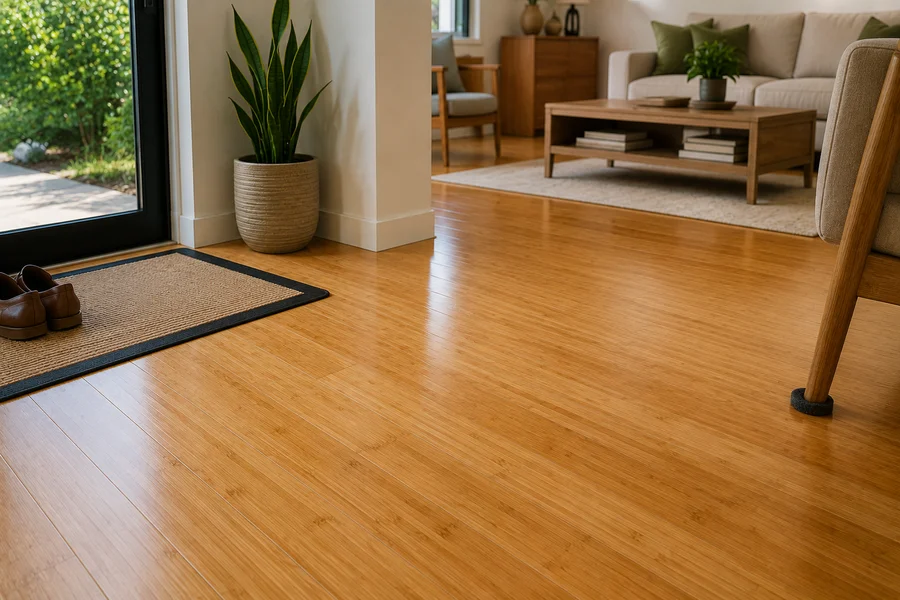
Cleaning bamboo floors well is mostly about doing small things often.
Daily Sweep or dust mop high traffic areas. Kitchens, hallways, and entrances collect the most grit. Wipe spills the moment they happen.
Weekly Vacuum the whole floor including edges and corners. Damp mop with your pH neutral cleaner using the ten step method above. Shake out doormats.
Monthly Wash your microfiber pads on a warm cycle with no fabric softener, because softener coats the fibers and ruins their grip. Check and replace felt furniture pads. Vacuum under rugs and move them slightly so the floor beneath ages evenly. Inspect the seams near sinks, dishwashers, and exterior doors for early signs of swelling.
Quarterly Rotate rugs and larger furniture to even out UV exposure. Bamboo changes color in sunlight, and carbonized bamboo lightens noticeably. A rug left in one spot for two years leaves a permanent outline. Check exterior door thresholds for water ingress.
Yearly Assess the finish under raking light. Reapply hardwax oil if your floor is oiled. Consider a manufacturer approved refresher on lacquered floors that look tired, but only if your warranty permits it. Never apply anything the manufacturer has not approved, because unapproved coatings void cover and complicate future recoating.
Every five to ten years Lacquered floors in busy homes may need a professional screen and recoat. This abrades the top layer and adds fresh lacquer without full sanding. Engineered bamboo has a limited wear layer, so confirm its thickness before anyone sands anything.
Prevention beats cleaning
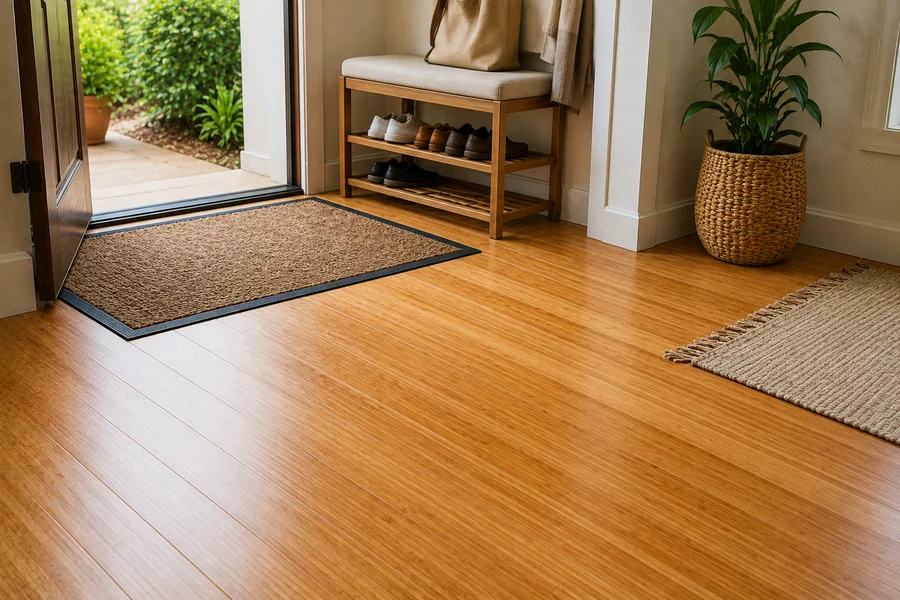
The cheapest floor care happens before dirt reaches the bamboo.
Place doormats outside and inside every exterior door. The outside mat scrapes, the inside mat absorbs. Together they stop most grit at the threshold.
Adopt a no shoes policy where you can. Stiletto heels concentrate enormous force on a tiny point and dent even strand woven bamboo. Grit trapped in a sneaker sole is the single biggest source of fine scratching.
Fit felt pads to every furniture leg, including dining chairs, which move constantly.
Use a rug in front of the sink and the dishwasher. Choose a breathable weave with a felt backing. Avoid rubber or vinyl backed mats, which trap moisture and can discolor the finish underneath.
Keep indoor humidity between 40 and 60 percent. Bamboo expands in damp air and contracts in dry air. Stable humidity prevents gapping in winter and tightness in summer. A cheap hygrometer tells you where you stand.
Trim pet claws and keep a towel by the door for wet paws.
Fit blinds or UV filtering film on windows that get strong direct sun.
Fixing common problems
Streaks after mopping. Too much cleaner, a dirty pad, or hot water. Redo the area with a clean pad and plain water, and reduce your dilution next time.
Cloudy or hazy finish. Usually residue buildup from an unsuitable product or years of polish. Try two plain water passes first. If the haze remains, ask your flooring supplier about an approved residue remover. Never reach for an abrasive.
Floor feels sticky underfoot. Almost always too much cleaner. Rinse with plain water until the tack disappears, then halve your dilution.
Fine scratches everywhere. Grit is getting in. Improve your doormats, tighten the shoe policy, and check your vacuum head for embedded debris.
Squeaks after cleaning. This suggests moisture reached the subfloor or the underlay. Reduce water immediately and monitor the area.
For another natural flooring option, learn how to clean cork flooring safely while protecting its texture, finish, and long-term durability.
Frequently asked questions
Can I use a Swiffer on bamboo floors? Dry Swiffer pads are fine for dust. Wet jet pads are acceptable only if the solution is pH neutral and rated for prefinished hardwood. Check the ingredient label rather than the marketing line on the front.
Can I use water alone? Yes, for light dust and quick touch ups, provided the pad is barely damp. Plain water will not shift grease or biological soiling, so it is not a full substitute for a proper cleaner.
How often should I mop? Once a week for a normal household. Twice a week for busy kitchens or homes with several pets. Daily mopping adds moisture without adding cleanliness.
Does bamboo flooring need polish? No. Factory finished bamboo needs nothing added. Use a refresher product only if your manufacturer sells or approves one.
Can bamboo floors be refinished? Solid bamboo can usually be sanded and refinished once or twice, though strand woven bamboo is extremely hard and needs a professional with the right equipment. Engineered bamboo depends entirely on wear layer thickness. Some can never be sanded.
Is bamboo waterproof? No. Some bamboo resists moisture better than many hardwoods, but no bamboo floor is waterproof. Treat every spill as urgent.
The bottom line
Knowing how to clean bamboo flooring comes down to three habits. Get the grit off daily. Use a barely damp microfiber pad and a pH neutral cleaner weekly. Let the floor dry on its own.
Skip the vinegar, skip the steam mop, and skip the wax. Deal with spills in seconds rather than minutes. Do that consistently and your bamboo floor will still look right in twenty years, without a single deep clean marathon along the way.

Noah Williams
Interior Designer & Flooring Expert