Noah Williams is an interior designer and flooring expert at Nova Floor. In Dubai, he helps people pick the right floor, get it installed, and keep it looking good. He also writes simple, practical flooring and home care guides for readers in Dubai and around the world.
15 Best Flooring For Dogs in 2026 | Pet-Friendly Floor Guide
Noah Williams
Your dog does three things to a floor. He scratches it with his nails. He spills water and tracks mud across it. And sooner or later, he has an accident on it.
Most flooring guides stop at “pick something durable.” That advice helps nobody. This guide by nova floor team names the exact specs that separate a floor lasting fifteen years from one showing claw marks by month four. You will learn what a 20 mil wear layer means, why AC4 beats AC3, and which floors survive dog urine instead of trapping it.
Let me walk you through all fifteen options.
Contents
Quick Comparison: Best Flooring for Dogs
| Flooring | Scratch Resistance | Waterproof | Traction | Spec to Demand | Cost (material/sq ft) |
| SPC Rigid Core LVP | Excellent | Yes | Good | 20 mil wear layer | $2.50 to $5 |
| WPC Luxury Vinyl | Very good | Yes | Good | Attached cork backing | $3 to $6 |
| Glue-Down LVT | Excellent | Yes | Good | Welded seams | $3 to $7 |
| Sheet Vinyl | Moderate | Yes | Good | Single-piece room fit | $1 to $3 |
| Porcelain Tile | Outstanding | Yes | Varies | PEI 4, DCOF 0.42+ | $3 to $10 |
| Engineered Stone Tile | Excellent | Yes | Very good | Textured face | $4 to $8 |
| Waterproof Laminate | Excellent | Yes (sealed) | Moderate | AC4 minimum | $2 to $4.50 |
| Hybrid Resilient | Excellent | Yes | Good | UV-stable surface | $3 to $6 |
| Strand-Woven Bamboo | Very good | No | Moderate | Light color, uncarbonized | $4 to $8 |
| Hickory Hardwood | Good | No | Moderate | Wire-brushed matte finish | $6 to $12 |
| Engineered Hardwood | Moderate | No | Moderate | 3mm+ veneer | $5 to $12 |
| Cork | Fair | No | Excellent | Quality penetrating sealer | $3 to $8 |
| Carpet Tile | Fair | Backing only | Excellent | Moisture-barrier backing | $2 to $6 |
| Triexta Broadloom | Fair | Backing only | Excellent | Dense cut pile | $2.50 to $6 |
| Polished Concrete | Outstanding | Yes (sealed) | Varies | Penetrating sealer | $3 to $12 |
Installation adds roughly $1.50 to $4 per square foot for resilient flooring and $7 to $15 for tile. A 400 square foot living room in mid-grade rigid core vinyl, professionally installed, lands between $2,000 and $3,000. Prices shift by region and by year.
The Five Specs That Actually Matter
Skip the marketing words. Judge every floor against these five numbers.
Wear layer thickness (vinyl). Manufacturers measure this clear top coat in mils, or thousandths of an inch. A 6 mil layer suits a quiet guest bedroom. A 12 mil layer handles a normal family. Dogs need 20 mil or higher. A thin plank with a 22 mil wear layer outlasts a thick plank with a 6 mil layer every time. Never confuse total plank thickness with wear layer thickness.
AC rating (laminate). The Abrasion Class scale runs from AC1 to AC6. AC3 covers ordinary residential traffic. Dog owners should buy AC4 at minimum, and AC5 for entryways and hallways.
Janka hardness (wood). This test measures the force required to press a steel ball halfway into a plank. Hickory scores 1,820. Hard maple hits 1,450. White oak reaches 1,360, and red oak sits at 1,290. Black walnut drops to 1,010, and cherry falls to 950. Pine can score under 500. Strand-woven bamboo tops the chart above 3,000.
DCOF (tile and hard surfaces). The Dynamic Coefficient of Friction measures traction. Under ANSI A326.3, interior floors that may get wet should test at 0.42 or higher. Treat that figure as a comparison tool between two tiles, not a promise of safety. Nails and paw pads behave differently from shoe soles.
Water absorption (tile). Porcelain absorbs 0.5% water or less, which puts it in the impervious category. Standard ceramic absorbs 3% to 7%. That single difference explains why porcelain shrugs off a puddle that soaks into ceramic.
Explore Top 15 Pet Floor Options
1. SPC Rigid Core Luxury Vinyl Plank
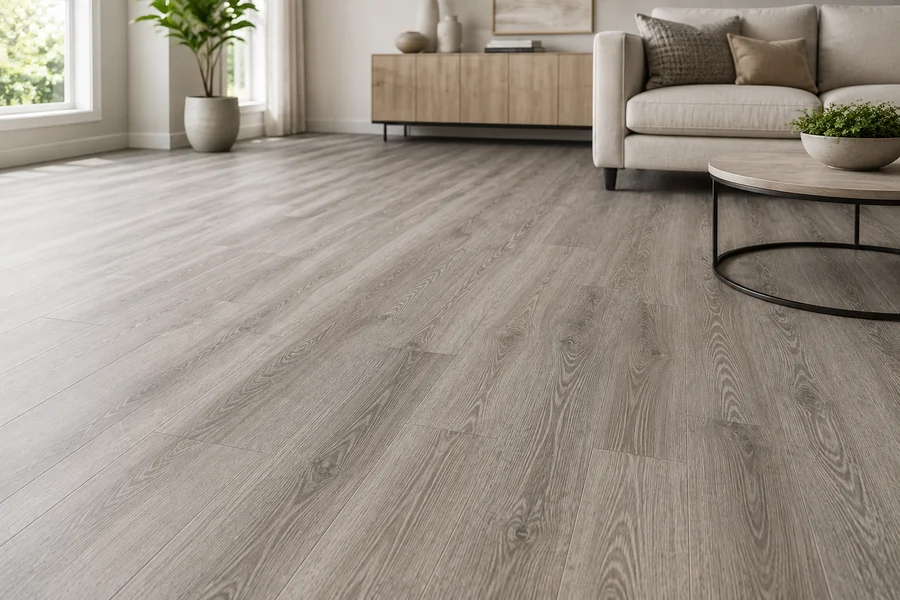
SPC stands for Stone Plastic Composite. Manufacturers blend limestone powder with PVC and stabilizers to form a dense, rigid core that will not swell or buckle when water sits on it.
This is the strongest all-round answer for dog owners. The density resists dents from dropped bowls and heavy paws. The click-lock system installs over most existing floors.
Look for Embossed in Register texture, where the surface grooves align with the printed wood grain. That feature adds genuine grip, not just visual realism.
Weakness: SPC flooring feels harder and sounds sharper underfoot than softer cores. An attached underlayment pad solves most of the noise.
2. WPC Luxury Vinyl Plank
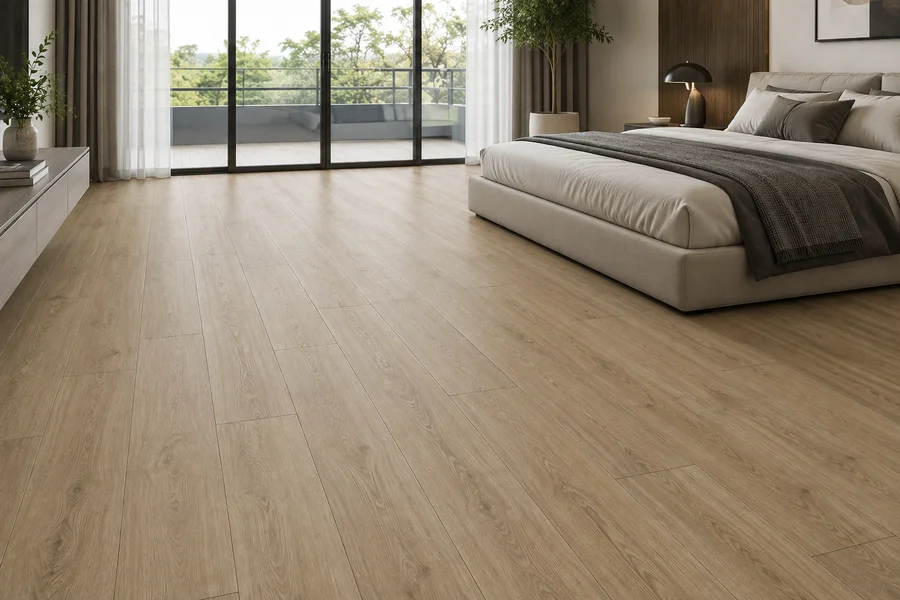
WPC uses a Wood Plastic Composite core containing foaming agents. The result feels warmer and quieter than a stone-based core.
Dogs benefit twice. The softer core cushions their joints during naps. It also muffles the click of nails crossing a room, which matters in open-plan homes with high ceilings.
Weakness: WPC flooring dents more easily than SPC under concentrated weight. A Great Dane landing on the same spot repeatedly will leave a mark that a stone core would resist.
3. Glue-Down Luxury Vinyl Tile
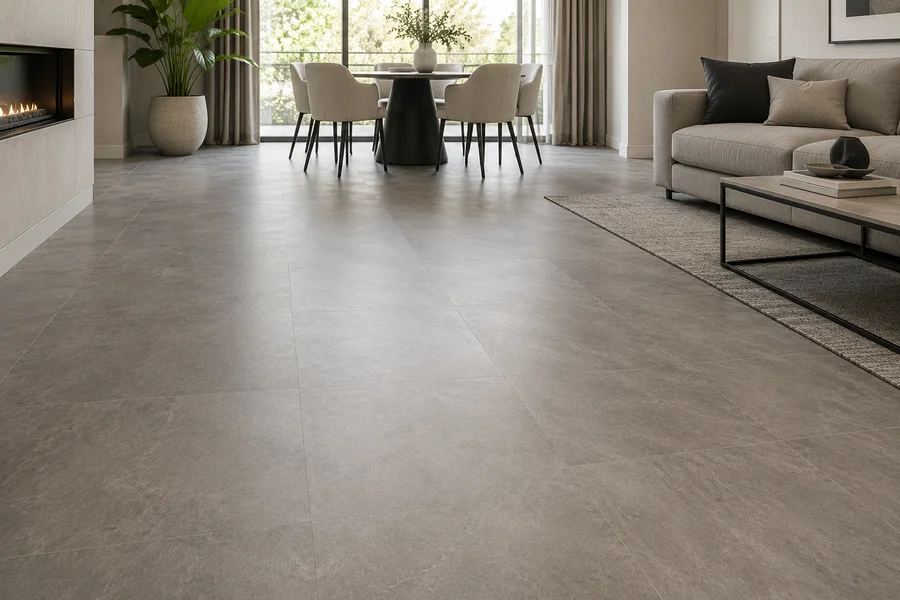
Click-lock planks float above the subfloor. Glue-down LVT flooring bonds directly to it, and that difference decides how a floor handles urine.
A floating floor has micro-gaps at every seam. Liquid finds them, travels underneath, and reaches the subfloor. A full-spread adhesive installation with heat-welded or chemically welded seams closes that path almost completely. Large dogs also cannot shift or gap a bonded floor by braking hard on a turn.
Weakness: removal is difficult, and the subfloor must sit flat and dry before installation.
4. Sheet Vinyl
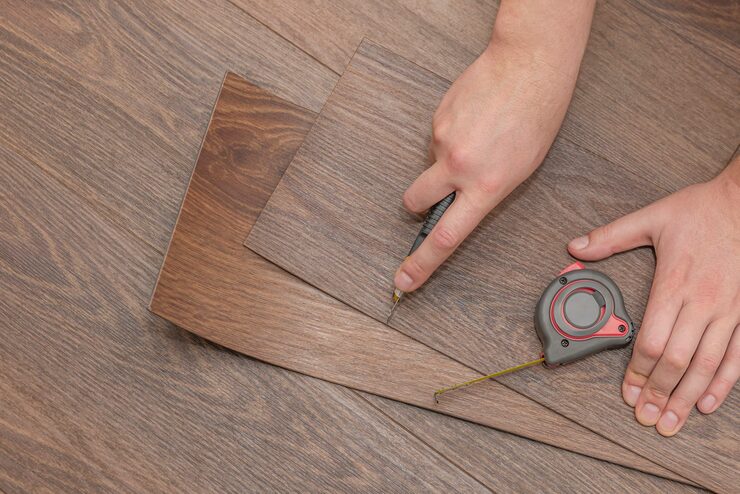
Sheet vinyl flooring arrives in wide rolls, so a small room may need zero seams. For a puppy in a laundry room or a bathroom, that beats almost everything at any price.
Modern sheet products print convincing wood and stone patterns. The material feels soft, cleans with a damp mop, and costs less than every other option here.
Weakness: long nails can gouge thin sheet vinyl. Expect to replace it sooner than plank flooring. In larger rooms, seams appear and the advantage disappears.
5. Porcelain Tile
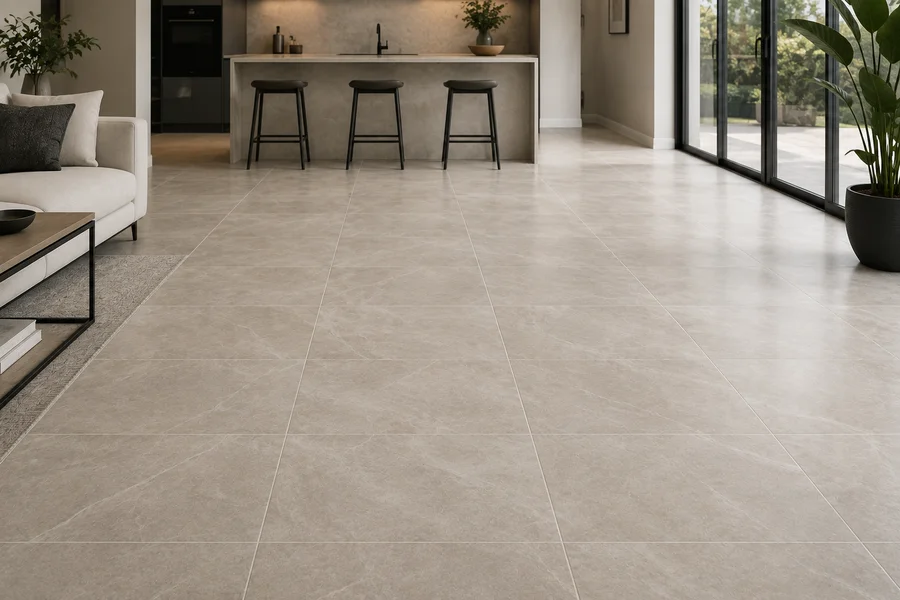
Porcelain is the toughest surface a dog will ever face. Nothing scratches through a properly fired glaze in normal household use, and mud wipes off with a rag.
Porcelain also stays cool. Thick-coated breeds like Huskies and Bernese Mountain Dogs seek it out in summer. It pairs well with radiant heating for winter comfort.
Ask for wider grout joints. Grout gives nails something to grip that a smooth tile face cannot.
Weakness: the surface is unforgiving. Older dogs with hip problems struggle on it, and dropped objects can crack a tile. Replacing a single tile is a manageable afternoon job.
6. Engineered Stone Composite Tile
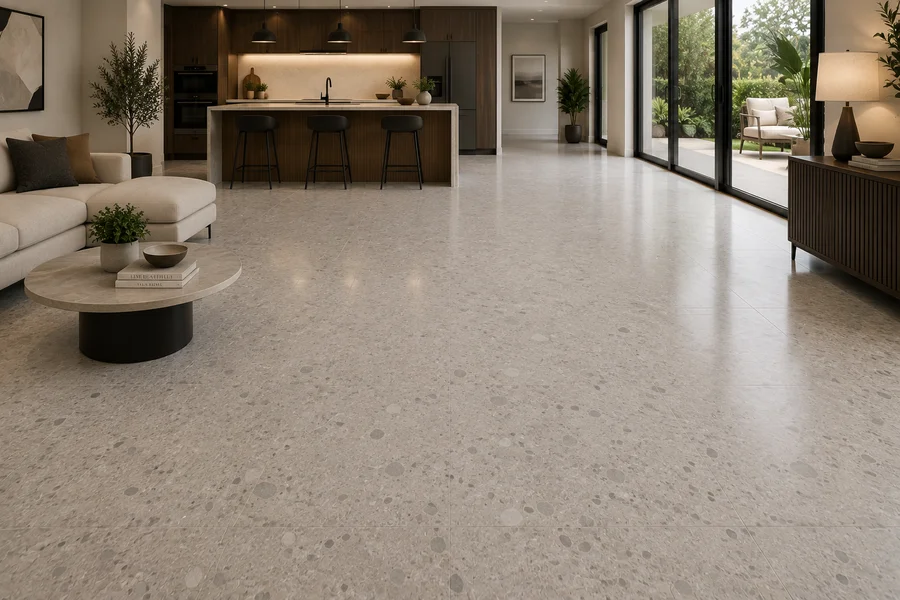
This category solves porcelain’s biggest flaw. Manufacturers press roughly 70% limestone into a flexible composite tile. You keep the stone look and the stain resistance. You lose the bone-chilling cold and the brittleness.
The surface absorbs sound instead of amplifying it, so scampering paws stop echoing through the house. Many products install with or without grout.
Weakness: availability varies by region, and the price sits above basic tile.
7. Waterproof Laminate
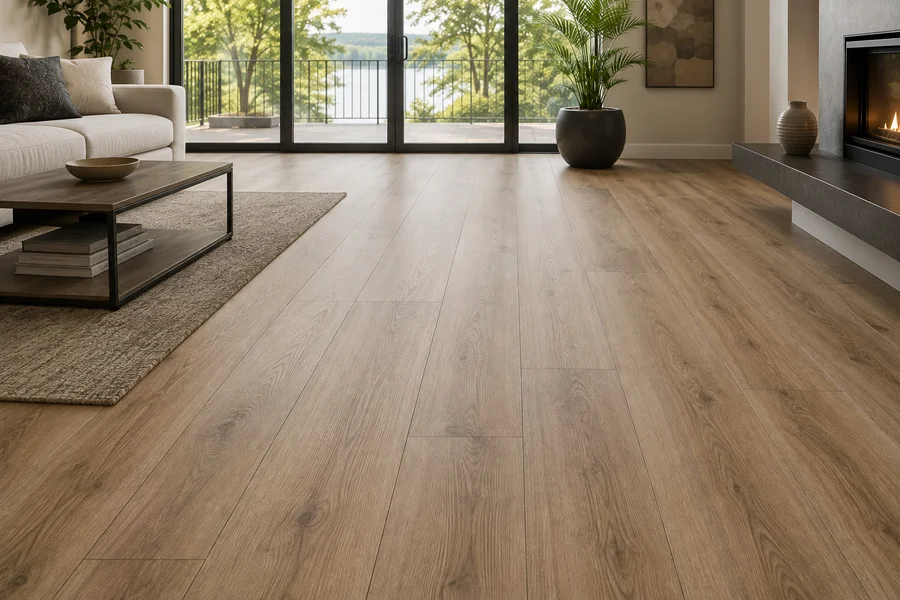
Laminate flooring stacks four layers: a melamine backing, a fiberboard core, a printed design layer, and a melamine wear layer on top. That top layer resists scratches extremely well, often better than vinyl at the same price.
Older laminate failed around water because liquid swelled the fiberboard core. Current waterproof products seal the core and treat the click joints, which changes the calculation for dog owners completely.
Read the warranty before you buy. Many policies cover pet accidents only if you wipe the spill within a stated number of hours.
Weakness: you cannot sand or refinish laminate. Once the wear layer goes, the plank goes.
8. Hybrid Resilient Flooring
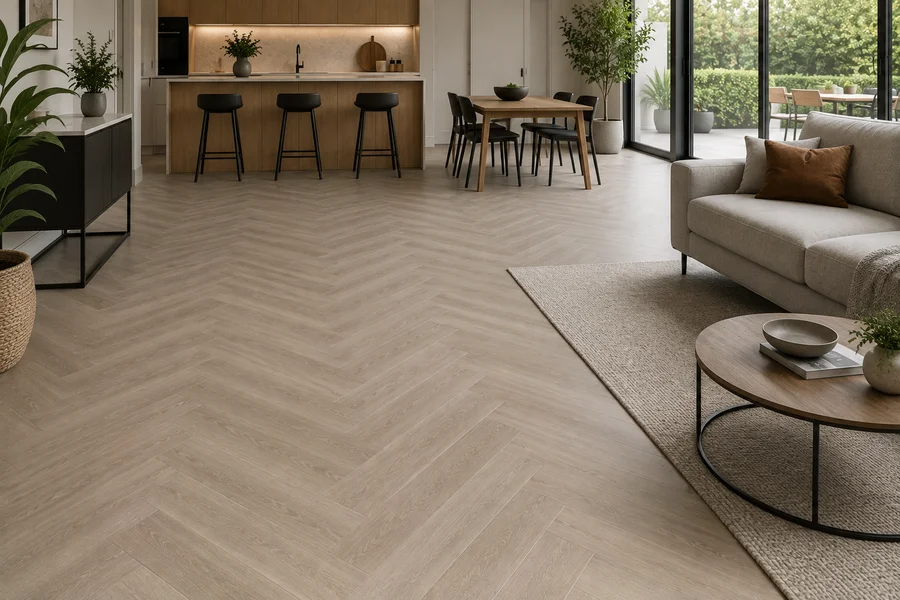
Hybrid products borrow the rigid core from laminate and the waterproof surface from vinyl. Installation runs fast because most hybrids float over existing flooring, which suits renovators who want to skip demolition.
The design range covers wood, stone, and concrete looks at a mid-tier price.
Weakness: direct sunlight can discolor some hybrid products over years. Check for a UV-stable surface if the room faces south.
9. Strand-Woven Bamboo
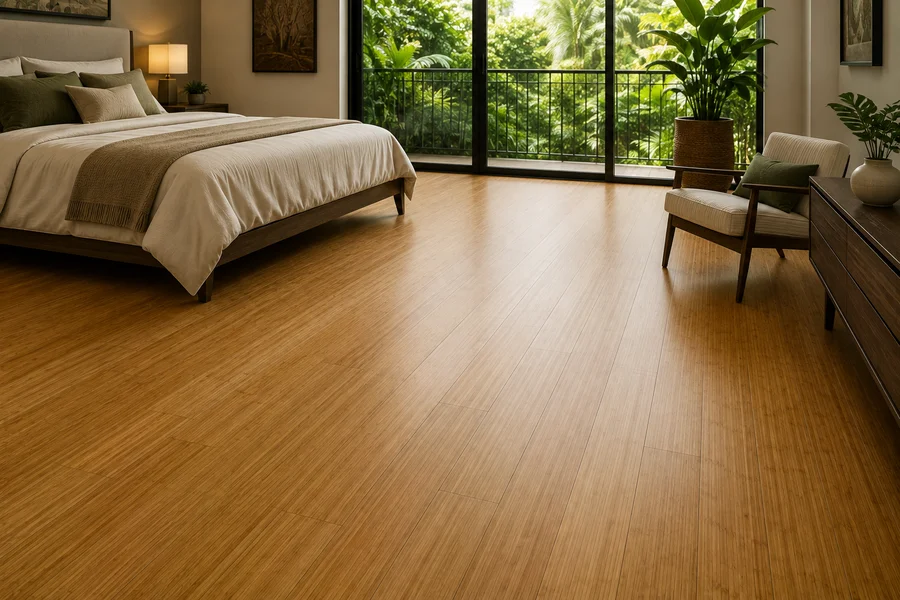
Bamboo is technically a grass, not a hardwood. Manufacturers shred the stalks, compress the fibers under extreme pressure, and bond them into planks. That process creates a surface harder than any common North American hardwood.
Nails that mark oak often leave nothing on strand-woven bamboo. The material is renewable, which appeals to buyers watching their environmental footprint.
Choose strand-woven construction, not horizontal or vertical bamboo. Also choose lighter colors, because the carbonizing process that darkens bamboo also softens it.
Weakness: bamboo is not waterproof. Standing urine stains it, and humidity swings can cup the planks.
10. Hickory and White Oak Solid Hardwood
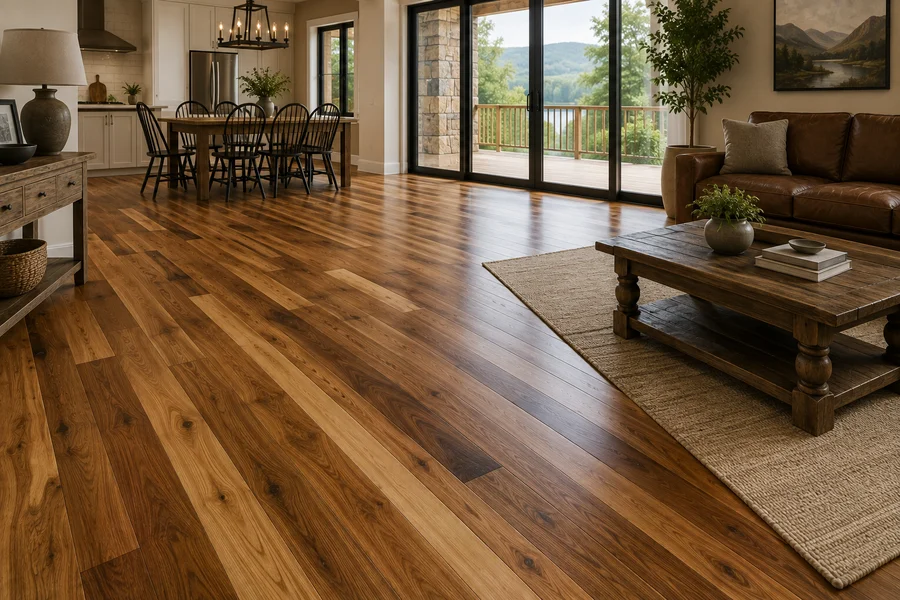
Real wood adds resale value that no vinyl product matches. With a dog, the species and the finish decide everything.
Choose a wire-brushed texture with a matte finish. Wire brushing removes the soft grain and leaves ridges that camouflage new scratches. Glossy finishes spotlight every mark instead.
The real advantage arrives years later. You can sand and refinish hardwood. After eight years of dog traffic, a refinish makes it new again. No other floor on this list offers that.
Weakness: wood absorbs liquid. It suits house-trained adult dogs, not puppies in training and not seniors losing bladder control.
11. Engineered Hardwood with Aluminum Oxide Finish
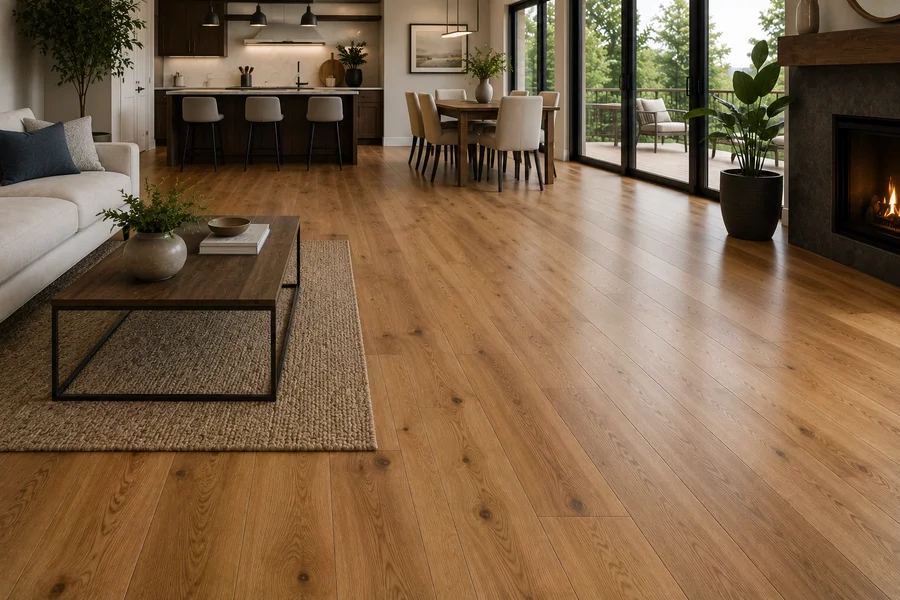
Engineered planks bond a real wood veneer to a plywood or HDF core. The core resists the seasonal expansion that makes solid wood cup and gap.
The finish carries the load here. Factory-applied aluminum oxide creates a hard ceramic-particle shield across the surface, and it outperforms any site-applied polyurethane against dog nails.
Buy a veneer of 3mm or thicker so one refinish stays possible.
Weakness: thin-veneer products scratch through to the core and cannot recover. Water protection remains limited.
12. Cork
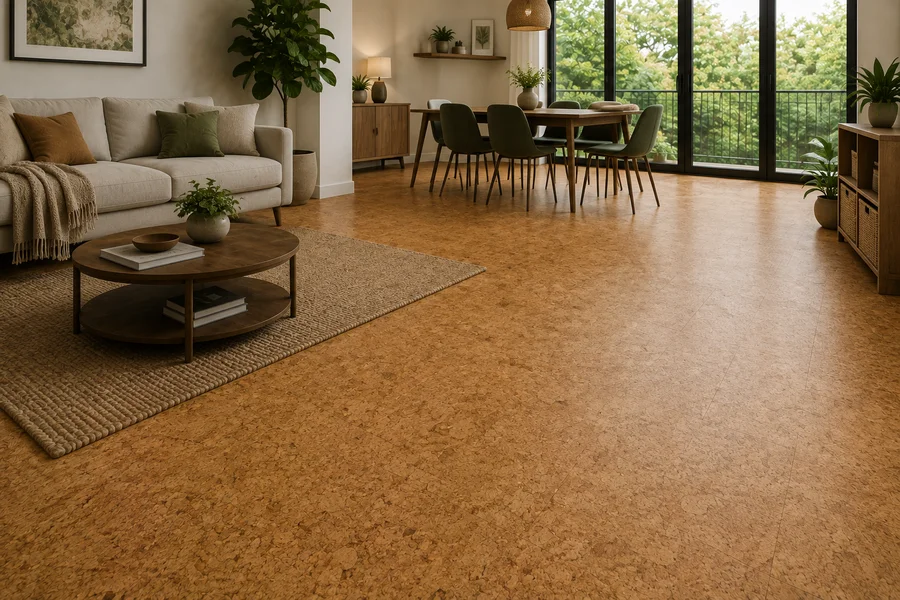
Cork surprises people. It comes from bark and contains a natural waxy substance called suberin, which resists mold, mildew, and insects without chemical treatment.
For dogs, cork delivers two things nothing else matches. Grip is superb, so senior dogs and dogs recovering from surgery walk with confidence. Cushioning is real, which spares aging joints. Cork also absorbs sound better than any hard surface, and its natural antimicrobial quality helps households with allergies.
Bedrooms and home offices suit cork best. Put it where an older dog spends most of the day.
Weakness: claws mark cork, heavy furniture leaves dents, and sunlight fades it. The sealer needs renewing every few years.
13. Carpet Tile with Waterproof Backing
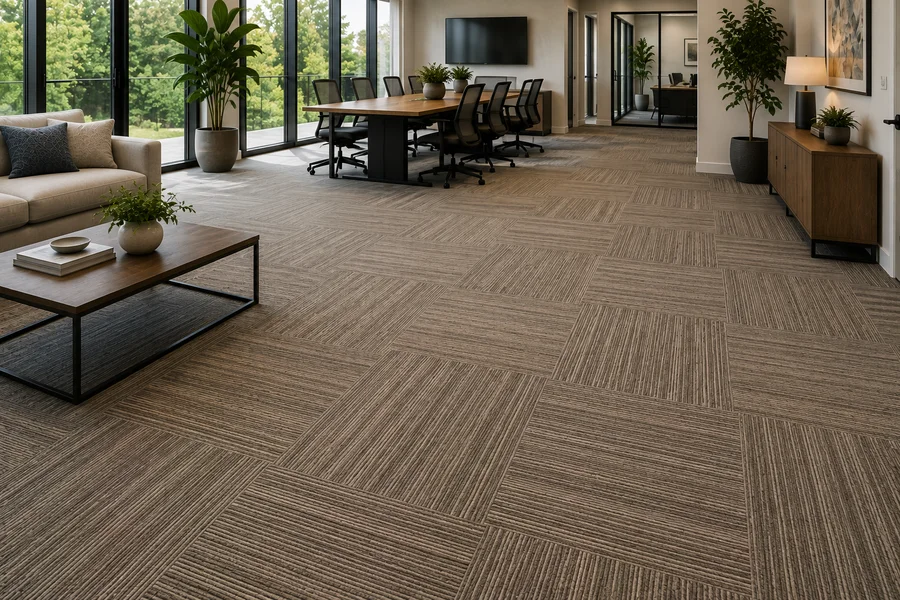
Broadloom punishes you for one accident by requiring a full replacement. Carpet tile does not. You lift the affected square, drop in a spare, and move on.
Pet-focused carpet tiles include an impermeable backing that stops liquid before it reaches the pad and subfloor. That backing is the entire point of the product. Buy a few extra cartons and store them in a closet.
Weakness: the surface still traps dander and hair, so vacuuming stays mandatory.
14. Triexta or Nylon Broadloom Carpet
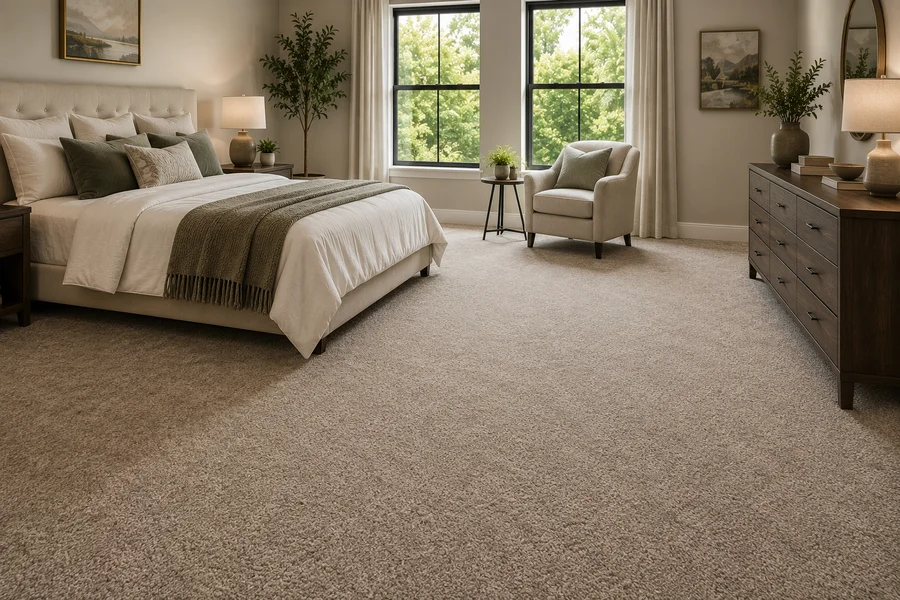
Carpets earn its place for one reason. Dogs with arthritis, hip dysplasia, or weak hind legs need grip, and no hard surface provides it the way carpet does.
Fiber choice decides how long the carpet survives:
- Nylon resists abrasion and snags better than any other fiber. It handles high traffic, cleans well, and holds color.
- Triexta repels liquid at the fiber level with permanent stain protection built in, not applied as a coating that wears away. It feels softer than nylon but wears faster.
- Olefin costs the least and resists stains well, so it suits big, messy dogs. The pile feels rough and short.
- Polyester feels wonderful and wears poorly. Reserve it for low-traffic bedrooms.
- Wool repels moisture naturally but cannot accept stain treatments. Accidents demand immediate cleanup.
Pile construction matters as much as fiber. Long loops let nails hook and pull, which produces runs and tears. Choose cut pile with a tight twist. Frieze pile hides dirt with its knobby texture. Saxony pile packs dense and short, which conceals wear and resists snagging. Density decides durability, so check face weight and tufts per square inch before you look at color.
Choose low-VOC fibers and adhesives. Volatile organic compounds can irritate a dog’s eyes and airways, and animals spend far more hours pressed against the floor than you do.
15. Polished and Sealed Concrete
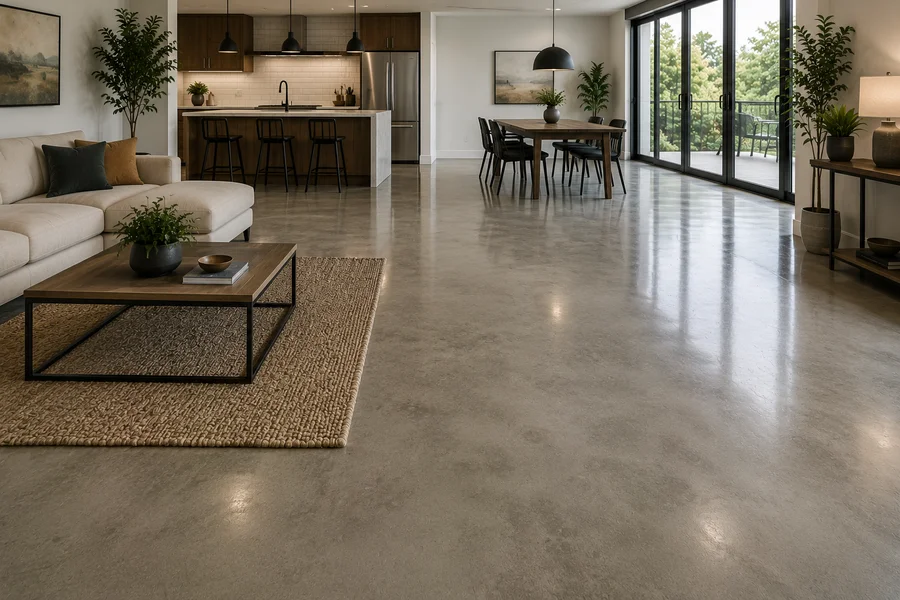
Concrete costs almost nothing to install if you already own a slab. Grinding and polishing an existing basement or ground-floor slab produces a surface no claw can touch.
Insist on a penetrating sealer rather than a topical one. Topical sealers scratch and peel under nails. Penetrating sealers soak into the slab and repel urine permanently. Request a matte or lightly textured polish, because a high-gloss finish turns into an ice rink for a running dog.
Weakness: unsealed concrete is porous and absorbs urine forever. The surface offers zero give, so pair it with a bed and rugs where your dog sleeps.
Two materials narrowly miss this list. Soft woods like pine, fir, and cedar dent under a medium dog’s weight alone. Unsealed natural stone such as marble, limestone, and travertine etches on contact with acidic urine.
Best Flooring for Dogs That Pee
Urine causes more permanent floor damage than claws ever will. Dog urine is acidic, so it etches finishes and bleaches wood stain. It also carries bacteria that keep producing odor long after the liquid dries.
The surface is only half the problem. Once urine passes a seam and reaches the subfloor, the smell becomes structural. Surface cleaning will not touch it. Your dog keeps smelling it and keeps returning to that spot.
Rank your options this way:
- Sheet vinyl in a seamless installation. Nothing gets through.
- Glue-down LVT. Nearly as good, and far more attractive.
- Porcelain tile. The tile body is impervious, so the grout becomes the only weak point.
- SPC rigid core plank. Excellent, provided you wipe accidents within a few hours.
- Carpet tile with waterproof backing. The only carpet worth considering for a dog with bladder issues.
Avoid solid hardwood, bamboo, cork, and standard broadloom if accidents happen weekly.
Protect the subfloor before the new floor goes down. Seal it with a stain-blocking primer, especially if the previous floor absorbed accidents. That step costs under $100 in materials and prevents a problem you cannot fix later. Under any carpet, add a moisture-barrier pad.
Clean accidents correctly. Blot, never rub. Then use an enzymatic cleaner. Enzymes break down the uric acid crystals that cause lingering odor. Ammonia-based cleaners smell like urine to a dog and invite a repeat visit to the same spot.
Best Waterproof Flooring for Pets
Marketing blurs two words that mean different things.
Water-resistant means the surface repels liquid for a limited time. Wipe it up and nothing happens. Leave it overnight and damage begins.
Waterproof means the material itself cannot absorb water. The core will not swell, buckle, or lose integrity no matter how long the liquid sits.
Truly waterproof pet friendly flooring options include porcelain tile, sheet vinyl, glue-down LVT, SPC and WPC rigid core planks, engineered stone composite tile, and sealed concrete.
One caution applies to every floating waterproof plank. The plank is waterproof. The floor assembly is not. Manufacturers know this, which is why their warranties specify cleanup windows. In rooms where your dog drinks, eats, or has accidents, a bonded installation always beats a floating one.
Traction: The Spec Most Owners Ignore
Dogs walk on nails and paw pads. Nails have no grip on a smooth surface. A young dog compensates with muscle. An old dog cannot, and one bad slip can end a senior dog’s mobility.
Watch for these warning signs. Your dog braces at doorways, takes corners wide, or refuses to cross a room he used to run through. Those behaviors mean the floor frightens him.
Fix it with the surface, not with the dog:
- Choose matte and textured finishes over gloss in every category.
- Buy tile at 0.42 wet DCOF or higher, and ask for the actual test figure.
- Lay runners with rubber backing along the routes your dog travels most, especially between his bed, the door, and his bowls.
- Trim nails every three to four weeks. Long nails force the toes upward and lift the pads off the floor, which removes the only real grip a dog has.
Puppies need the same help for a different reason. Slick floors during the first year can affect gait development in large breeds.
Room by Room
Entryway and mudroom. Grit arrives here on wet paws and acts like sandpaper on whatever you install. Porcelain tile and sealed concrete handle it. Rubber flooring also works well in this zone and around crates, because it grips, absorbs impact, and hoses clean.
Kitchen. Bowls tip and food spills, so the floor stays damp longer than anywhere else. Waterproof rigid core or tile suits it.
Living room. Balance appearance with durability. SPC plank, engineered stone tile, and wire-brushed hardwood all deliver.
Bedroom. Your dog sleeps here, so comfort outranks toughness. Cork or dense nylon carpet suits an aging dog best.
Basement. Moisture rises through concrete slabs year-round. Use tile, sealed concrete, or SPC with a vapor barrier. Never install solid hardwood below grade.
Dealing with a basement space as well? Explore the best flooring options for basements to find a surface suited to moisture and everyday use.
Installation Details That Decide Everything
Buying the right floor solves half the problem. These four details solve the rest.
Test the subfloor for moisture first. Concrete slabs release vapor for months after pouring. A calcium chloride or relative humidity test costs little and prevents a total failure.
Leave the expansion gap. Floating floors move with temperature and humidity. Skip the gap and the floor buckles into a ridge that a running dog can catch a nail on.
Seal the grout, then reseal it. Grout is porous and absorbs urine. Reseal every twelve to eighteen months in dog areas.
Choose the underlayment deliberately. A quality pad quiets nail clicks, softens the surface for joints, and adds a vapor barrier. Skipping it to save $200 undoes much of what you paid for.
Maintenance That Keeps Floors Looking New
Place a washable mat under every food and water bowl. Constant drips at one spot damage even a good floor.
Sweep or vacuum before grit grinds in. Sand tracked in on paws wears a finish faster than claws do.
Mop damp, never wet, on vinyl and laminate. Standing water finds seams.
Add rugs at doors, at the base of stairs, and around your dog’s bed. They catch dirt and take wear the floor would otherwise absorb.
Frequently Asked Questions
What is the best flooring for dogs overall? SPC rigid core luxury vinyl plank at 20 mil or thicker. It balances a waterproof core, strong scratch resistance, and a fair price better than anything else. Porcelain tile wins on pure toughness but costs more and offers no joint support.
Does dog urine ruin hardwood floors? Often, yes. Urine penetrates the finish and reaches the wood, leaving a dark stain. Light staining sands out during a refinish. Once the discoloration passes deeper than the sandable layer, board replacement is the only fix.
What flooring hides dog hair and scratches best? Mid-tone floors with varied grain or a speckled pattern. Solid black, solid white, and any high-gloss surface display every hair and every mark. Texture in the pattern does the hiding, not the color alone.
Do flooring warranties really cover pet damage? Read the fine print. Most pet warranties cover staining from accidents, not scratches or gouges from claws. Many require cleanup within a set number of hours and proof that you followed the manufacturer’s cleaning instructions. Keep your receipt and the product documentation.
Can I install pet-friendly flooring myself? Click-lock rigid core, laminate, and carpet tile all suit a confident DIYer. Sheet vinyl in a single piece is harder than it looks because of the templating. Tile, glue-down LVT, and concrete polishing need a professional or specialist tools.
Is tile too cold for dogs? Tile suits warm climates and summer months, and many dogs deliberately seek it out. In cold regions, pair it with radiant heat or accept that your dog will migrate to rugs from November onward.
How long should pet-friendly flooring last with a dog? Porcelain tile and sealed concrete last decades. Rigid core vinyl at 20 mil runs fifteen to twenty years. Laminate at AC4 gives ten to fifteen. Carpet in a dog household rarely passes seven, whatever the warranty claims.
The Bottom Line
Match the floor to your dog, not to a showroom sample.
Young and house-trained? SPC rigid core plank at 20 mil.
A puppy still learning, or a senior losing control? Go waterproof and go bonded.
Stiff hips and slipping on every turn? Traction outranks scratch resistance, so choose cork or dense nylon carpet.
Big active breed and a house you plan to sell? Wire-brushed hickory in a matte finish.
Whatever you choose, spend the extra money on the wear layer, the underlayment, and the subfloor prep. Those three decisions determine whether your floor still looks good in 2036.

Noah Williams
Interior Designer & Flooring Expert
Related Posts