Noah Williams is an interior designer and flooring expert at Nova Floor. In Dubai, he helps people pick the right floor, get it installed, and keep it looking good. He also writes simple, practical flooring and home care guides for readers in Dubai and around the world.
Best Flooring for Basements | Top 10 Waterproof & Moisture-Resistant Options
Noah Williams
The best flooring for basements is SPC rigid core vinyl plank. It is waterproof through its full thickness, dimensionally stable when the slab temperature swings, installs directly over concrete, and survives a flood event that would destroy laminate or carpet.
That said, “best” depends on what your slab is doing:
| Your basement | Best choice | Why |
| Wet (has flooded, or floods) | Porcelain tile or polyaspartic coating | Bonded to the slab; nothing to delaminate or trap water |
| Damp (humid, occasional seepage) | SPC rigid core vinyl | Waterproof core, floats over minor slab imperfections |
| Finished & dry (living space) | SPC, WPC vinyl, or engineered hardwood | Comfort and warmth without moisture risk |
| High-traffic (gym, playroom, rental) | Porcelain tile or rubber | Highest wear resistance and impact tolerance |
Read on for how each of the ten options actually performs & more importantly, how to test your slab before you spend a dollar on material.
Contents
Why Basements Break Flooring
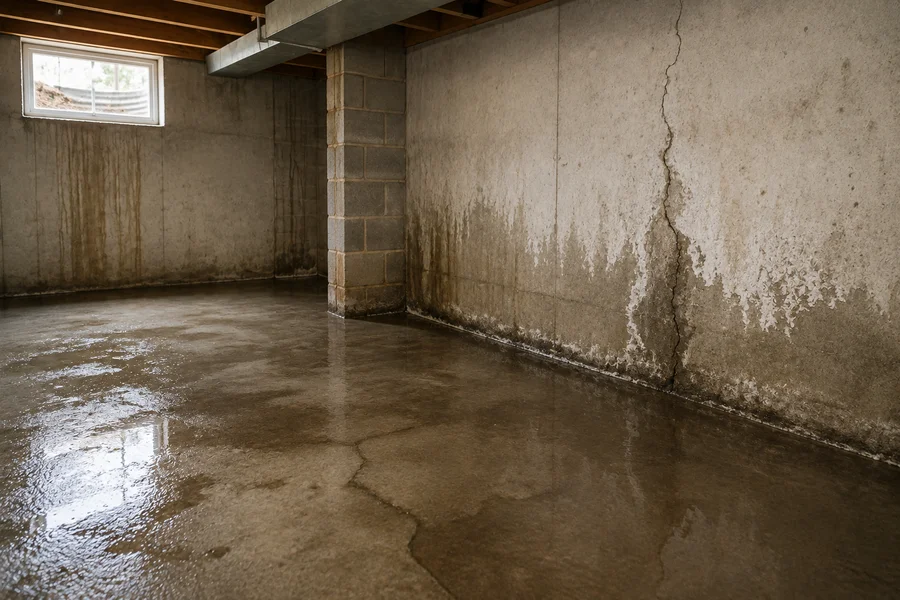
In our experience, basement flooring failures are almost never material failures. They are moisture failures that the material was blamed for.
A below-grade slab is in constant contact with soil, and soil holds water. That water moves into your basement through four mechanisms, and each one calls for a different response.
Capillary action. Concrete is porous. Water wicks upward through the slab’s capillary structure even when the soil is only damp, not saturated.
Vapor drive. Moisture moves as vapor from the higher-pressure side (wet soil) to the lower-pressure side (your conditioned basement). This happens year-round and is invisible until flooring starts to cup, lift, or smell.
Hydrostatic pressure. When groundwater rises around the foundation, it pushes liquid water through cracks, cold joints, and the slab-wall seam. No floor covering solves this. It is a drainage and waterproofing problem.
Condensation. Warm, humid summer air meets a slab sitting at 55–60°F. If the slab is below the dew point, water condenses on the surface. This is why basements often feel damp in July, not January.
The practical takeaway: a floor labeled “waterproof” resists water from above. Almost nothing resists water from below. That distinction drives every recommendation in this guide.
Test Your Slab First
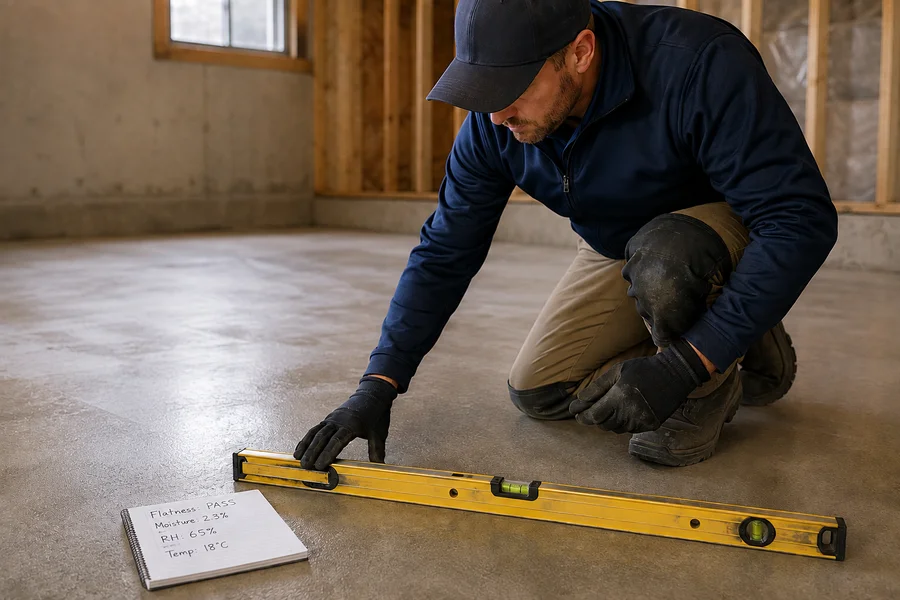
Before choosing between basement flooring materials, measure what your concrete is doing. This is standard practice on commercial jobs and it is why commercial floors do not fail the way residential basements do.
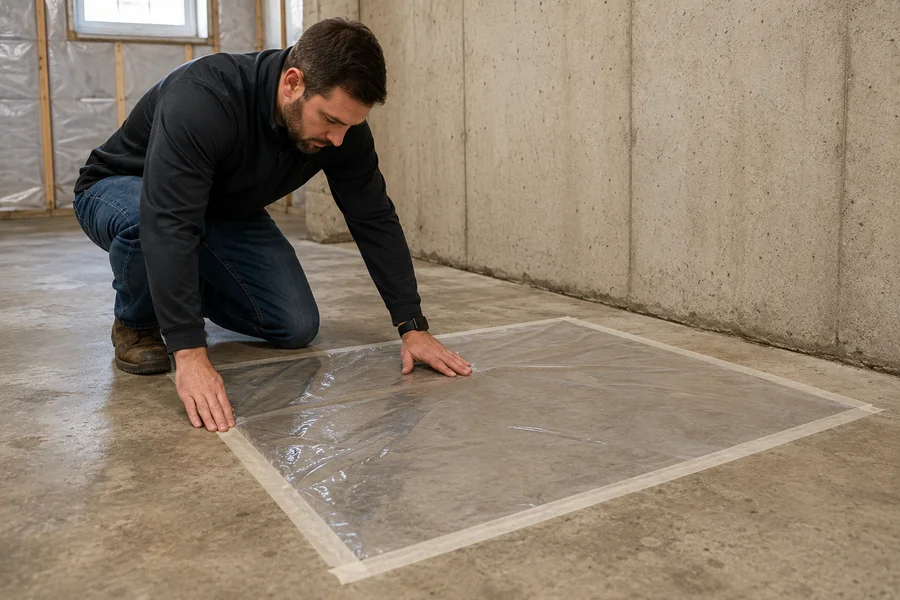
The free test: ASTM D4263 plastic sheet test
Tape an 18″ × 18″ square of clear polyethylene to the slab on all four sides. Leave it 16–24 hours. Darkened concrete or condensation on the underside of the plastic means active moisture. This is a pass/fail indicator only — it tells you whether to worry, not how much.
The real tests
ASTM F2170 — in-situ relative humidity. Probes are drilled into the slab at 40% of its depth and read after equilibration. This is the industry-preferred method because it measures moisture within the slab, not just at the surface. Most manufacturers specify a maximum internal RH, commonly in the 75–85% range, though limits vary by product and adhesive.
ASTM F1869 — calcium chloride (MVER). Measures moisture vapor emission rate in pounds per 1,000 sq ft per 24 hours. Many adhesives cap out around 3–5 lbs. Useful, but only valid for the top layer of the slab.
ASTM F710 — surface prep standard. Covers flatness, pH, cleanliness, and bond testing. Alkalinity matters: high slab pH destroys many adhesives, and basement slabs are frequently alkaline.
If your readings exceed the manufacturer’s limits, you have three options: a moisture mitigation coating (an epoxy vapor-suppression system applied to the slab), a dimpled subfloor panel system, or choose a floating floor with a Class I vapor retarder (below 0.1 perm) that tolerates the condition.
Expert insight: Manufacturers do not honor warranties on slabs that exceed their stated moisture limits. A $200 test protects a $6,000 floor and is the single best-value step in the entire project.
The Top 10 Basement Flooring Options
1. SPC Rigid Core Vinyl Plank | Best Overall
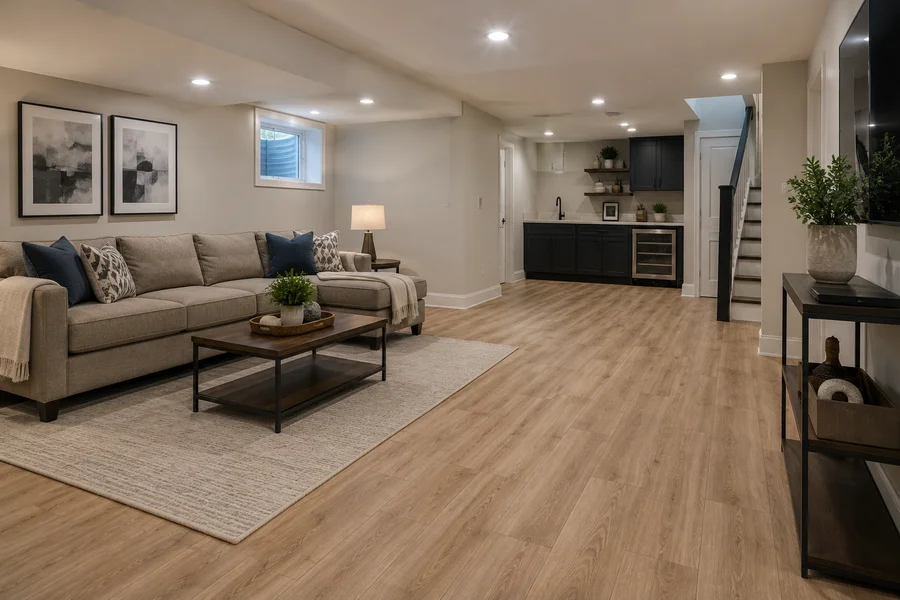
Stone Plastic Composite uses a limestone-and-PVC core that is denser and more rigid than any other resilient product. The core does not absorb water, swell, or support mold.
Its defining advantage in a basement is dimensional stability. Basement slabs move through a wider temperature range than main-floor subfloors, and SPC expands and contracts far less than WPC or laminate under that cycling. Fewer gaps at the seams, less peaking at the walls.
Wear layer determines lifespan more than any other spec:
| Wear layer | Typical use | Expected service life |
| 6 mil | Light residential | 5–10 years |
| 12 mil (≈0.3 mm) | Standard residential | 10–15 years |
| 20 mil (≈0.5 mm) | Heavy residential / light commercial | 15–20 years |
| 28–30 mil (≈0.7 mm) | Commercial | 20+ years |
For any basement that sees real use, specify 20 mil minimum.
Pros: 100% waterproof core with excellent dimensional stability, floats over concrete, and offers a DIY-friendly click-lock system. It survives flooding and can often be dried and reinstalled, with wide wood and stone visuals.
Cons: Firm and cold underfoot without an attached pad, while its rigid construction telegraphs slab imperfections and can dent under concentrated point loads. Lower-cost products may fade in direct sun.
Lifespan: 15–25 years. Installed cost: roughly $4–$12/sq ft.
2. WPC Vinyl Plank | Best for Comfort
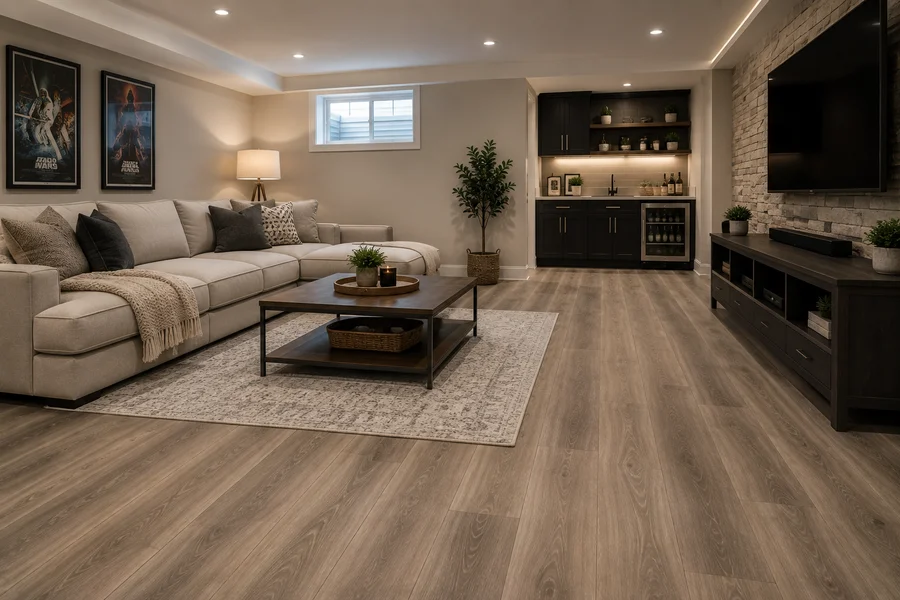
Wood Plastic Composite uses a foamed core, making it noticeably softer, warmer, and quieter than SPC. The core is still waterproof.
The trade-off is thermal movement. WPC’s foamed structure expands and contracts more with temperature change, so it is a better fit for a climate-controlled, finished basement than an unconditioned one where slab temperatures swing seasonally.
Pros: Warmest and quietest of the vinyls, hides minor slab imperfections better than SPC, and has a waterproof core. It is comfortable for playrooms and media rooms.
Cons: More thermal movement than SPC, with a softer core that dents more easily, while the thicker profile can affect door clearances. It generally costs more.
Lifespan: 15–20 years. Installed cost: roughly $5–$13/sq ft.
3. Glue-Down Luxury Vinyl Tile (LVT) | Best for Large or Problem Slabs
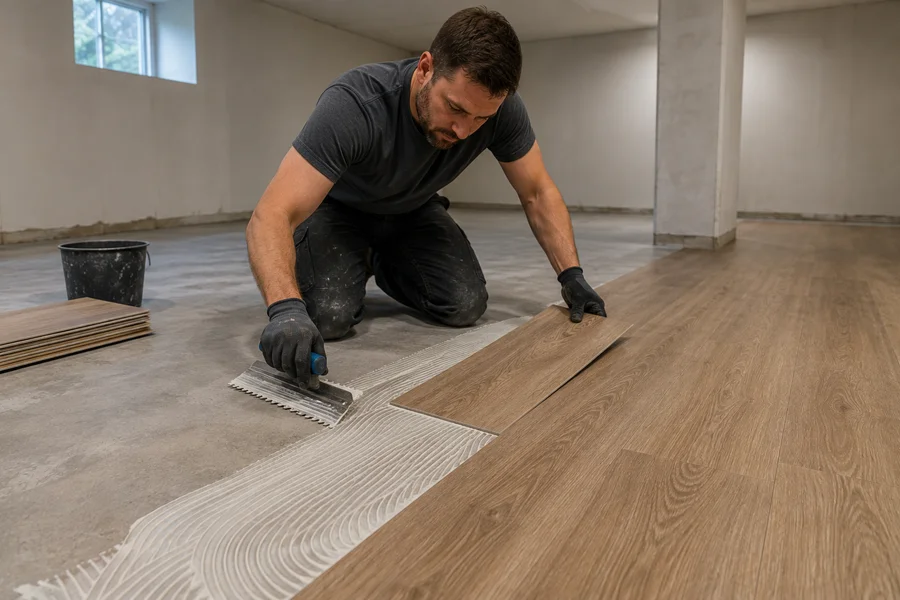
Glue-down LVT is a flexible plank or tile that sticks directly to the concrete floor. Since it is firmly bonded, it is less likely to peak, buckle, or show gaps between seams like a floating floor. It also has no expansion-gap limit, making it a good choice for large, open basements..
The main concern is the adhesive. This is more sensitive to moisture in the concrete than other vinyl flooring options because moisture can weaken the adhesive bond. That is why testing the concrete for moisture is essential before installation.
Pros: No expansion gap constraints, thinnest profile, and individual tiles are replaceable. It works well for irregular layouts and provides excellent stability underfoot.
Cons: Adhesive can fail under high vapor emission and demands a flat, clean, correctly prepped slab. Removal is labor-intensive and it is not DIY-friendly.
Lifespan: 15–25 years. Installed cost: roughly $4–$10/sq ft.
4. Porcelain & Ceramic Tile | Best for Wet Basements
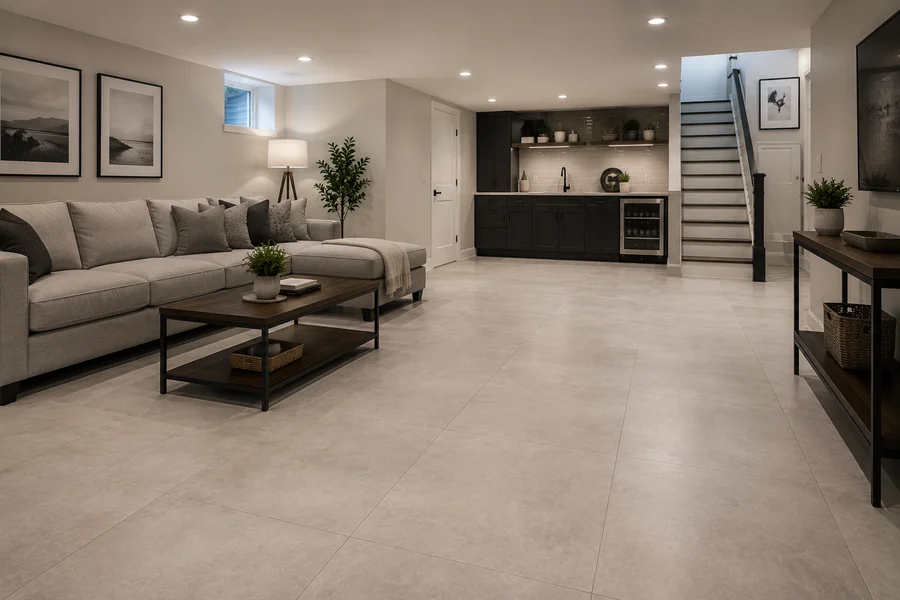
Tile is the only option on this list that is genuinely unaffected by liquid water. It cannot rot, swell, delaminate, or off-gas after a flood.
Porcelain and ceramic are not interchangeable. Porcelain is fired denser and, per ANSI A137.1, absorbs 0.5% or less of its weight in water. Ceramic is more porous and better suited to dry, low-traffic areas.
Note that the tile is waterproof; the assembly may not be. Cement grout is porous and must be sealed and periodically resealed, or specified as epoxy grout in wet zones. And tile does nothing to stop vapor drive, it simply does not care about it.
Pros: Impervious to water, with a 50+ year lifespan, unmatched wear resistance, and ideal performance over radiant heat. It installs directly on a sound slab and can add resale value.
Cons: Hard and cold without radiant heat, with loud sound and significant reverberation, plus grout maintenance. Slab cracks can telegraph through without an uncoupling membrane, and it has the highest installed cost.
Lifespan: 50+ years. Installed cost: roughly $10–$30/sq ft.
5. Waterproof Laminate | Best Budget Wood Look
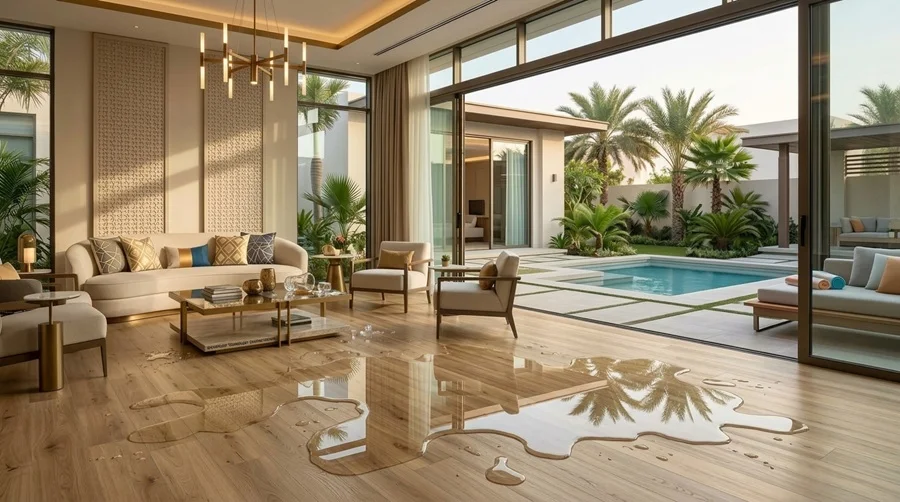
Modern waterproof laminate Flooring uses a treated HDF core with sealed edges and tight locking systems. It is a genuine improvement over legacy laminate, which had no business in a basement.
But be precise about what “waterproof” means here. Most warranties cover surface water for a defined window, commonly 24 to 72 hours & specifically exclude moisture from below and standing water. The core is still wood fiber. If it gets saturated, it swells irreversibly.
Pros: Convincing wood visuals, a harder surface layer than vinyl for better scratch resistance, and lower cost than engineered wood. It also offers easy click installation.
Cons: The wood-fiber core is the failure point, with time-limited water warranties, and it cannot be refinished. It can have hollow acoustics without quality underlayment and requires a vapor retarder over concrete.
Lifespan: 10–20 years. Installed cost: roughly $4–$9/sq ft.
Verdict: Acceptable in a dry, tested basement. Not the right call for flooring for damp basements.
6. Engineered Hardwood | Best for Real Wood
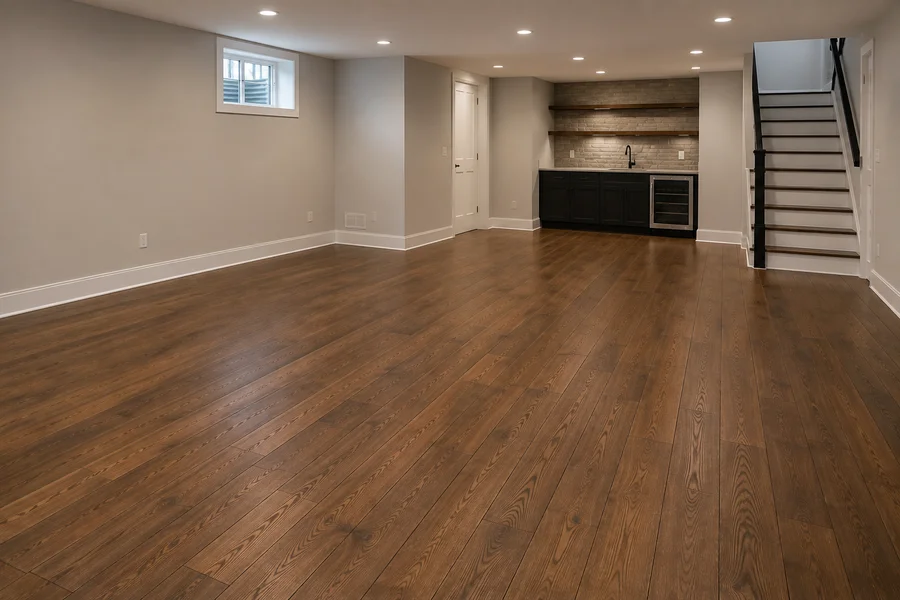
If you want real wood below grade, engineered wood is the best choice. Its layered plywood core helps prevent the cupping and buckling that can damage solid hardwood in humid conditions. Solid hardwood should not be installed below grade.
Choose engineered wood with a plywood core instead of HDF, and look for a wear layer of at least 3 mm if you may refinish it later. Also, make sure the manufacturer allows below-grade installation. Keep the basement humidity stable with a dehumidifier.
Pros: Genuine hardwood surface, warm underfoot, and refinishable if the veneer is thick enough. It offers the strongest resale appeal of any basement flooring material.
Cons: Not waterproof, so a flood can be a total loss, and it requires stable year-round humidity. It scratches like any wood floor, is expensive, and has a narrow tolerance for slab moisture.
Lifespan: 20–30 years in the right conditions. Installed cost: roughly $8–$20/sq ft.
7. Polished & Sealed Concrete | Best Value on a Sound Slab
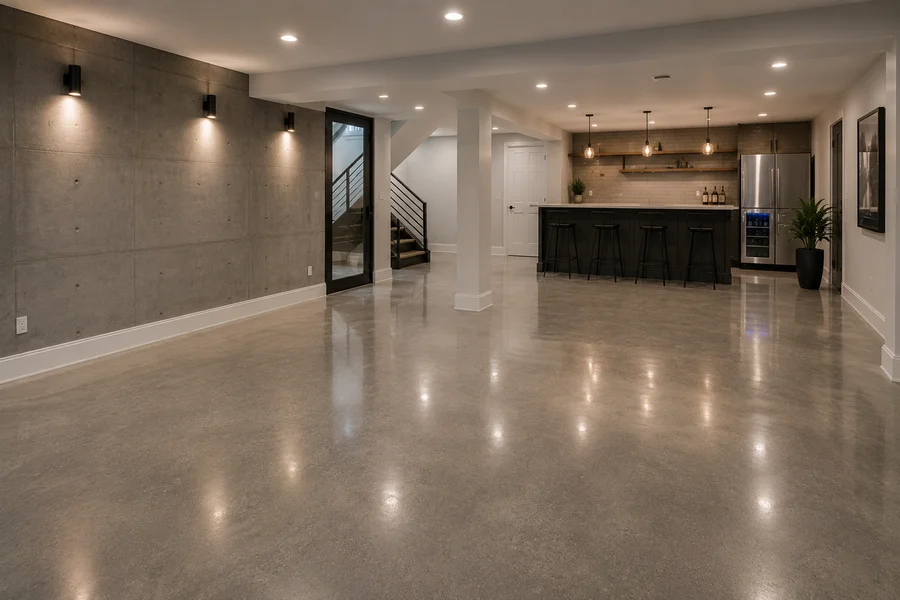
You already own a floor. Polishing, staining, or dyeing the existing slab turns it into a finished surface with no added assembly to trap moisture, which is precisely why it works where other options fail.
Because there is no layer between you and the concrete, vapor drive becomes a non-issue. Water passes through and evaporates rather than being trapped beneath a membrane. That is a genuine advantage in basements with borderline moisture readings.
Pros: No moisture-trapping assembly, extremely durable, no lost ceiling height, and easy to clean. It accepts radiant heat under an overlay and provides a modern aesthetic.
Cons: Hard, cold, and unforgiving, with no insulation or sound absorption, while existing cracks generally remain visible. Sealers need periodic reapplication, and results depend heavily on slab condition and installer skill.
Lifespan: Indefinite; resealing every 3–10 years. Installed cost: roughly $3–$12/sq ft.
8. Epoxy & Polyaspartic Coatings | Best for Utility & Gym Spaces
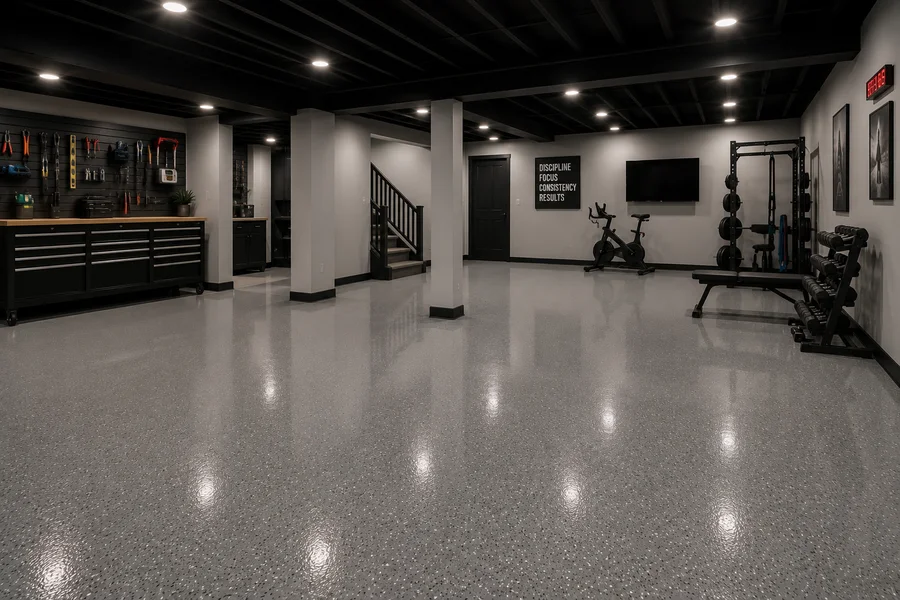
These are seamless resinous coatings bonded to the slab. Polyaspartic is the more capable of the two below grade: it stays flexible as the slab moves with temperature, cures fast, and holds color under UV. Standard epoxy is more rigid and more prone to cracking or delaminating when concrete shifts.
Surface preparation determines everything. These systems fail from inadequate grinding and untested moisture, not from wear. Some epoxy systems double as moisture mitigation membranes when specified for that purpose.
Pros: Seamless with no grout or joints, very resistant to chemicals and impact, and easy to clean. It also comes in decorative flakes and metallic finishes and can help control moisture.
Cons: Hard and cold, and slippery when wet unless anti-slip aggregate is added, while it also needs diamond grinding and careful floor prep. It can peel if slab moisture is too high, and standard epoxy can turn yellow.
Lifespan: 10–20 years. Installed cost: roughly $4–$12/sq ft.
9. Rubber Flooring | Best for Home Gyms
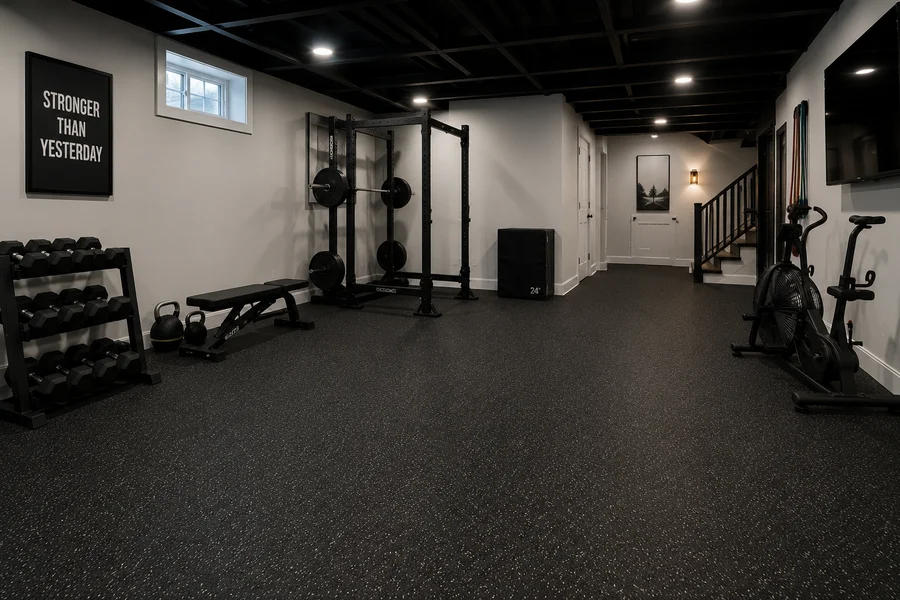
Rolled or interlocking rubber flooring is non-absorbent, impact-absorbing, and effectively immune to the abuse a home gym delivers. It also has a valuable secondary property: it is naturally slip-resistant when wet.
Choose rolled goods over interlocking tiles where you can. Fewer seams means fewer places for water to reach the slab.
Pros: Waterproof and mold-resistant, with strong impact and sound absorption, while protecting the slab from dropped weights. It is also slip-resistant and easy to maintain.
Cons: Limited in style choices, and new material can have a noticeable smell, so choose low-VOC products. Seams can trap moisture, and it may not suit formal living areas.
Lifespan: 20+ years. Installed cost: roughly $3–$10/sq ft.
10. Modular Carpet Tile | Best Soft Surface
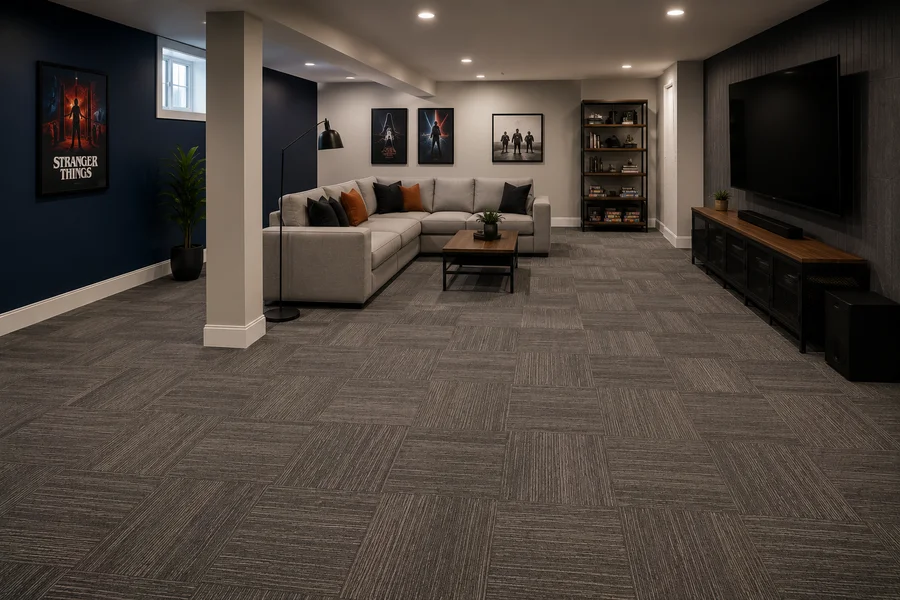
Broadloom carpet does not belong in a basement. Carpet tile is a different product. Commercial-grade tiles with closed-cell cushion or vinyl backing resist moisture wicking, and their modularity is the point: if a section gets wet, you lift and replace those tiles instead of the room.
Always specify synthetic face fiber, nylon, polyester, or olefin. Never use jute or natural-fiber backing below grade; it is organic material and will support mold.
Pros: Warm, soft, and sound-absorbing, with replaceable individual tiles and little installation waste. Permeable backings allow some slab breathing, making it a good choice for media rooms.
Cons: It is the least moisture-tolerant option here and can harbor allergens. It has visible seams and is not suitable for basements with any history of water.
Lifespan: 10-15 years. Installed cost: roughly $3-$9/sq ft.
Basement Flooring Comparison Table
| Option | Moisture resistance | Truly waterproof | Durability | Comfort | Maintenance | Lifespan | Installed cost/sq ft |
| SPC rigid core vinyl | Excellent | Yes | High | Moderate | Low | 15–25 yrs | $4–$12 |
| WPC vinyl | Excellent | Yes | Moderate–High | High | Low | 15–20 yrs | $5–$13 |
| Glue-down LVT | Very good* | Yes (adhesive is the limit) | High | Moderate | Low | 15–25 yrs | $4–$10 |
| Porcelain & ceramic tile | Excellent | Yes | Very high | Low | Low–Moderate | 50+ yrs | $10–$30 |
| Waterproof laminate | Moderate | No | Moderate–High | Moderate | Low | 10–20 yrs | $4–$9 |
| Engineered hardwood | Fair | No | Moderate | High | Moderate | 20–30 yrs | $8–$20 |
| Polished concrete | Excellent | Yes | Very high | Low | Low | Indefinite | $3–$12 |
| Epoxy / polyaspartic | Excellent | Yes | Very high | Low | Low | 10–20 yrs | $4–$12 |
| Rubber | Excellent | Yes | Very high | High | Low | 20+ yrs | $3–$10 |
| Carpet tile | Poor–Fair | No | Moderate | Very high | Moderate | 10–15 yrs | $3–$9 |
Glue-down LVT’s material is waterproof, but bond performance depends on slab moisture staying within the adhesive’s rated limits.
Costs are typical installed ranges and vary significantly by region, slab preparation required, and product tier.
Which Basement Flooring Is Best for Your Conditions?
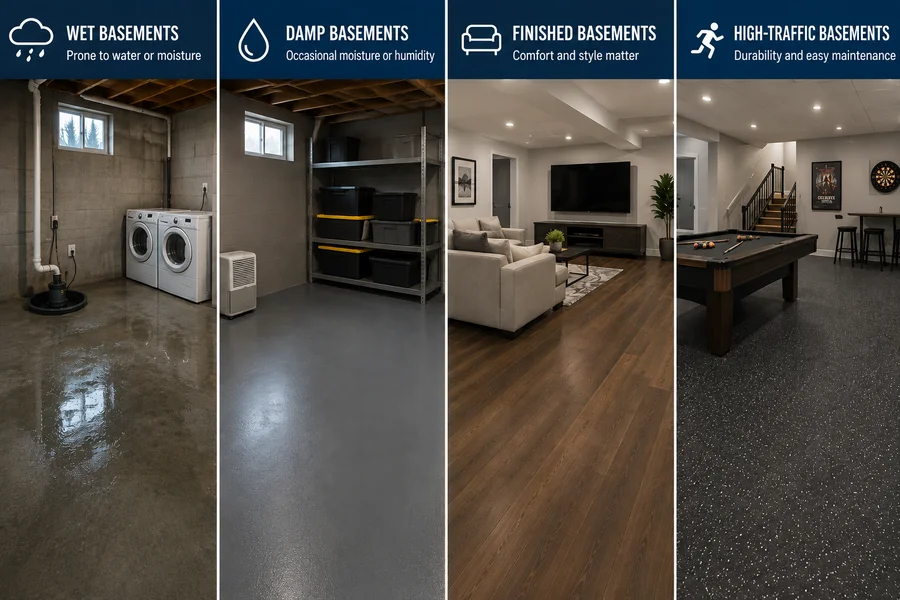
Best flooring for a wet basement
Porcelain tile or a polyaspartic coating. If your basement has taken on water, choose something bonded directly to the slab with no cavity beneath it. Floating floors trap water underneath, where it cannot evaporate and mold has weeks to establish before you notice.
Fix the water first. Flooring is a finish, not a waterproofing system. Address grading, gutters, drainage, and the sump before selecting a floor covering.
Best flooring for a damp basement
SPC rigid core vinyl over a Class I vapor retarder. For basements with elevated humidity, seasonal seepage, or borderline moisture readings, SPC gives you a fully waterproof wearing surface with the ability to lift and dry the floor if something goes wrong. Pair it with a dehumidifier holding relative humidity between 30% and 50%.
Best flooring for a finished basement
SPC, WPC, or engineered hardwood, depending on your test results. In a dry, conditioned, tested basement, comfort and appearance can lead the decision. WPC is warmer underfoot than SPC. Engineered hardwood delivers the most resale appeal, but only commit to it if your slab tests well and you will maintain stable humidity.
Best flooring for a high-traffic basement
Porcelain tile for general use, rubber for gyms. Porcelain has the highest wear resistance of any residential flooring material and will outlast the house. For a home gym, rubber’s impact absorption protects both the slab and the equipment. If you want a warmer surface in a busy family basement, 20 mil or 28 mil wear layer SPC is the practical compromise.
Subfloor Systems: Warmth, and a Caution
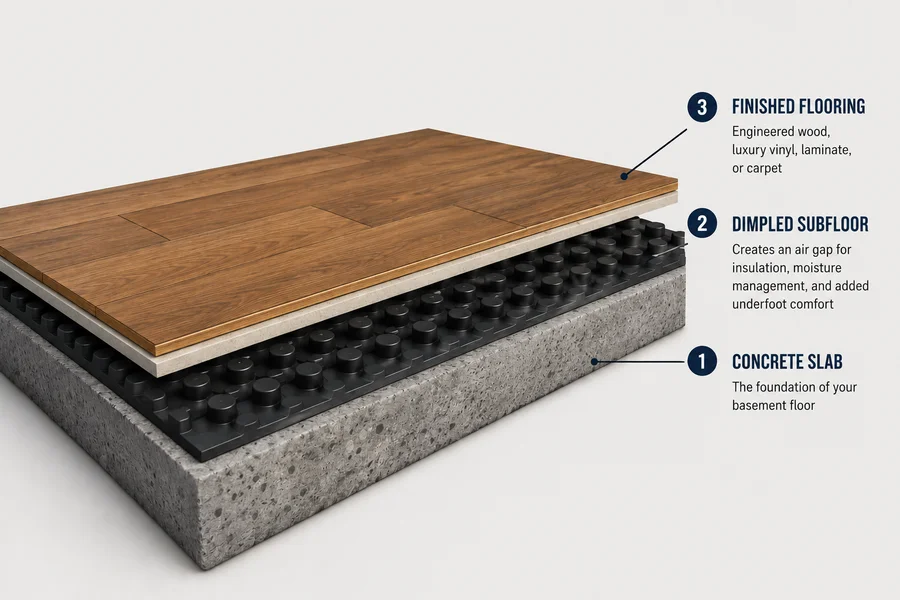
Dimpled subfloor panels, rigid boards with a raised plastic underside, create an air gap over the slab. Sold as basement subfloor systems, they add insulation value, warmth underfoot, and a level surface.
They work well on a dry slab. On a slab with active moisture, that air gap becomes a concealed reservoir. Water enters, sits in a dark unventilated cavity against an OSB panel, and mold follows. We have seen this outcome more than once.
The same caution applies to sleeper systems built from 2x4s and plywood. They are effective when moisture has been ruled out and a liability when it has not. They also consume 1 to 1½ inches of ceiling height, which matters in a basement already tight on headroom.
What to Avoid in a Basement
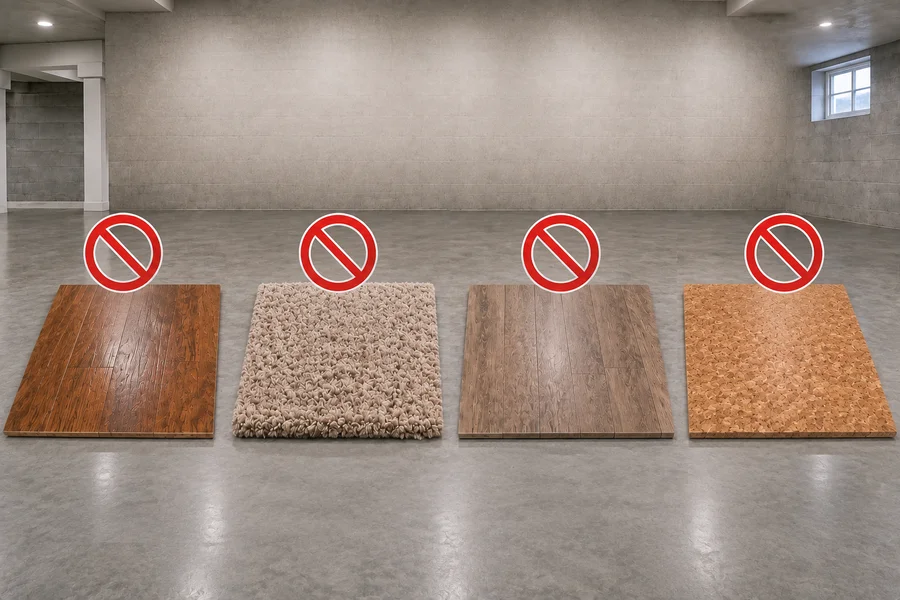
- Solid hardwood. It will cup and buckle. No exceptions below grade.
- Broadloom carpet with jute backing. Organic backing plus below-grade moisture equals mold.
- Standard (non-waterproof) laminate. The original core swells on contact with water.
- Bamboo and cork. Both are highly sensitive to humidity fluctuation.
- Any floating floor installed without a vapor retarder over concrete, regardless of how dry the slab looks.
- Installing over an untested slab. It voids warranties and is the leading cause of basement flooring failure.
Installation Notes That Protect Your Warranty
Acclimate the material. Most manufacturers require 48–72 hours in the installed environment. SPC needs less than WPC or laminate, but follow the spec sheet.
Respect expansion gaps. Floating floors need perimeter clearance, typically ¼” to ½”. Skipping this causes peaking and buckling, the single most common floating-floor callback.
Verify slab flatness. ASTM F710 flatness tolerances apply. Rigid cores bridge hollows and eventually crack at the unsupported seam. Grind high spots and fill low spots before installation.
Check pH. Basement slabs are often alkaline. High pH destroys adhesives and voids glue-down warranties.
Use the specified underlayment. Substituting a generic pad for the manufacturer’s required product is a common way to lose warranty coverage.
Frequently Asked Questions
What is the best flooring for basements overall?
SPC rigid core vinyl plank is the best choice for most basements. It is waterproof, handles temperature changes well, and can be removed and dried after a water leak. If your basement has a history of serious flooding, porcelain tile is a stronger option.
Is vinyl plank actually waterproof in a basement?
The flooring material is waterproof. SPC and WPC cores do not absorb water. However, a floating floor cannot stop moisture from coming up through the concrete. Water can still collect underneath the floor. So, “waterproof” refers to the plank, not the entire floor system.
Can I install flooring directly on a concrete basement floor?
Yes, if the concrete is tested, clean, flat, and within the moisture limits set by the manufacturer. Most floating floors also need a Class I vapor retarder over concrete.
What flooring should I use if my basement floods?
Porcelain tile, polished concrete, or polyaspartic coating are good choices because they bond directly to the concrete and do not leave a space where water can collect. However, fix the source of the water first. No flooring can replace proper drainage and waterproofing.
Does basement flooring need a vapor barrier?
In most cases, yes. Floating floors over concrete usually need a Class I vapor retarder with a rating below 0.1 perm. Tile, polished concrete, and coatings bond directly to the slab and handle moisture differently, but they still have specific moisture limits.
How long does basement flooring last?
Porcelain tile can last more than 50 years. Quality SPC with a 20 mil wear layer can last 15 to 25 years. Engineered hardwood can last 20 to 30 years when humidity stays stable. Carpet tile usually lasts 10 to 15 years. In all cases, good slab preparation has a major impact on how long the floor lasts.

Noah Williams
Interior Designer & Flooring Expert
Related Posts