
Noah Williams is an interior designer and flooring expert at Nova Floor. In Dubai, he helps people pick the right floor, get it installed, and keep it looking good. He also writes simple, practical flooring and home care guides for readers in Dubai and around the world.
How to Get Rust Out of Carpet | 7 Effective Ways to Remove Rust Stains

Noah Williams
You move a chair, a plant pot or a metal bed frame, and there it is: an orange-brown mark on the carpet. Rust won’t come out with normal carpet shampoo, which is why so many people give up on it.
This guide shows you how to get rust out of carpet with seven methods, starting with the gentlest. You’ll also learn how to treat old rust stains, which products suit your carpet fibre, and which popular tips make rust worse.
Quick answer: To get rust out of carpet, scrape off loose flakes and patch test first. Dab on diluted white vinegar or lemon juice, wait 10–15 minutes, then blot with a white cloth and rinse with cool water. For old stains, use cream of tartar or an oxalic acid remover. Never use bleach.
Contents
Why Are Rust Stains on Carpet So Hard to Remove?
Rust is iron oxide. It forms when iron or steel meets water and air. When a damp metal object sits on carpet, tiny rust particles move into the fibres and grip them tightly.
Soap and detergent can’t break that grip. Rust only dissolves in acid. That’s why most methods below use one, from mild vinegar to strong oxalic acid.
Where rust stains usually come from in UAE homes:
- Metal furniture legs, bed frames and chair glides
- Plant pots with metal bases, especially after watering
- Balcony and patio furniture in humid, coastal areas like Dubai Marina or Palm Jumeirah
- AC units dripping onto metal items
- Paint tins, aerosol cans and tool boxes left on the floor
- Hairpins, keys and coins dropped on damp carpet
- Rusty nails or gripper strips hidden under the carpet edges
Before You Start: 4 Steps That Decide Your Results
Skip these and you’ll likely spread the stain. They take five minutes.
1. Remove the rust source
Move whatever caused the stain. Wipe and dry metal legs before you put the furniture back, and add felt or plastic pads. If the source stays, the stain returns.
2. Scrape off loose rust while it’s dry
Use a blunt butter knife or a spoon to lift crusty flakes from the top of the fibres. Then vacuum. If you add liquid to loose flakes, they turn into rusty water that spreads wider.
3. Know your carpet fibre
Check the label on the back of a rug, or ask your installer. Nylon, polyester and polypropylene handle acids well. Wool needs a gentle touch. Silk, viscose, sisal and jute need a professional. Not sure what you have? Nova Floor’s wall-to-wall carpet guide explains the main fibre types.
4. Do a patch test
Choose a hidden spot, such as inside a wardrobe or under the sofa. Dab on a little of your cleaner and wait 10 minutes. Press a white cloth on it. If colour comes off, or the carpet looks lighter, pick a different method.
What you’ll need: white cotton cloths or paper towels (coloured cloths can bleed dye), a spray bottle of cool water, a small bowl, a spoon and rubber gloves.
How to Get Rust Out of Carpet: 7 Effective Methods
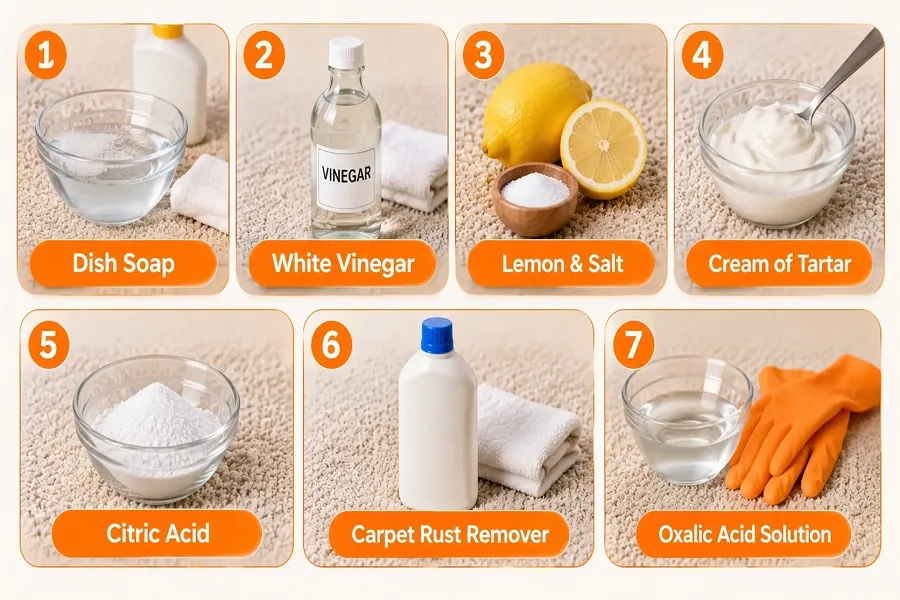
Work down the list. Each method is a little stronger than the last, so stop as soon as the stain is gone.
Method 1: Cool Water and Dish Soap Blot
Start here if the stain is fresh. Dish soap won’t dissolve rust. It lifts loose particles and any dirt or grease sitting on top. Sometimes that’s all a fresh mark needs. It also clears the surface so the acid in later methods can reach the rust.
- Mix 1 teaspoon of clear dish soap into 2 cups of cool water.
- Dab it onto the stain with a white cloth.
- Wait 5 minutes, then blot from the outer edge toward the centre.
- Rinse with a light spray of cool water and blot again. Leftover soap attracts dirt.
Still seeing an orange tint? That’s rust bonded to the fibres. Move on to Method 2.
Method 2: White Vinegar Solution
Vinegar is the best first acid to try. It’s cheap, gentle and safe on most synthetic carpets. Its acetic acid slowly loosens rust’s grip on the fibres.
Mix ½ cup of white vinegar with 1 cup of cool water. Dab it on until the fibres are wet but the carpet isn’t soaked. Leave it for 10 to 15 minutes, then blot from the outside in. Switch to a clean part of the cloth as the rust transfers. Rinse with cool water, blot dry, and repeat once or twice if needed.
Don’t pour neat vinegar straight on. Soaking the carpet pushes rust and moisture down into the underlay, where it can rise back up later.
Method 3: Lemon Juice and Salt
Why it works: Lemon juice contains citric acid, which acts on rust faster than vinegar. The salt holds the juice in place on the stain.
Best for: small, fresh spots on light-coloured synthetic carpet.
- Squeeze fresh lemon juice onto the stain until the fibres are damp.
- Sprinkle about 1 teaspoon of salt on top.
- Leave it for 15 to 30 minutes, away from direct sunlight. Lemon and strong sun together can lighten some dyes.
- Blot firmly with a white cloth.
- Rinse well. Lemon juice contains sugar, and any left behind turns sticky and attracts dirt.
Don’t scrub the salt in. On wool or loop-pile carpet, rubbing frays the pile.
Method 4: Cream of Tartar and Lemon Paste
Cream of tartar is a mild acid powder from the baking aisle. Mixed with lemon juice, it forms a thick paste. A paste stays on the stain longer than a liquid, and that extra contact time is what older marks need.
Stir 1 tablespoon of cream of tartar with just enough lemon juice to make it as thick as toothpaste. Spread it over the stain and leave it for 20 to 30 minutes. Scrape it off gently with a spoon, then blot, rinse with cool water and blot again.
Method 5: Citric Acid Solution
Citric acid powder is sold in supermarkets for descaling kettles. It’s the same acid as lemon juice, but without the sugar or pulp, and its strength is easier to control.
- Dissolve 1 teaspoon of citric acid powder in 1 cup of warm water.
- Let it cool to lukewarm, then patch test. It’s stronger than vinegar.
- Dab it onto the stain and wait 15 to 20 minutes.
- Blot, rinse twice with cool water, and blot dry.
Method 6: Ready-Made Carpet Rust Remover
If you’d rather not mix powders, buy a rust remover made for carpet. Most contain oxalic acid or a similar ingredient at a measured strength, which takes the guesswork out. Check that the label names carpet before you buy. The buying guide further down explains what to look for and what to avoid.
Follow the label exactly. In general, you’ll patch test, apply a small amount to the stain only, wait for the time the label states, then blot. Rinse with cool water at least twice. Product left in the fibres can fade the colour over time.
Method 7: Oxalic Acid Solution (Strongest DIY Option)
Oxalic acid is the active ingredient in many professional rust removers. It shifts rust that kitchen methods can’t. It’s also poisonous, so this method needs care.
Use it only on colourfast synthetic carpet. Don’t use it on wool, silk, viscose or natural fibres.
Before you start: put on rubber gloves and eye protection, open a window or run a fan, and keep children and pets out of the room until the area is rinsed and dry.
- If the product has mixing directions, follow them. If you’re using plain crystals, start weak, with about 1 teaspoon in 1 cup of warm water.
- Patch test and wait 10 minutes.
- Dab a small amount onto the stain only.
- Leave it for 5 to 10 minutes. No longer.
- Blot, then rinse with cool water at least twice.
- Blot dry, and store leftover crystals high up, out of reach.
When DIY Isn’t Enough: Professional Help or a Patch Repair
Some stains are too deep, too old, or sit on carpet too delicate for home treatment.
Call a professional carpet cleaner if:
- Your carpet or rug is wool, silk, viscose, sisal or jute
- The rug is handmade, antique or valuable
- Three rounds of acid treatment haven’t lightened the stain
- The stain covers a large area
- Your patch test showed colour loss
Professionals can test dyes properly and use controlled-strength removers. They also rinse with extraction machines, which pull the acid back out of the carpet.
Patching is the cleaner fix when rust has soaked through to the backing, or an earlier attempt has bleached the colour. A carpet fitter cuts out the stained piece and fits a matching section from a hidden spot, such as inside a wardrobe. With carpet tiles, you simply swap one tile. That’s one reason many businesses choose office carpet tiles over rolls.
Which Rust Removal Method Should You Use?
| Method | Best for | Strength | Contact time | Fibre safety |
| 1. Dish soap blot | Fresh surface marks | Very mild | 5 min | All washable fibres |
| 2. White vinegar | Fresh, light stains | Mild | 10–15 min | Most synthetics; test on wool |
| 3. Lemon + salt | Small fresh spots | Mild–medium | 15–30 min | Synthetics; don’t scrub wool |
| 4. Cream of tartar paste | Old, faded stains | Medium | 20–30 min | Synthetics; test on wool |
| 5. Citric acid | Medium stains | Medium | 15–20 min | Synthetics |
| 6. Carpet rust remover | Stubborn stains | Medium–strong | As per label | As per label |
| 7. Oxalic acid | Set-in, old rust | Strong | 5–10 min max | Colourfast synthetics only |
Is Your Carpet Fibre Safe for Rust Removal?
| Carpet fibre | Mild acids (vinegar, lemon) | Strong acids (oxalic) | Notes |
| Nylon | ✓ Safe | ✓ With patch test | The most common home carpet; handles rust removal well |
| Polyester | ✓ Safe | ✓ With patch test | Good stain resistance |
| Polypropylene (olefin) | ✓ Safe | ✓ With patch test | Common in outdoor carpets and rugs |
| Wool | ⚠ Test first | ✗ Avoid | Copes with mild acid better than alkali; never rub hard |
| Silk / viscose | ✗ Avoid | ✗ Avoid | Viscose browns and weakens when wet; call a pro |
| Sisal / jute | ✗ Avoid | ✗ Avoid | Water can leave brown marks and cause shrinking; call a pro |
Outdoor rugs on balconies and terraces are usually polypropylene, which copes well with rust treatments. If yours is past saving, browse Nova Floor’s outdoor carpets.
How to Remove Old Rust Stains From Carpet
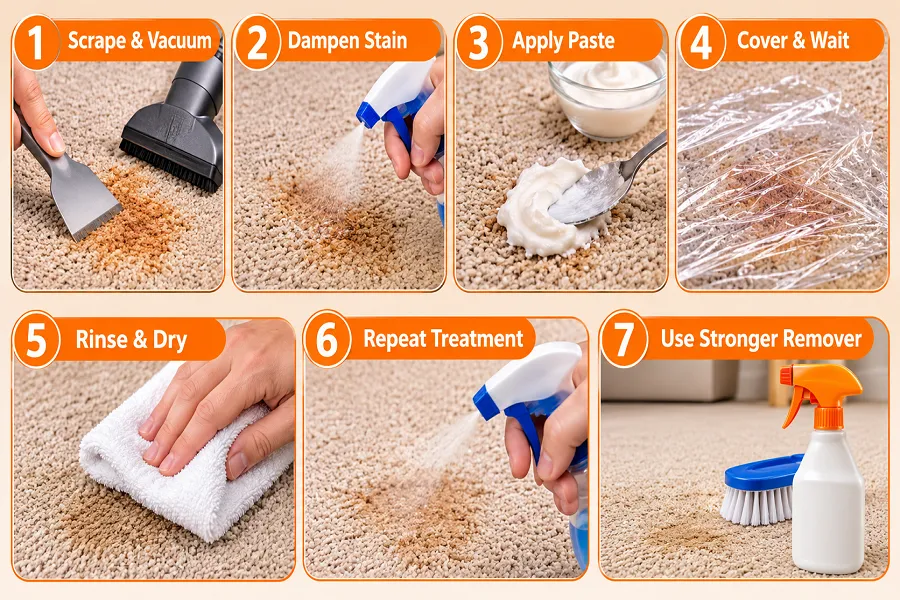
Old rust stains are harder, but they’re rarely hopeless. Rust that has sat for months often fades a lot with patient, repeated treatment.
- Dry scrape and vacuum to clear crusted rust from the surface.
- Pre-wet the stain with a little cool water. Damp fibres soak up acid better than dry ones.
- Use a paste, not a liquid. The cream of tartar paste (Method 4) stays put.
- Keep it damp. Lay a small piece of cling film over the paste so it doesn’t dry out during the contact time.
- Rinse and let it dry fully before you judge the result. Wet carpet always looks darker.
- Repeat up to three rounds, letting the carpet dry between each one.
- Step up to Method 6 or 7 on synthetic carpet only if the paste stops making progress.
Set realistic expectations. If rust has reached the carpet backing, the stain may end up much lighter rather than completely gone. On a patterned carpet, that’s often hard to spot. If three rounds make no difference, stop. More acid at that point risks fading the colour, so a professional or a patch is the better next step.
Moving into a home with old rust marks? Photograph them before you start. If you rent, check with your landlord before using strong products like oxalic acid.
What NOT to Use on Rust Stains
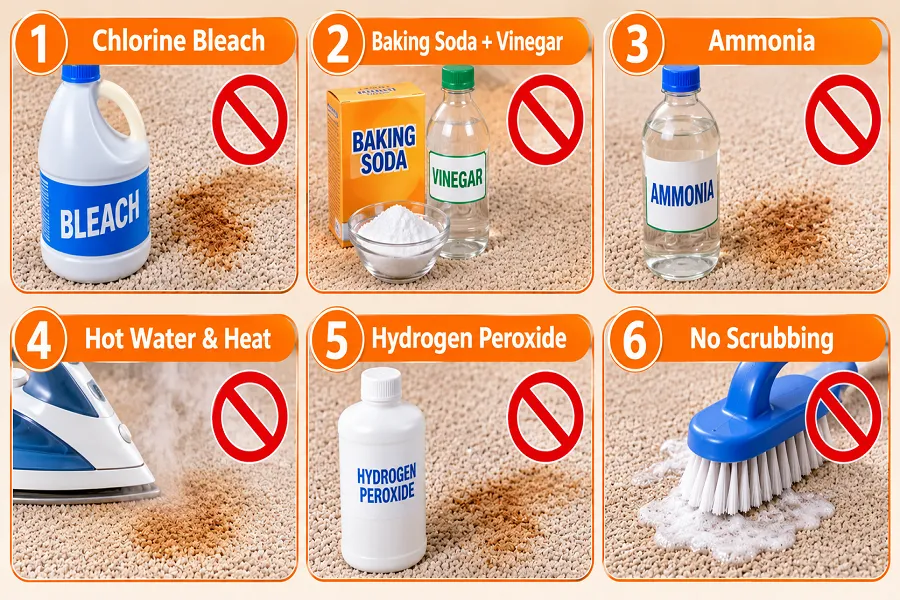
Plenty of cleaning tips online suggest products that don’t touch rust, or make it worse.
✗ Chlorine bleach
This is the biggest mistake. Bleach doesn’t remove rust. It can set the stain permanently and turn it darker, and it strips colour from carpet too. The University of Georgia Extension specifically warns against using chlorine bleach on rust.
✗ Baking soda and vinegar together
The fizz looks like it’s working, but it’s actually the two cancelling each other out. Baking soda is alkaline and vinegar is acidic. Together they neutralise and release carbon dioxide gas, leaving almost no rust-dissolving power. Baking soda alone doesn’t dissolve rust either.
✗ Ammonia
Ammonia is alkaline, so it can’t break down rust. It can also damage wool and fade some dyes. Never mix ammonia with bleach. The combination releases toxic gas.
✗ Hot water and heat
Hot water can shrink wool, loosen the carpet backing and soak the underlay. Keep hair dryers and irons away from the spot until the stain is fully gone, because heat can make it harder to remove. Use cool or lukewarm water only.
✗ Hydrogen peroxide
Peroxide doesn’t dissolve rust, and it can lighten carpet dyes.
✗ Scrubbing
Rubbing pushes rust deeper and spreads it sideways. It also frays the pile. Always blot.
Best Rust Stain Removers for Carpet: What to Buy and What to Skip
Not every product labelled “rust remover” is meant for carpet. Read the label before you buy.
Buy: oxalic acid-based removers made for carpet or fabric. These are the best fit for most home rust removal. They’re strong enough for stubborn stains but controllable on synthetic fibres.
Skip: hydrofluoric acid-based removers. Some well-known rust removers, such as Whink Rust Stain Remover, contain hydrofluoric acid. The label does list colourfast carpet as a use. But hydrofluoric acid is a hazardous chemical that can cause serious burns, and those burns may not hurt straight away. We don’t recommend these for home carpet cleaning, especially with children or pets in the house. Leave them to professionals.
Check first: laundry rust removers. Products made for clothes are not always tested on carpet. Carbona’s Stain Devils Rust & Perspiration, for example, says it’s not recommended for carpeting.
The simple rule: choose the mildest product that works, check that the label names carpet, and rinse it out fully.
Rinsing and Drying: The Step Most Guides Skip
Acid left in carpet keeps working after you stop. It can fade dyes, weaken fibres, or leave a sticky patch that attracts dirt. Rinsing well matters as much as the cleaning itself.
- Mist the area with cool water from a spray bottle.
- Blot firmly with a dry white towel.
- Repeat two or three times.
- Fold a thick, dry towel over the spot and put a heavy book on top for 1 to 2 hours. This pulls moisture up from deep in the pile.
- Run a fan or the AC to finish drying.
- Once dry, gently lift the pile with your fingers.
For more drying tips, see Nova Floor’s guide on how to clean a carpet without a carpet cleaner.
Troubleshooting: When the Rust Stain Won’t Go Away
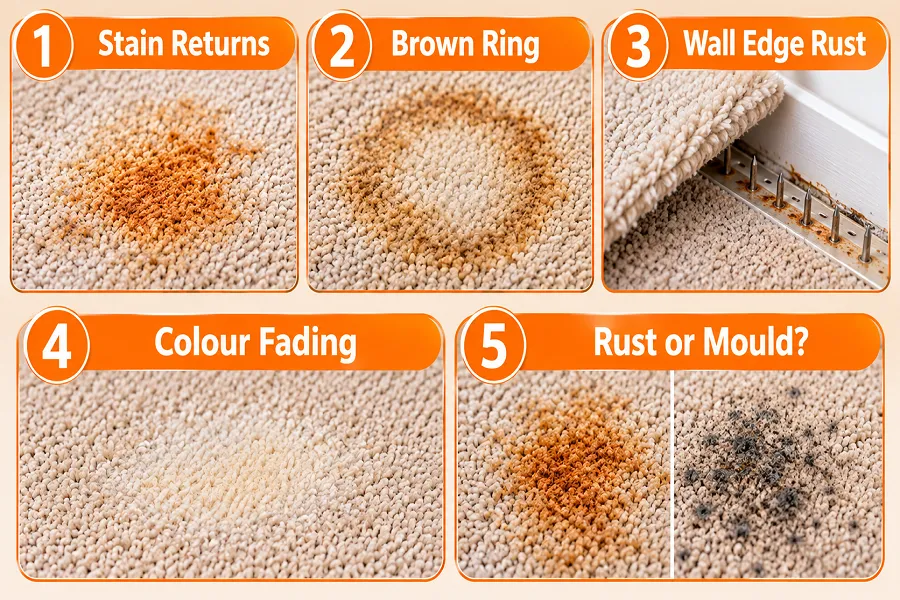
The stain came back after drying
This is called wicking. Rust that soaked into the underlay rises back through the fibres as the carpet dries. Use less liquid next time, and press-dry with a towel and a heavy object. If it keeps returning, the underlay may need treating or replacing. Other liquids behave the same way, as Nova Floor’s guide to removing dog pee smell from carpet explains.
A brown or yellow ring appeared around the spot
This usually comes from overwetting. As the carpet dries, dirt and residue collect at the edge of the wet patch. Lightly mist the ring with clean water and blot from the outer edge inward. The same fix works for drying rings left by spills, as shown in the coffee stain removal guide.
Rust keeps showing up along the walls
Look under the carpet edge. Carpet is held in place by gripper strips (tack strips) with small metal pins. If water from an AC leak, a mopped floor nearby or a balcony door gets underneath, those pins can rust. A fitter will need to lift the edge, dry the area and replace the strip. Surface cleaning alone won’t fix it.
The carpet looks lighter than the area around it
That’s dye loss from a cleaner that was too strong. You can’t clean it back. A professional can sometimes re-dye a small area, or the section can be patched.
Is it rust or mould?
Rust is orange to reddish-brown with sharp edges, and it usually sits exactly where a metal object stood. Mould is grey, green or black, often looks fuzzy, and smells musty. They need different treatments. For mould, follow Nova Floor’s guide on how to get mould out of carpet.
How to Prevent Rust Stains on Carpet
Preventing rust is far easier than removing it.
- Pad every metal furniture leg with felt, plastic or rubber glides.
- Put trays or saucers under plant pots. Pick plastic or glazed ceramic, not bare metal.
- Dry metal items before they touch carpet. That includes gym weights, ironing boards and shoes with metal parts.
- Check balcony furniture often. Salty, humid coastal air rusts metal fast. Rubber mats under metal planters and furniture help protect the surface below.
- Fix AC drips quickly. Condensation dripping onto metal is a common cause of rust in UAE homes.
- Wipe up spills under heavy furniture. Water sitting under a metal leg is exactly how rust stains start.
- Keep a small rust kit ready: a white cloth, a spray bottle and white vinegar. Treating rust within hours makes removal much easier.
Rust can mark hard floors too. If it spreads to tiles near your carpet, this guide on cleaning terracotta tiles naturally covers rust marks.
Frequently Asked Questions
What is the fastest way to get rust out of carpet?
Blot on a mix of ½ cup white vinegar and 1 cup cool water, wait 10 to 15 minutes, then blot and rinse. For a slightly stronger option, use lemon juice and salt. Fresh rust stains often lift in one or two rounds.
Can old rust stains be removed from carpet?
Yes, most old rust stains can be lightened a lot. Use a cream of tartar and lemon paste, keep it damp for 20 to 30 minutes, and repeat up to three times. On synthetic carpet, an oxalic acid rust remover can shift stubborn, set-in rust.
Does bleach remove rust stains from carpet?
No. Chlorine bleach can set rust stains permanently and make them darker. It also removes colour from carpet. Use an acid such as vinegar, lemon juice, citric acid or oxalic acid instead.
Does baking soda remove rust from carpet?
No. Baking soda is alkaline, and rust only dissolves in acid. Mixing baking soda with vinegar creates fizz, but the two neutralise each other, so the mixture has very little rust-removing power.
Is oxalic acid safe to use on carpet?
Oxalic acid is safe on colourfast synthetic carpets like nylon and polyester if you follow the label, wear gloves and rinse well. It’s poisonous, so keep children and pets away while you work. Don’t use it on wool, silk, viscose or natural-fibre rugs.
Why does a rust stain come back after cleaning?
The stain usually returns because rust soaked into the underlay and rose back up as the carpet dried. This is called wicking. Use less liquid, press-dry with a towel and a heavy object, and check for rusty gripper strips under the carpet edges.
Final Thoughts
Rust looks alarming on carpet, but it follows simple rules. It needs an acid, gentle blotting and a thorough rinse. Start with the mildest method and only step up when you have to.
If your carpet is wool, silk or a valued rug, or the stain has survived three rounds of treatment, hand it to a professional or consider a patch. And if the stain is a sign your carpet is ready for an upgrade, Nova Floor supplies and fits carpets across Dubai and the UAE.

Noah Williams
Interior Designer & Flooring Expert